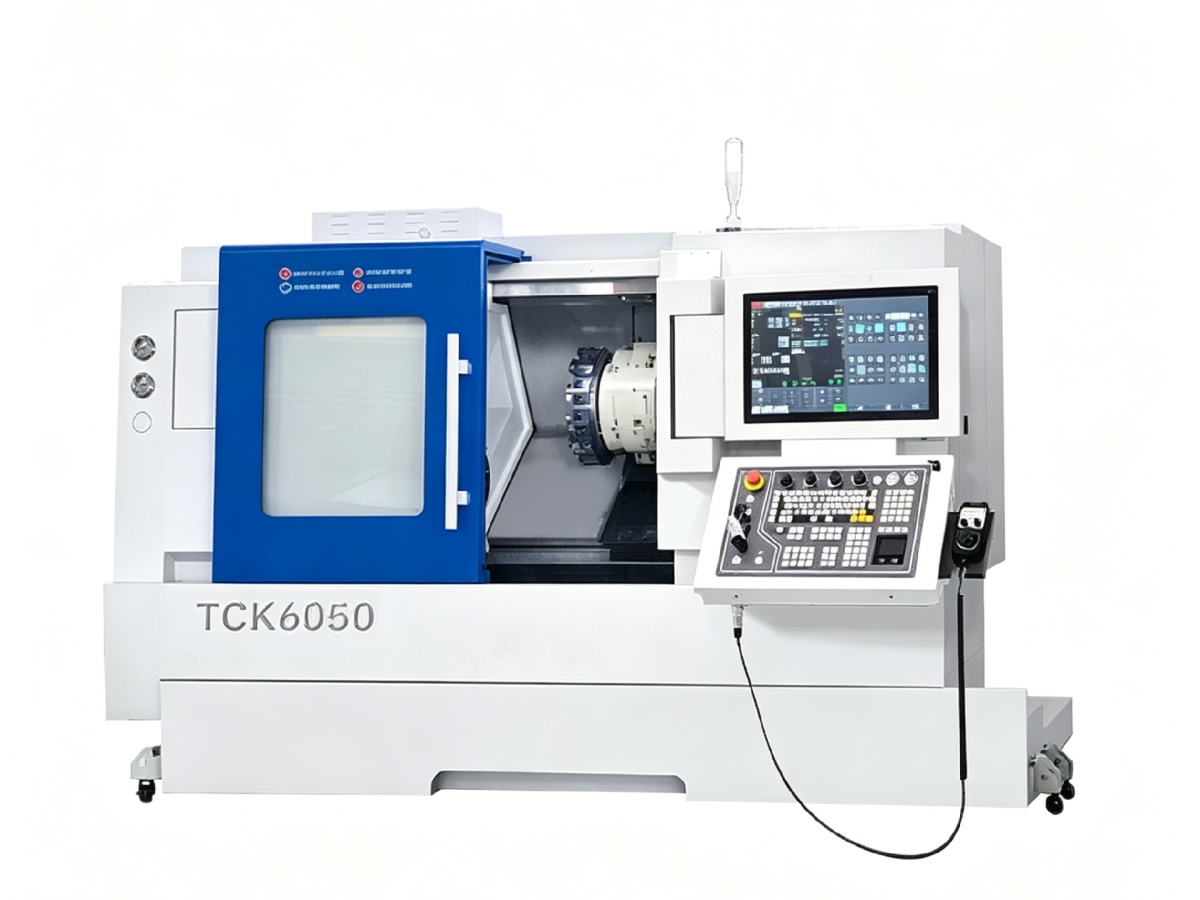
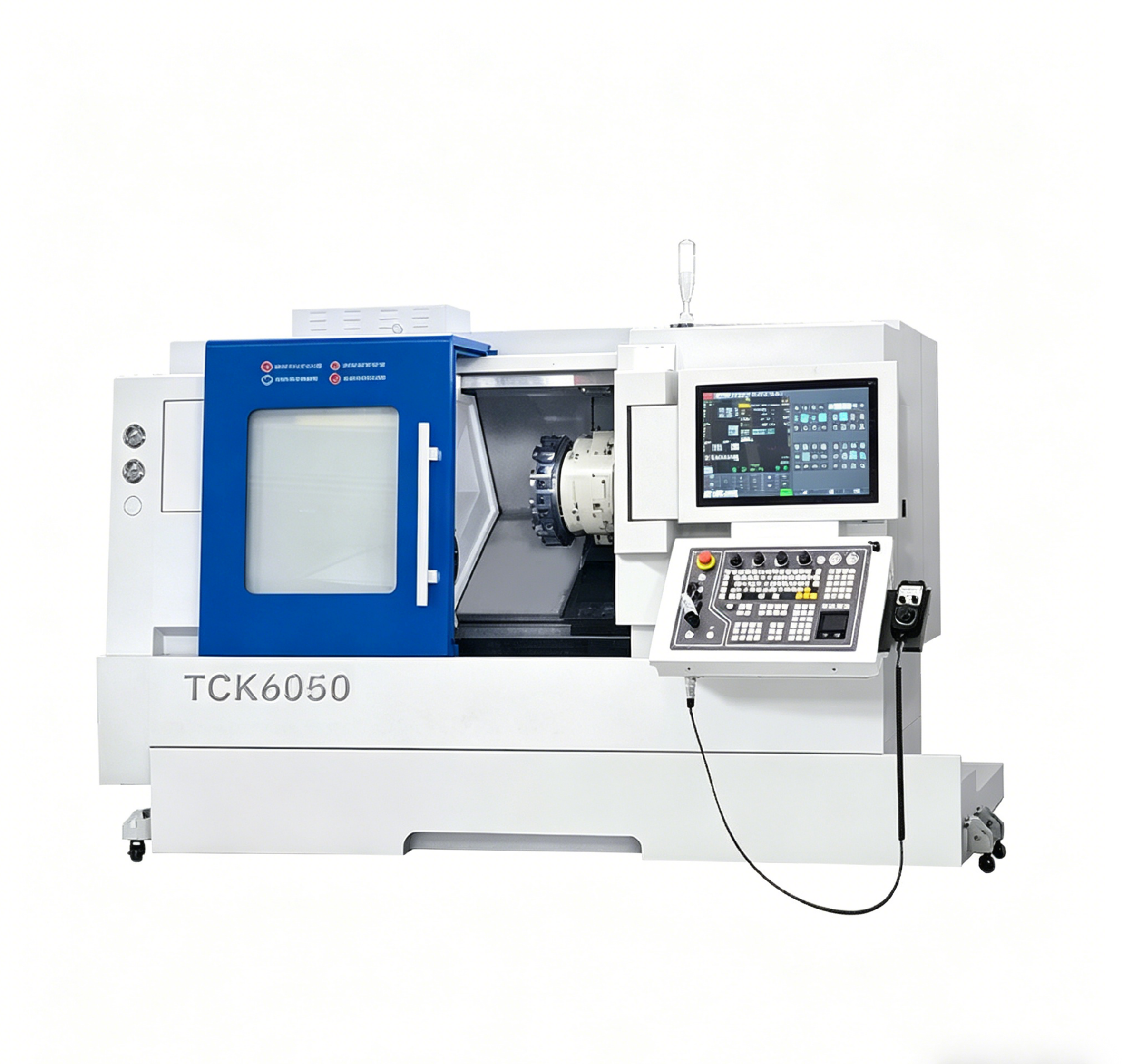
Most lathe buyers arrive at a number first. For a lot of job shops in Europe and North America, that number is 50 mm — the largest bar they can feed through the spindle without switching to a bigger, heavier, more expensive class of machine. The TCK6050 is built around exactly that bar size, and the rest of its dimensions follow from it: a 65 mm spindle bore, a 560 mm swing over the bed, and 540 mm of cutting length on a 3,800 kg frame.
We build the TCK series in Tengzhou, Shandong, and ship these lathes to shops that run mixed production — one day hydraulic fittings, the next day shaft work, the week after a rush order of aluminum housings. That kind of schedule punishes a machine with narrow capability. Here is what the TCK6050 puts on the table, and where it stops.
TCK6050 Specifications
| Parameter | Value |
|---|---|
| Max. turning diameter on bed | 560 mm |
| Max. cutting diameter | 500 mm |
| Max. rotation diameter on slide | 400 mm |
| Max. cutting length | 540 mm |
| Spindle end type | A2-6 |
| Spindle bore diameter | 65 mm |
| Max. bar diameter | 50 mm |
| Spindle speed range | 50–4,000 r/min |
| Max. output torque | 182 Nm |
| X-axis travel | 280 mm |
| Z-axis travel | 620 mm |
| X/Z rapid traverse | 15 / 15 m/min |
| Machine dimensions | 3,240 × 1,940 × 1,965 mm |
| Machine weight | 3,800 kg |
Why the 65 mm Bore Matters More Than the Swing
Swing numbers sell machines. Bore numbers decide whether the machine earns its floor space.
A 65 mm bore with a 50 mm maximum bar capacity means you can run 50 mm bar stock all day with clearance around it, load it from a bar feeder or a magazine, and never touch a chuck jaw between parts. Shops that buy a lathe with a 40 mm bore and then bid on 45 mm bar work end up turning between centers or buying pre-cut blanks — both of which eat the margin the job was supposed to deliver.
The A2-6 spindle nose is the other half of that decision. It is a common interface, so chuck and collet availability is not a sourcing problem, and tooling you already own from a previous lathe often transfers. Spindle speed runs 50 to 4,000 r/min, which covers the range you need for steel at moderate diameter and still lets you push small-diameter aluminum parts at a speed that produces a real chip instead of a smear.
Maximum output torque is 182 Nm. That figure tells you what to expect: this is a lathe for consistent, moderate-depth cuts in steel and cast iron, not a machine for burying a 6 mm depth-of-cut insert in 4140 and expecting the spindle to shrug it off. If your work is heavy stock removal, look at the TCK6350B heavy-duty model instead — it will take 12 mm on one side continuously, and it has a 96 mm bore to match.
The 30° Bed and What It Does for Chip Flow
The bed is inclined at 30 degrees. On a flat-bed lathe, chips land on the bed and stay there until the operator clears them, which means the machine spends part of every shift being cleaned rather than cutting. On a slant bed, gravity does that work: chips fall away from the cutting zone into the conveyor area, and coolant drains instead of pooling around the turret.
That matters most on continuous turning with coolant, where a nest of stringy chips around the workpiece can scratch a finished surface or pull a part out of the chuck. It also matters for the operator, who no longer reaches over a bed of hot chips to check a dimension.
Travel, Footprint, and the Real Constraint
X-axis travel is 280 mm and Z-axis travel is 620 mm, with rapid traverse of 15 m/min on both axes. The Z figure is the one to read carefully. With 540 mm of maximum cutting length, a 620 mm Z travel gives you room for the part, the chuck, and the tool approach — but it also defines the boundary of the machine’s usefulness.
If your parts are mostly under 500 mm long, the TCK6050 is comfortable and the cycle times are short. If a regular customer sends you 800 mm shafts, this is the wrong lathe, and no amount of clever fixturing fixes it. Step up to the TCK6050D, which offers a 980 mm turning length in its TCK6050D-1000 configuration with a tailstock and 1,120 mm Z travel, or go to the TCK80D-1500 for longer work.
Machine dimensions are 3,240 × 1,940 × 1,965 mm at 3,800 kg. That is a size most shops can land without a special foundation or a crane booking that costs more than the installation. Compare it against a 4,400 kg TCK6350D and the difference in handling and floor loading is real, not cosmetic.
Where the TCK6050 Fits in a Shop
Three profiles buy this lathe, in our experience.
The first is a shop adding its second CNC lathe. They have one machine running long cycles on a family of parts, and they need a second spindle to take the smaller, faster jobs that keep getting queued behind it. The TCK6050’s 4,000 r/min top speed and 15 m/min rapids make it productive on short cycles where acceleration and tool changes dominate the time.
The second is a shop moving from manual or cam-controlled lathes to CNC for the first time. The control interface on a two-axis slant bed is not intimidating, the work envelope is generous enough to absorb learning mistakes, and the 400 mm rotation diameter over the slide means a chuck and a boring bar can coexist without interference.
The third is a Tier-2 supplier that needs a dedicated cell for one customer’s part family, sized 40–50 mm bar, and does not want to tie up a large turning center on it.
Questions Buyers Ask Before Ordering
Can it run a bar feeder?
Yes. The 65 mm bore and 50 mm bar capacity are designed for bar-fed production. Confirm the feeder interface and turret clearance with us at the quoting stage so the feeder arrives with the right adaptor plate.
Will it hold tolerance on a long run?
Thermal stability on a 3,800 kg cast frame is the reason this machine holds size through a shift. The practical limit is usually the tool, not the lathe — check inserts before blaming the machine.
Which model handles milling and drilling too?
If your parts need cross-drilling or light milling in the same setup, look at the TCK6050Y or the TCK6050SY. Both share the TCK6050 platform with a driven tool turret, so the footprint and bar capacity stay familiar.
Next Step
Full specifications for the TCK6050 CNC slant bed lathe are on the product page, and the rest of the range sits under CNC slant bed lathes. Send us your part drawing with material, blank size, and tolerance, and we will tell you honestly whether this is the right model or whether a TCK50, TCK6050D, or a larger frame suits the job better.