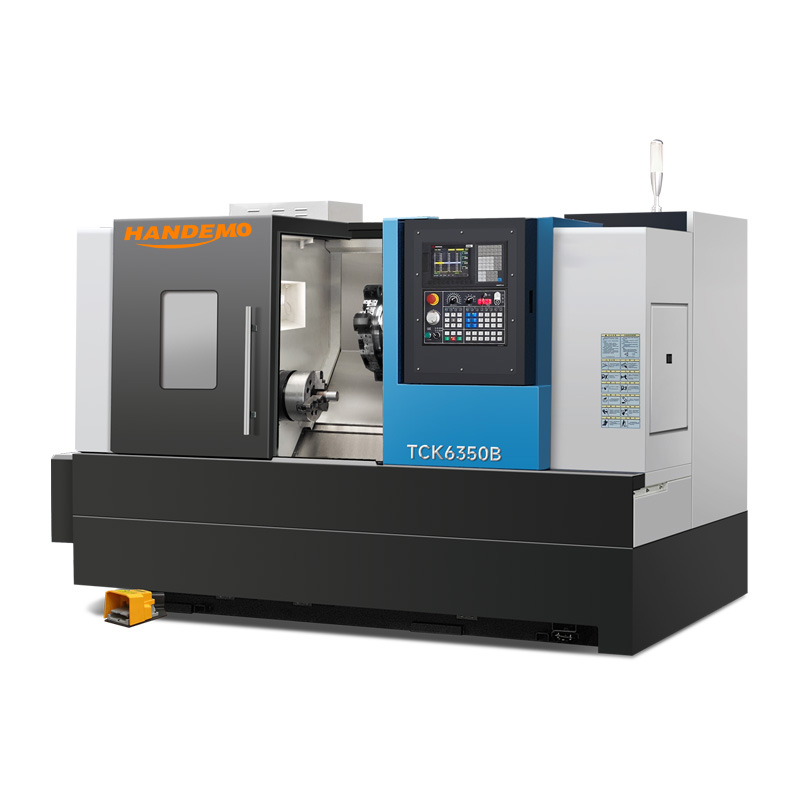
TCK Series CNC Slant Bed Lathes: Bar Capacity, Swing and Bed Length Compared
Most inquiries about a slant bed lathe arrive with a drawing, a bar diameter, and a bed length estimated from the sample part on the bench. On the TCK range those three numbers cut the field down quickly. The nine published models run from a 500 mm swing machine at 3,600 kg to a 1,000 mm swing machine at 12,000 kg, and the figures that separate them settle most jobs before spindle speed or control choice gets a hearing. What follows is the range read strictly off the specification tables on the product pages, including the places where those pages contradict themselves.
Spindle bore sets the bar, and the bar sets the loading method
Bar work is where a lathe either fits the process or forces a change to it. A machine fed from a bar magazine has to swallow the stock through the draw tube, so the usable bar capacity is always a few millimeters under the spindle bore: 50 mm of bar through a 65 mm bore on the A2-6 machines, 85 mm through 96 mm on the A2-8 machines, and 90 to 105 mm through 120 mm on the A2-11 machines.
That step between families is the real decision. The A2-6 group covers the TCK50, TCK6050 and TCK6050D, all with a 65 mm bore and 50 mm bar capacity. Moving to A2-8 buys the TCK6350B and TCK6350D at 96 mm bore and 85 mm bar, which is where 70 mm stock stops needing a second operation. The A2-11 group, TCK70D and both 80-series machines, goes to a 120 mm bore, with the TCK80B-1500 rated for 105 mm bar against 90 mm on the TCK80D-1500. The TCK70 sits apart at 80 mm bore and 70 mm bar on an A2-8 or A2-11 nose, depending on configuration.
If the part is a forging or casting rather than bar stock, bore size matters far less and swing takes over.
Swing over bed is the number buyers quote. Swing over the cross slide is the one that stops the job
Bed swing is measured where nothing is in the way. Cross-slide swing is measured over the saddle and turret, which is where the tool actually has to go, and on this range the gap between the two figures runs from 200 mm on the TCK50 to 450 mm on the TCK80B-1500.
The TCK6350D is a good example of why the second number deserves attention. It swings 630 mm over the bed but 300 mm over the cross slide, with a maximum turning diameter of 330 mm. Its stablemate the TCK6350B has the same 630 mm bed swing, 370 mm over the cross slide and a 480 mm maximum turning diameter. Same size class, 150 mm more part capacity, because the two are built for different work: the B is a hard rail machine for sustained heavy cutting.
Use the cross-slide figure as the working envelope for chucked work. A 300 mm flange on the TCK6050D, with 320 mm over the cross slide, leaves very little room for a boring bar. The same part on the TCK80D-1500, at 560 mm, has room to spare.
Bed length, floor space and weight travel together
Turning length on the TCK range spans 450 mm to 1,950 mm. Each step up lengthens the bed, the Z-axis screw and the tailstock travel, and adds mass:
- TCK6350D: 450 mm turning length, 4,400 kg
- TCK6350B: 500 mm, 4,300 kg
- TCK6050: 550 mm, 3,800 kg
- TCK6050D: 500 mm, or 980 mm on the TCK6050D-1000 variant
- TCK50: 500 mm, 3,600 kg
- TCK70-1500: 1,500 mm, 8,500 kg
- TCK80D-1500: 1,450 mm, 9,000 kg
- TCK80B-1500: 1,500 mm, 12,000 kg
- TCK70D-2000: 1,950 mm, 10,000 kg
A 12-tonne machine needs a foundation and a crane plan, not just floor space. Short-bed machines get overlooked for the opposite reason: a 450 mm machine turning 330 mm diameter parts all day is often more productive than a long-bed machine working the first 400 mm of its travel.
When the cut is heavy and interrupted
The TCK6350B is the outlier. It uses a box-type spindle and a full hard rail bed, and it is rated for continuous 12 mm unilateral depth of cut. Spindle power is 18.5 kW with a 4,500 rpm maximum, driving a 10 or 12 inch chuck through an A2-8 nose. On castings with hard spots or rough forgings that hammer the turret, that rail construction is worth more than a higher rapid rate. Compare it with the TCK6350D at 22 kW: more spindle power, less machine mass, faster rapids on the published table. Two machines of similar footprint aimed at different cutting strategies.
The full range on published figures
| Model | Max swing over bed | Max turning dia. | Swing over cross slide | Turning length | Spindle nose | Bore | Bar capacity | Spindle power | X / Z travel | Weight |
|---|---|---|---|---|---|---|---|---|---|---|
| TCK50 | 500 mm | 360 mm | 300 mm | 500 mm | A2-6 | 65 mm | 50 mm | 15 kW | 200 / 550 mm | 3,600 kg |
| TCK6050 | 560 mm | 500 mm | 320 mm | 550 mm | A2-6 | 65 mm | 50 mm | 11/15 kW | 260 / 630 mm | 3,800 kg |
| TCK6050D | 560 mm | 410 mm | 320 mm | 500 mm | A2-6 | 65 mm | 50 mm | 11/15 kW | 280 / 630 mm | not published |
| TCK6350B | 630 mm | 480 mm | 370 mm | 500 mm | A2-8 | 96 mm | 85 mm | 18.5 kW | 270 / 690 mm | 4,300 kg |
| TCK6350D | 630 mm | 330 mm | 300 mm | 450 mm | A2-8 | 96 mm | 85 mm | 22 kW | 230 / 470 mm | 4,400 kg |
| TCK70-1500 | 720 mm | 500 mm | 420 mm | 1,500 mm | A2-8 / A2-11 | 80 mm | 70 mm | 18.5 kW | 250 / 1,520 mm | 8,500 kg |
| TCK70D-2000 | 720 mm | 550 mm | 400 mm | 1,950 mm | A2-11 | 120 mm | not published | not published | 300 / 1,950 mm | 10,000 kg |
| TCK80D-1500 | 850 mm | 700 mm | 560 mm | 1,450 mm | A2-11 | 120 mm | 90 mm | 18.5/22 kW | 410 / 1,500 mm | 9,000 kg |
| TCK80B-1500 | 1,000 mm | 800 mm | 550 mm | 1,500 mm | A2-11 | 120 mm | 105 mm | 22 kW | 450 / 1,600 mm | 12,000 kg |
Figure source: the specification table on each model’s product page. Where a page offers two bed lengths, the table shows the longer variant.
Where the product pages disagree
Several of these pages carry two sets of numbers that do not match, and a buyer comparing them will notice.
The TCK70D page is the clearest case. Its summary bullets state a 2,950 mm turning length, dimensions of 6,154 × 2,321 × 2,130 mm and 12,000 kg. The table on the same page is headed TCK70D-2000 and gives 1,950 mm, 4,756 × 2,240 × 2,238 mm and 10,000 kg. The bullets most likely describe a longer bed option that is not otherwise listed, but that is an inference, not a published fact.
TCK6350D lists 12/12 m/min rapids in the summary and 18/15 m/min in the table. TCK6050 quotes 620 mm of Z travel and 540 mm turning length against 630 mm and 550 mm in the table. TCK80B-1500 summarizes 630 mm of bed swing and 530 mm of cutting length while its table states 1,000 mm and 1,500 mm. The TCK6050D table has its last two rows transposed.
None of this changes the shape of the range, but the specification table, not the summary paragraph, is the safer reference.
What no page publishes
Numbers that decide a real purchase are absent across the whole range: spindle torque curves, turret index time, maximum tool cross-section and boring bar diameter, tailstock thrust, chip conveyor type, control model, and positioning and repeatability figures with the standard they were measured to. The TCK50 page does list accuracy values, but they are labelled X, Y and Z on a two-axis lathe, which suggests a copied template rather than measured data. Worth requesting all of these with the quotation.
Choosing by part, not by model number
A workable order of checks: confirm bar diameter against bar capacity, then part diameter plus tool clearance against swing over the cross slide, then part length plus facing and tailstock allowance against turning length, and only then compare spindle power and rapids between the two or three models still standing.
Two examples. A shop running 65 mm bar in 300 mm diameter, 400 mm long shaft work has no reason to look above the A2-8 machines, and the choice between TCK6350B and TCK6350D comes down to whether the cut is heavy and interrupted or lighter and faster. A shop turning 600 mm valve bodies from castings needs the cross-slide clearance of the TCK80D-1500 or TCK80B-1500, and the 12-tonne B model only pays if the castings are hard enough to justify the rail construction.
The CNC slant bed lathe series page lists all nine models with their published tables. Individual pages: TCK50, TCK6050, TCK6050D, TCK6350B, TCK6350D, TCK70, TCK70D, TCK80D-1500 and TCK80B-1500.
Send the part drawing with the bar size and batch quantity and we will come back with the model, the tooling envelope and the accuracy figures in writing.