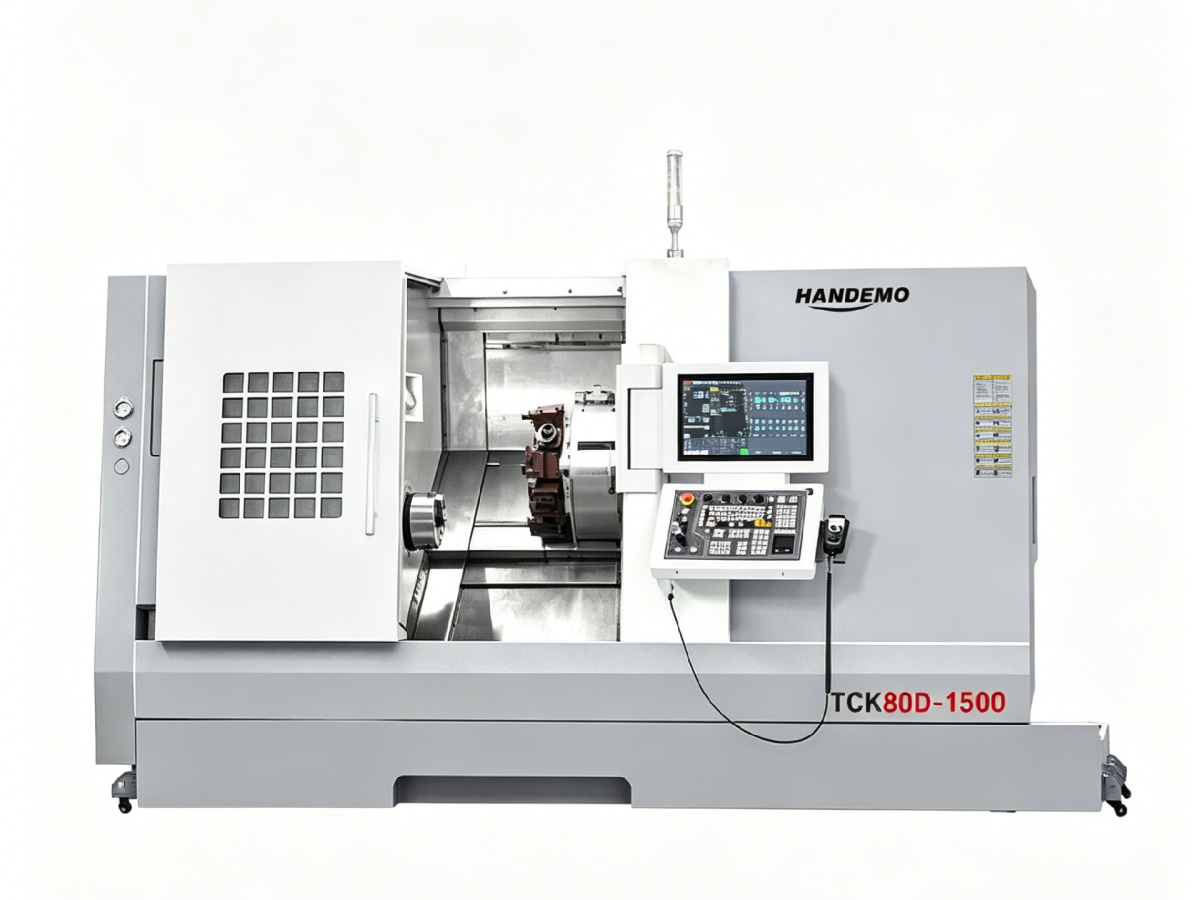
TCK80D-1500 CNC Slant Bed Lathe – 850 mm Swing, a 120 mm Bore and 18.5/22 kW
The TCK80D-1500 is the biggest slant bed lathe BONANZA builds around a 120 mm through-hole spindle. It turns 700 mm diameter parts, swings 850 mm over the bed, and holds an 18.5/22 kW spindle motor on a frame that lands at roughly 9,000 kg.
If you are turning large flanges, heavy shafts, valve bodies or roll-type work that no longer fits a 600-class lathe, this is the model in the range that picks up where the TCK6350D and TCK70D leave off. Here is what the numbers actually mean at the machine, and where the published sheet stops short of what you need to quote a job.
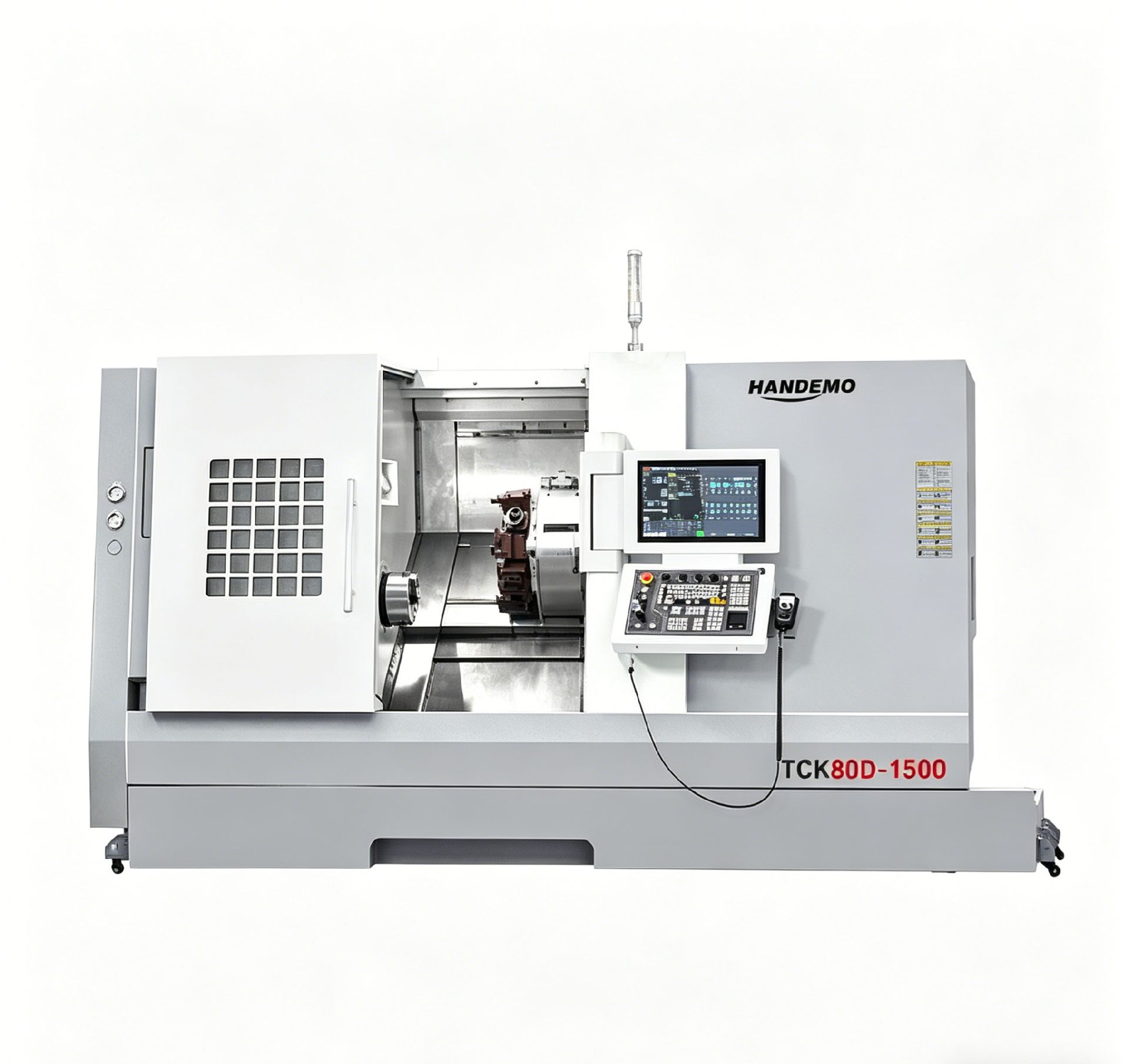
TCK80D-1500 at a glance
| Parameter | TCK80D-1500 |
|---|---|
| Max. swing over bed | 850 mm |
| Max. turning length | 1,450 mm |
| Max. turning diameter | 700 mm |
| Max. swing over cross slide | 560 mm |
| Standard turning diameter | 550 mm |
| Spindle nose type | A2-11 |
| Spindle bore diameter | 120 mm |
| Max. bar capacity | 90 mm |
| Spindle motor output power | 18.5/22 kW |
| X-axis travel | 410 mm |
| Z-axis travel | 1,500 mm |
| Rapid traverse X / Z | 10 / 10 m/min |
| Tailstock travel | 110 mm |
| Tailstock quill stroke | 100 mm |
| Approx. gross weight | 9,000 kg |
850 mm of swing is a workholding decision, not a spec-sheet flex
Swings and diameters get mixed up a lot when buyers compare lathes, so it is worth separating the four figures on this sheet. Max. swing over bed is 850 mm, which is the largest disc the bed casting will clear without the part touching anything. Max. turning diameter is 700 mm, the largest part the machine will actually cut in practice. Swing over the cross slide drops to 560 mm because the saddle and tooling eat into the envelope, and standard turning diameter is 550 mm, which is the size BONANZA expects most customers to work in day to day.
Read that way, the machine is comfortable at 550 mm and capable up to 700 mm when the setup allows. Anyone quoting work above 560 mm should plan the tool approach and turret position carefully, because that is the number that bites first.
The 120 mm bore spindle and 90 mm of bar capacity
The spindle nose is A2-11 with a 120 mm bore and 90 mm of bar capacity, driven by an 18.5/22 kW motor. That is the headline of this model. Bar capacity decides whether a part is fed from bar stock through a bar feeder or cut from blanks, and a lot of margin comes back when a 90 mm bar runs straight through the spindle without a second operation.
For scale inside the range: the TCK6050D runs an A2-6 nose with a 65 mm bore and 50 mm bar, the TCK6350D steps to A2-8 with a 96 mm bore and 85 mm bar, and the hard-rail TCK6350B uses a 96 mm box spindle for 85 mm bar. The TCK80D-1500 sits at the top of the bore list with the 120 mm TCK70D.
The 18.5/22 kW rating is a dual figure on the sheet, and on a lathe this size it normally means an 18.5 kW continuous rating with a 22 kW short-time peak for heavy first passes and interrupted cuts. If your material is 4140, duplex stainless or a casting with hard spots, ask the factory which number applies for how long. It changes the depth of cut you can write into the process sheet.
Travel, rapids, and where the cycle time goes
X travel is 410 mm and Z travel is 1,500 mm, against a 1,450 mm maximum turning length. Rapid traverse is 10 m/min on both axes. A 10 m/min Z rapid covers the full 1,500 mm in about nine seconds, so on a machine this heavy the number that matters is not the traverse rate but how much of the cycle is spent cutting and how often it stops for tool changes.
The tailstock is where the published sheet gets thin. It lists 110 mm of tailstock travel and 100 mm of quill stroke, yet 110 mm is far too little travel to support a 1,450 mm shaft, and on the TCK70-1500 the same 110 mm figure appears as the quill diameter. Our read is that the spec sheet carries a data-entry slip and the real tailstock travel is in the 1,000 mm class. Treat that as our read, not a published figure, and get it in writing with your quotation if you turn long shafts between centres.
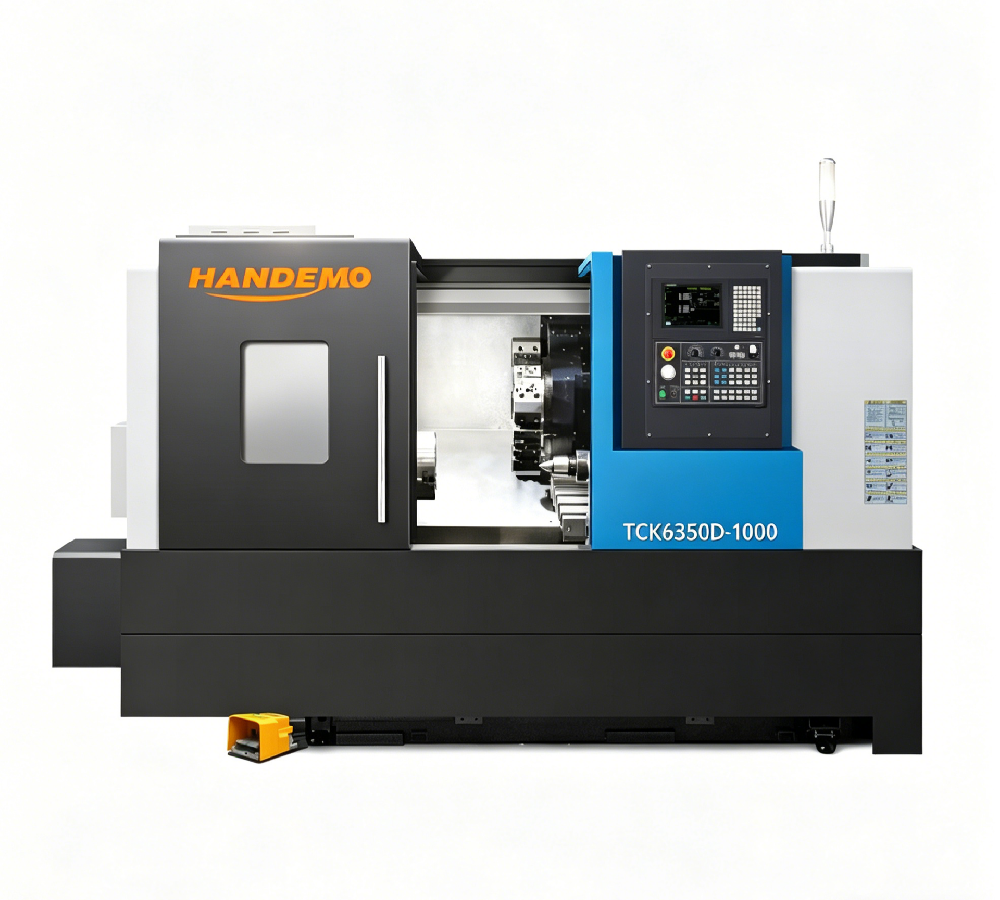
Where the TCK80D-1500 sits in the slant bed range
The CNC slant bed lathe series runs from a compact 30-degree machine up to this one, and the climb is worth seeing side by side because the family overlaps more than the model names suggest.
| Model | Swing / turning dia. | Turning length | Spindle | Bar capacity | Weight |
|---|---|---|---|---|---|
| TCK6050 | 560 mm / 500 mm | 540 mm | A2-6, 65 mm bore | 50 mm | 3,800 kg |
| TCK6050D | 560 mm / 410 mm | 500 / 980 mm | A2-6, 65 mm bore, 11/15 kW | 50 mm | – |
| TCK6350D | 630 mm / 330 mm | 450 mm | A2-8, 96 mm bore | 85 mm | 4,400 kg |
| TCK70D | 720 mm / 550 mm | 2,950 mm | A2-11, 120 mm bore | – | 12,000 kg |
| TCK80B-1500 | 630 mm bed rotation | 530 mm cutting | A2-8, hard rail | – | – |
| TCK80D-1500 | 850 mm / 700 mm | 1,450 mm | A2-11, 120 mm bore, 18.5/22 kW | 90 mm | 9,000 kg |
Two things stand out. The TCK80D-1500 has the biggest swing and bar capacity of the group, but the TCK70D is longer at 2,950 mm of turning length, heavier at 12,000 kg, and the choice when parts are long rather than wide. And “80” does not put the 80D above the TCK80B-1500: the B is the hard-rail variant on a 630 mm bed with an A2-8 spindle, built for stubborn material and long-term unilateral cuts rather than large-diameter work. Both carry 80 in the model number and they solve different problems.
Who the TCK80D-1500 suits
- Large flanges, discs, rings and covers up to roughly 550 mm that need facing, boring, grooving and threading in one setup
- Heavy shaft work fed from 90 mm bar or from blanks through the 120 mm bore
A 120 mm bore with 90 mm bar capacity turns a whole class of large-diameter work into a bar-fed job, which removes handling, fixturing and re-chucking from the process. The 9,000 kg frame keeps the machine steady under the interrupted cuts that come with castings and flame-cut blanks.
What to confirm before you order
The sheet covers the cutting envelope well and stops there. Ask for these with the quotation:
- Overall machine dimensions and the foundation drawing, since only the gross weight is published
- Spindle speed range and maximum output torque, plus how the 18.5/22 kW dual rating is timed
- Tailstock travel, because the 110 mm on the sheet does not match a 1,450 mm turning length
- Positioning and repeat positioning accuracy, and the acceptance test standard behind them
- Turret tooling interface, number of stations, and whether live tooling or a Y axis is available
- Chip conveyor, coolant-through-spindle and bar feeder interface options for your build
Frequently asked questions
What is the maximum bar capacity of the TCK80D-1500?
90 mm, through a 120 mm spindle bore on an A2-11 spindle nose.
How big a part will the TCK80D-1500 turn?
700 mm maximum turning diameter and 1,450 mm turning length, with 850 mm of swing over the bed and 550 mm as the standard working diameter. The practical limit on wide parts is the 560 mm swing over the cross slide.
How much spindle power does it have?
The sheet lists 18.5/22 kW. That is normally an 18.5 kW continuous rating with a 22 kW short-time peak, but ask the factory to confirm the duty cycle before you set cutting data.
Is the TCK80D-1500 bigger than the TCK80B-1500?
For swing and bore, yes. The TCK80D-1500 turns 700 mm with a 120 mm bore, while the TCK80B-1500 is a hard-rail machine with a 630 mm bed rotation, a 530 mm shaft cutting length and an A2-8 spindle, aimed at heavy cutting on smaller diameters.
Bottom line
The TCK80D-1500 is the large-diameter, big-bore end of the BONANZA slant bed range: 850 mm of swing, 700 mm of turning diameter, a 120 mm bore feeding 90 mm bar, 18.5/22 kW and 9,000 kg. If you are turning flange or disc work around 550 mm, or bar-fed parts that need more than 85 mm of bar, price it against the TCK70D and the hard-rail TCK80B-1500. Send the BONANZA team your drawing, material and batch quantity and you will get a straight answer on which of the three fits.