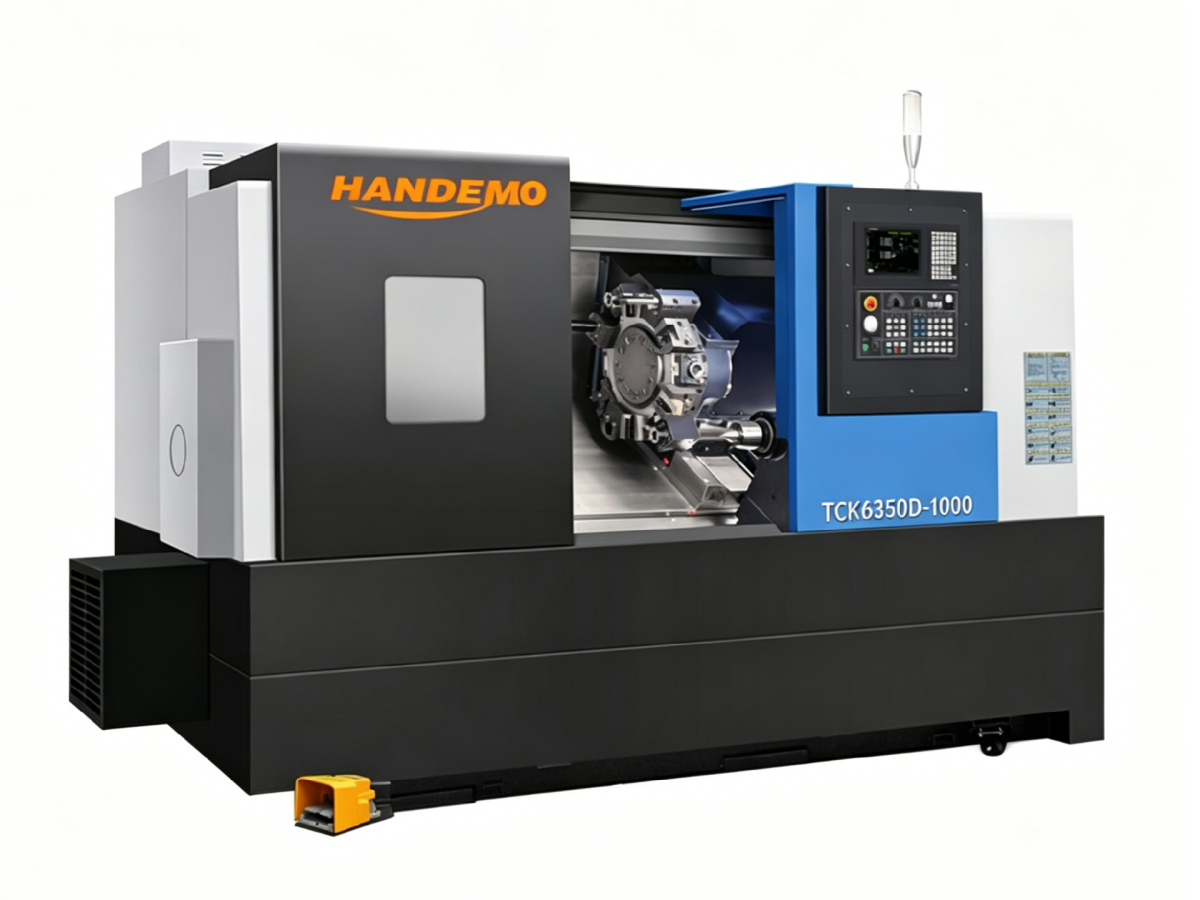
Read the swing figure on the TCK6350D and it looks like a big lathe. Read the cutting length and the picture changes: 630 mm over the bed, but only 450 mm of cutting length. That is not a shaft machine. It is a short-bed lathe built for bar work, near-net forgings and chucking jobs where the tool spends its time in the cut rather than travelling.
The distinction matters when you specify a machine. A long-bed lathe with the same swing would weigh twice as much and deflect more under the same cut, because the carriage sits far from the headstock. The TCK6350D keeps the work close to the spindle nose and puts the mass into a 4,400 kg frame measuring 3,503 × 1,711.5 × 2,096 mm.
TCK6350D specifications
| Parameter | TCK6350D |
|---|---|
| Max. swing over bed | 630 mm |
| Max. cutting length | 450 mm |
| Max. cutting diameter | 330 mm |
| Max. swing over cross slide | 300 mm |
| Spindle nose | A2-8 |
| Spindle bore | 96 mm |
| Max. bar capacity | 85 mm |
| Spindle motor | 22 kW |
| X-axis travel | 230 mm |
| Z-axis travel | 470 mm |
| X / Z rapid traverse | 18 / 15 m/min |
| Tailstock travel | 500 mm |
| Tailstock quill stroke | 100 mm |
| Machine dimensions (L × W × H) | 3,503 × 1,711.5 × 2,096 mm |
| Approx. gross weight | 4,400 kg |
Where the 450 mm cutting length fits
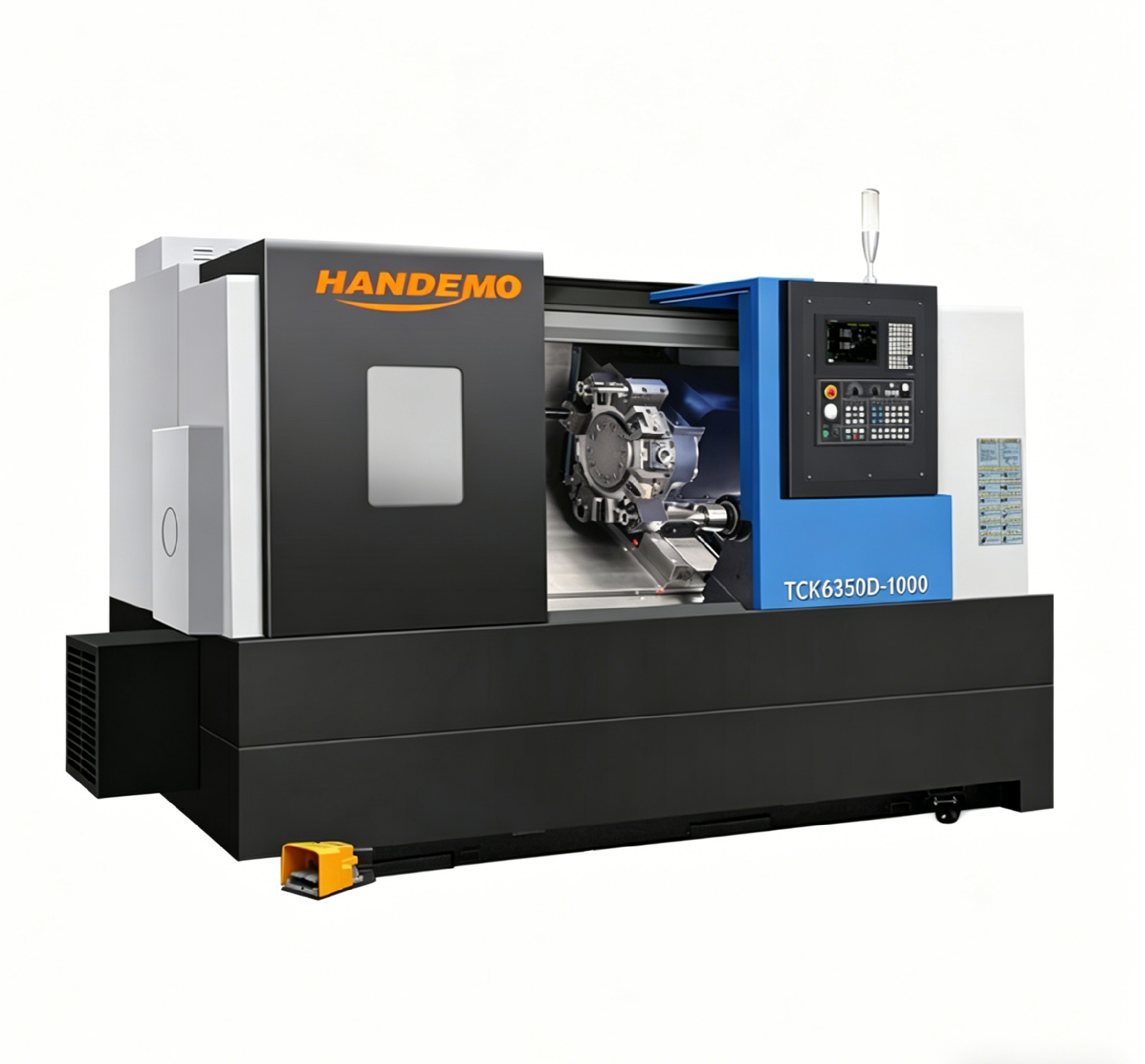
Short Z travel is a design decision, not an oversight. On a 45-degree slant bed the carriage rides an inclined surface and gravity helps keep it seated. With the Z stroke held at 470 mm the saddle never cantilevers far past the bed’s stiffest section, so the machine takes a heavier chip at the same tool overhang.
In practice that suits three kinds of work. Bar-fed parts up to 85 mm, where the blank comes out of the spindle and the finished part drops into a conveyor. Castings and forgings needing one face and one bore, where 450 mm covers the whole feature envelope. And second-operation chucking on parts cut to length, where the operator never touches the tailstock.
If your part is a 900 mm hydraulic rod, this is the wrong machine and no tooling will fix it. Look at the TCK80D-1500 at 1,450 mm turning length, or the TCK70D at 2,950 mm. Buying stroke you do not use costs rigidity on every part you do run.
Spindle: A2-8, 96 mm bore, 22 kW
The A2-8 nose with a 96 mm bore and 85 mm bar capacity sits in the middle of the heavy-turning range. An 85 mm bar is the size range for large valve bodies, pump housings, coupling blanks and hub forgings. The 22 kW spindle motor is sized to drive roughing passes in that range without stalling at the bottom of a cut, and a 96 mm bore means a standard 85 mm bar feeder bolts straight to the rear of the spindle without a reducing liner.
Two details are worth checking. Whether 22 kW is the continuous or the 30-minute rating, which decides how hard you can run on a three-shift schedule. And the chuck package — an A2-8 nose accepts several chuck sizes, and a 12-inch three-jaw behaves differently from a 10-inch when you spin an 85 mm bar at speed.
How it sits against the TCK6350B
BONANZA builds two machines around the same 630 mm class and the same 96 mm bore: the TCK6350B and this TCK6350D. The B is a hard-rail machine with a box-type spindle, rated for continuous 12 mm single-side cuts, which is a different proposition from a guided lathe.
Hard rails absorb shock and damp chatter on interrupted cuts — castings with ports, forgings with scale, anything where the insert meets a gap. Guided carriages hold position with less stick-slip, which pays off on finishing passes and high-rapid cycles. Rough 80 percent of the time in cast iron and the B is the safer buy. Run bar stock at 18 m/min with mixed roughing and finishing, and the D earns its money.
The published TCK6350D table does not state the guideway type. Confirm it in writing before you order, because a specification sheet that stays silent on rails is the one place where a lathe can be quietly downgraded between quotation and delivery.
Rapids: a note on the numbers
The product table lists X and Z rapid traverse at 18 and 15 m/min. The short summary bullet on the same page says 12 and 12. Both figures appear on BONANZA’s own pages, so treat the table value as current and ask the factory which applies to your configuration.
Where it fits in the slant bed range
The CNC slant bed lathe series spans a wide range, and the TCK6350D fills a specific slot.
- TCK50: 8-inch chuck, 50 mm bar, 500 mm swing, 3,600 kg. The entry point for small-parts bar work.
- TCK6050D: 560 mm swing, A2-6 nose with a 65 mm bore, 11/15 kW, 500 or 980 mm turning length. The general-purpose choice.
- TCK6350D: 630 mm swing, A2-8 with a 96 mm bore, 22 kW, 450 mm cutting length, 4,400 kg. The heavy short-bed option.
- TCK80D-1500: 850 mm swing, 120 mm bore, 18.5/22 kW, 1,450 mm turning length, 9,000 kg. Where diameter and length both grow.
The step from TCK6050D to TCK6350D is mostly about the spindle: 65 mm to 96 mm bore and 15 kW to 22 kW changes what you can feed and how hard you can push. The step to TCK80D-1500 is size in every dimension — swing, bore, length and mass move together.
What the sheet does not tell you
A specification table is the start of a quotation, not the end of one. Items that decide whether the machine suits your shop are missing from the published page, and each deserves a written answer before you sign.
Guideway type and preload. Turret type, station count and live tooling. Chuck size and whether the hydraulic cylinder is included. Spindle speed range, maximum torque, continuous versus intermittent power. Positioning and repeatability with the test standard named. Controller model and the standard-versus-optional list. Tailstock quill taper — the table gives the 100 mm stroke but not the Morse size.
These are ordinary gaps on a Chinese builder’s web page and BONANZA will answer them. Ask before the purchase order, not after the machine lands.
FAQ
Can the TCK6350D turn a 400 mm diameter part?
No. The 630 mm figure is swing over the bed — clearance, not cutting capacity. Maximum cutting diameter is 330 mm and swing over the cross slide is 300 mm. A 400 mm flange clears the bed but the tool will not reach it.
What size bar can it run?
85 mm maximum, through a 96 mm spindle bore with an A2-8 nose. That is large enough for most valve, pump and coupling blanks in the 60 to 85 mm range.
Is 450 mm of cutting length enough for shaft work?
For short shafts, yes — roughly 400 mm between chuck and tailstock centre once you allow for chuck depth and quill extension. Beyond that, move to the TCK70D or TCK80D-1500.
Hard rails or linear guides?
The TCK6350B is the hard-rail machine in this class, rated for continuous 12 mm single-side cuts. The D’s table does not name its guideway type, so confirm it with the factory for the configuration you quote.
Next step
If your parts are 85 mm bar or 330 mm castings and 450 mm of Z covers the features you need, the TCK6350D is worth a quote. Send BONANZA the drawing, the material and your target cycle time, and ask for guideway type, turret configuration and spindle power rating in writing with the price. Full specifications are on the TCK6350D product page.