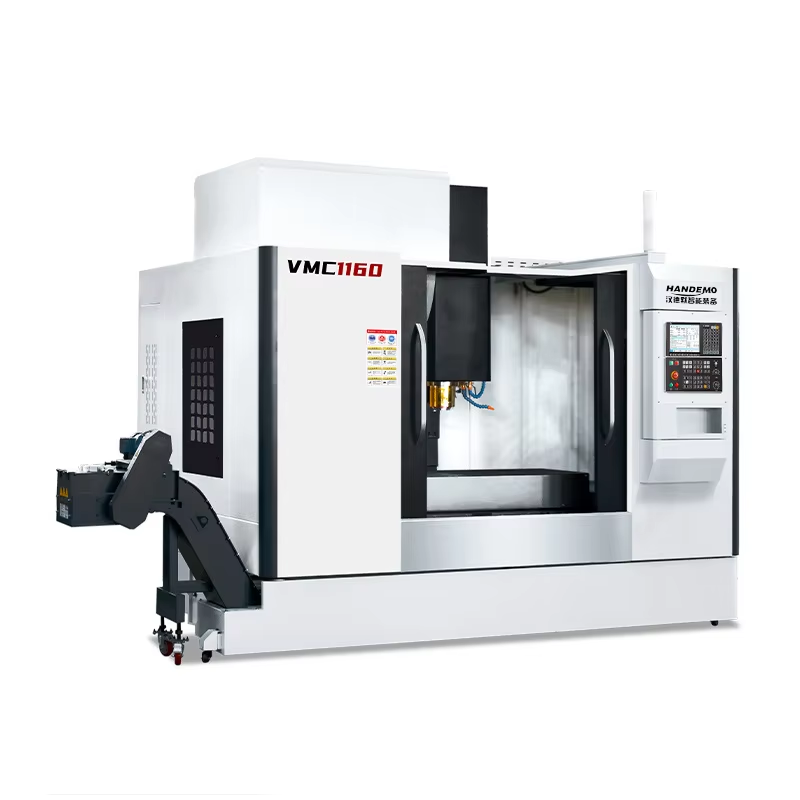
1160 Vertical Machining Center: 1,100 mm of X Travel and a 24-Tool ATC on a 6,500 kg Frame
The 1160 is the machine most shops end up comparing everything else against: a 1,200 × 600 mm table, 1,100 mm of X travel, an 8,000 rpm BT40 spindle, a 24-tool disc magazine and 6,500 kg of casting underneath. Nothing on that list is unusual. What matters is where each number sits next to the work you actually run.
Here is what the published spec sheet says, and the places where you should ask for written confirmation before you sign.
1160 at a glance
| Parameter | 1160 |
|---|---|
| Table size | 1,200 × 600 mm |
| Max. worktable load | 800 kg |
| X-axis travel | 1,100 mm |
| Y-axis travel | 600 mm |
| Z-axis travel | 600 mm |
| Rapid traverse X / Y | 24 / 24 m/min |
| Rapid traverse Z | 18 m/min |
| Spindle taper | BT40 Φ150 |
| Spindle speed | 8,000 rpm |
| Tool magazine | 24-tool disc type ATC |
| Machine size (L×W×H) | 3,100 × 2,500 × 2,800 mm |
| Machine weight | 6,500 kg |
| Positioning accuracy X / Y / Z | 0.053 / 0.014 / 0.010 mm |
Table and travel: 1,100 mm of X on a 1,200 mm table
Note the gap between table length and stroke. The table is 1,200 mm long, the X travel is 1,100 mm, and that 100 mm difference decides how you plan fixtures rather than how big a part you can accept. Anything clamped inside a 1,100 mm working window gets cut in one setup. Clamp a long plate hard against one end of the table and you will be re-clamping it to reach the last few centimetres.
The 800 kg table rating matters more often than people expect. A 600 mm vice or a tombstone with four small parts fits with room to spare. If your typical setup is heavier, this table was not sized for it, and the honest move is to look at the 1560, which carries 1,500 kg on a longer 2,200 × 600 mm table, or at a BT50 machine such as the 1690.
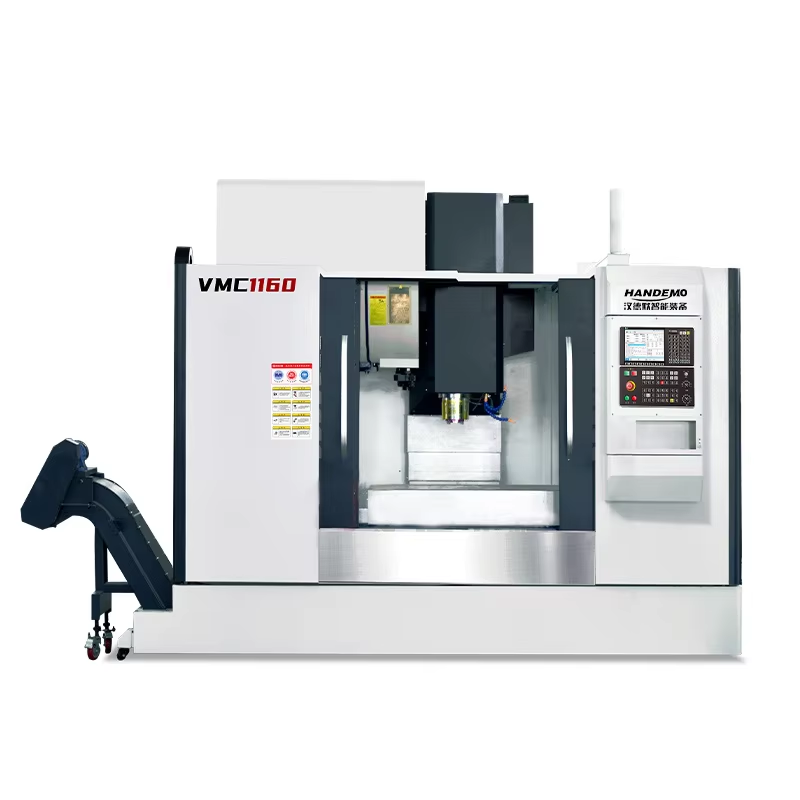
A BT40 spindle at 8,000 rpm
The spindle is BT40 with a Φ150 nose at up to 8,000 rpm. The number after the taper is the outside diameter of the spindle nose in millimetres, and a larger nose with a shorter overhang keeps the tool closer to the front bearing. That does not turn a BT40 machine into a BT50 machine, but it does take some of the chatter out of a 50 mm face mill.
8,000 rpm covers a wide band of work in steel, cast iron and aluminium with carbide tooling, which is why it is the standard for this size of machine. Where it frustrates people is small-diameter aluminium work or finishing with very small ball nose cutters, where spindle speed becomes the bottleneck instead of the toolpath. Spindle motor power and torque are not published for the 1160, so if roughing is the bulk of your work, get that rating in writing.
24 tools and 24/24/18 m/min rapids
Rapids are 24 m/min on X and Y, and 18 m/min on Z. Ignoring acceleration, that is about 2.8 seconds across the full 1,100 mm X stroke and 1.5 seconds for 600 mm of Y. The smaller 855, in the same family, is quicker still at 32/32/24 m/min, and it carries less mass to do it. The ratio is what tells you the intent here: parts with a lot of small features spread over a large area, such as drilling and tapping on plates, hole patterns in brackets, and cavity work in mould inserts.
The magazine holds 24 tools in a disc, enough for a job shop running drills, taps, end mills and a face mill without stopping to re-tool. Disc magazines sit off to the side of the column rather than overhead, so you keep the full 600 mm of Z clearance for tall fixtures.
Accuracy figures, and the one number to question
Published positioning accuracy is 0.053 mm on X, 0.014 mm on Y and 0.010 mm on Z. The X figure is roughly four times looser than the other two, which is odd rather than alarming on a machine this size, but it is worth raising at quote stage. Ask whether 0.053 mm is the axis or a whole-machine figure. Repeatability is not published at all, and repeatability is usually what decides whether a batch stays inside tolerance, so ask for it on the paperwork too.
Where the 1160 sits in the range
| Model | Table (mm) | Load (kg) | Travel X/Y/Z (mm) | Spindle | Weight (kg) |
|---|---|---|---|---|---|
| 855 | 1,000 × 550 | 600 | 800 / 550 / 550 | BT40, 8,000 rpm | 5,300 |
| 1160 | 1,200 × 600 | 800 | 1,100 / 600 / 600 | BT40 Φ150, 8,000 rpm | 6,500 |
| 1265 | 1,200 × 600 | 800 | 1,200 / 650 / 650 | BT40 Φ150 | 6,800 |
| 1370D | 1,400 × 700 | 800 | 1,300 / 700 / 750 | BT40-150, 8,000 rpm | 9,000 |
| 1560 | 2,200 × 600 | 1,500 | 1,500 / 650 / 650 | BT40-150 | – |
| 1690 | 1,600 × 800 | 1,500 | 1,600 / 900 / 700 | BT50-190, 6,000 rpm | 12,000 |
The 1265 is the closest sibling and nearly duplicates the 1160 on paper: same table, same load rating, same BT40 Φ150 taper, plus 100 mm more X travel and 300 kg more machine. The difference is what BONANZA documents. The 1160 sheet states an 8,000 rpm spindle speed and a 24-tool disc; the 1265 listing states no spindle speed at all.
Move up to the 1370D and you gain a wider 1,400 × 700 mm table and 200 mm more X travel, at the cost of 2,500 kg more machine and a much larger footprint. That is the right trade when parts grow in two directions instead of one.
Options that change what the machine can do
BONANZA lists through-spindle coolant, a chip conveyor and an oil cooler as options on this platform. Through-spindle coolant clears chips from deep holes and blind pockets that flood coolant cannot reach, and it is close to mandatory on any job drilling more than about four times the tool diameter. A chip conveyor keeps the operator from shovelling swarf on lights-out shifts, and an oil cooler holds spindle and ballscrew temperatures steady through a long unattended run.
Price all three at quote stage; a field-retrofitted conveyor costs more than a factory-fit unit.
What to confirm before you order
- Spindle motor power and torque rating for your build
- Repeatability, plus the basis of the 0.053 mm X-axis positioning figure
- Tool-to-tool and chip-to-chip change times for the 24-tool disc
- Whether a fourth-axis rotary table is supported on the 1,200 × 600 mm table
- Factory-fit pricing for through-spindle coolant, chip conveyor and oil cooler
Frequently asked questions
Is the 1160 a 3-axis machine?
Yes. X, Y and Z travels are 1,100, 600 and 600 mm. If your parts need a fourth or fifth axis, raise it when you request the quote.
What is the difference between the 1160 and the 1265?
Both are 1,200 × 600 mm rated to 800 kg with a BT40 Φ150 spindle. The 1265 has 100 mm more X travel and weighs 6,800 kg against 6,500 kg. The 1160 is the one with a published 8,000 rpm spindle speed and a stated 24-tool disc magazine.
How much weight can the 1160 table hold?
800 kg, which covers most vices, tombstones and medium fixtures. For heavier workpieces the 1560 and the 1690 both take 1,500 kg.
Bottom line
The 1160 is not the largest or the fastest machine in the vertical machining center range, and it is not trying to be. It is a 6,500 kg frame with a 1,200 × 600 mm table, 1,100 mm of X travel, an 8,000 rpm BT40 spindle and a 24-tool magazine, sized for general engineering, mould work and automotive parts that fit inside a 1,100 mm window and weigh under 800 kg.
Send the BONANZA team a drawing with material, part size and tolerance. You will get a straight answer on whether the 1160 Vertical Machining Center is the right frame, or whether a wider 1370D, a longer-table 1560 or a BT50 machine is the better match.