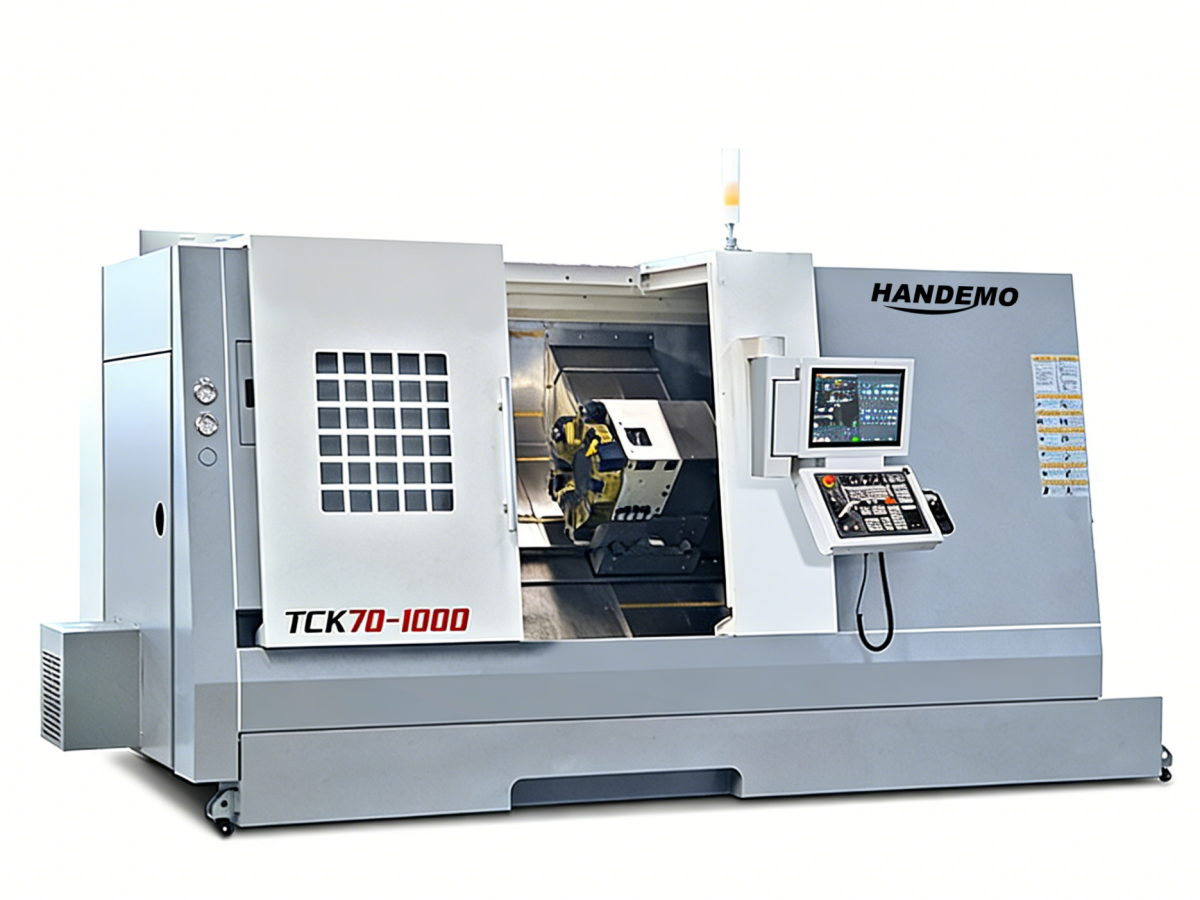
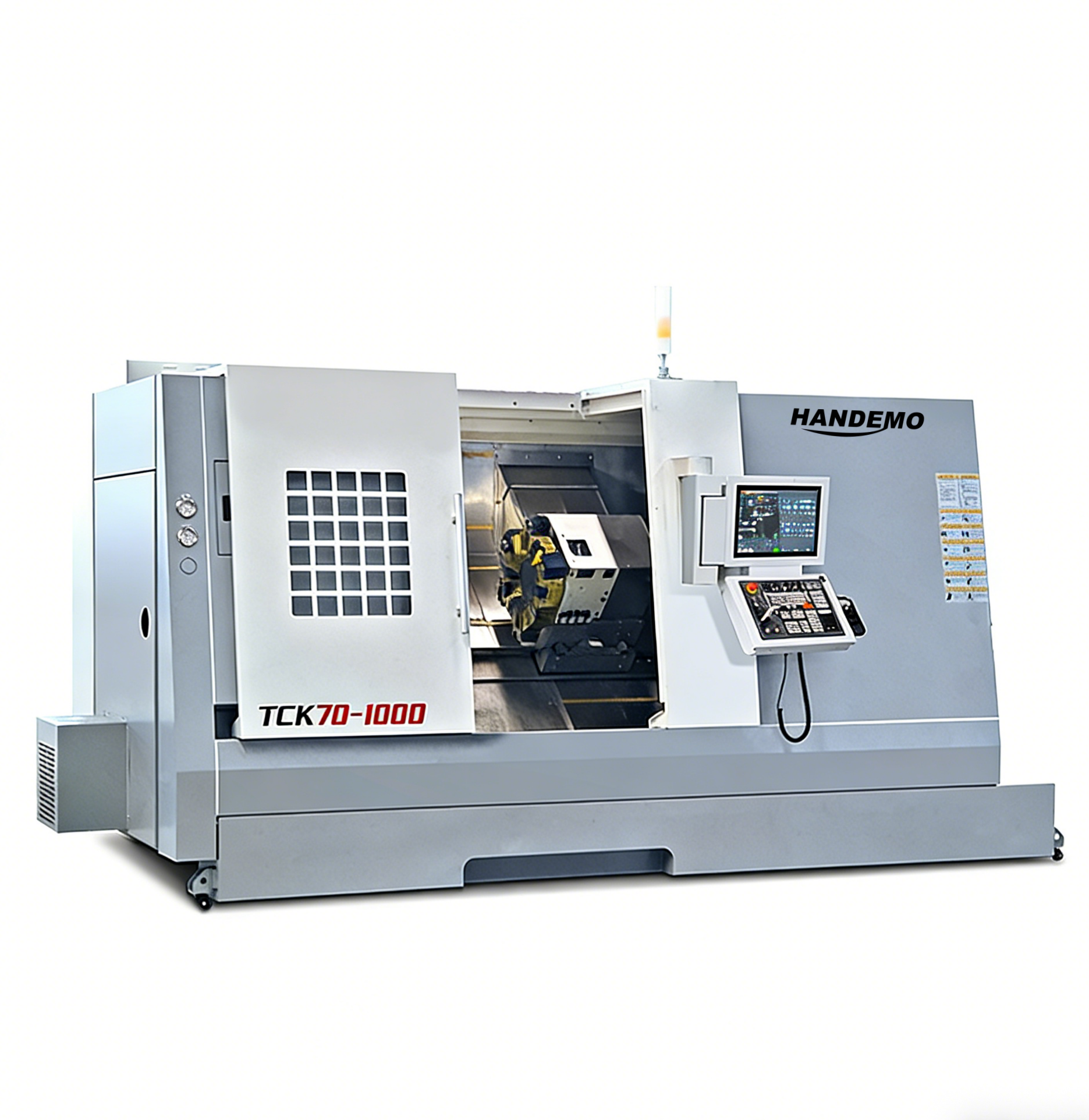
A 720 mm swing over the bed and a 500 mm maximum turning diameter put the TCK70 in the class of lathes that shops buy when the work is too big for a 50-series machine but does not justify a heavy-duty box way lathe. BONANZA lists it as a general-purpose, high-efficiency model, and the sheet backs that up: an 80 mm spindle bore, an 18.5 kW spindle motor, a 45-degree slant bed, and a 12-station turret on a 125 mm centre height.
Here is what those numbers mean on the shop floor, and what to confirm in writing before ordering.
Where the TCK70 sits in the slant bed line
The TCK series runs from the 50-series up through the 80-series, and the TCK70 sits in the middle: more swing and more bore than a TCK6050D, less mass and turning length than a TCK80D-1500.
That distinction matters more than the model numbers suggest. The TCK6050D has a 65 mm bore and 50 mm bar capacity, so 50 mm stock is its ceiling. The TCK70 takes 70 mm bar. If your bar feeder is loaded with 65 mm stock, the 50-series machine cannot run it at all, and that single number often settles the purchase before anyone looks at the turret.
TCK70-1500 specifications
| Max. swing over bed | 720 mm |
| Max. turning length | 1500 mm |
| Max. turning diameter | 500 mm |
| Max. swing over cross slide | 420 mm |
| Spindle nose type | A2-8 / A2-11 |
| Spindle bore diameter | 80 mm |
| Max. bar capacity | 70 mm |
| Spindle motor output power | 18.5 kW |
| X-axis travel | 250 mm |
| Z-axis travel | 1520 mm |
| Rapid traverse, X / Z | 12 / 16 m/min |
| Tailstock travel | 1400 mm |
| Tailstock quill diameter | 110 mm |
| Tailstock quill stroke | 100 mm |
| Turret | 12 stations, 125 mm centre height |
| Approx. gross weight | 8500 kg |
The 45-degree bed
A slant bed is not a styling choice. On a 45-degree machine the cutting zone sits closer to the operator and chips fall away from the work instead of piling on the bed and the way surfaces. On a lathe cutting steel all day, that is the difference between clearing chips with a hook every forty minutes and checking the conveyor at lunch.
The angle also moves turret mass down and behind the centre line, so boring bars reach the part at an angle that leaves the shank stiffer than on a horizontal bed.
What a slant bed does not fix is mass. It does not remove the need for a foundation under 8.5 tonnes of cast iron.
The spindle: 80 mm bore, two nose options, 18.5 kW
Bore is 80 mm and maximum bar capacity is 70 mm. That 10 mm gap is the allowance for bar straightness, feeder alignment and chuck jaw clearance. Shops that quote bar capacity as bore size minus nothing find out about the gap on their first long bar.
BONANZA lists the nose as A2-8 or A2-11. A2-8 is lighter and suits a 10-inch chuck; A2-11 carries more mass and suits a 12-inch chuck or a heavy fixture with long overhang. Which one you get changes maximum spindle speed and the inertia the drive must accelerate, so specify it on the order rather than leaving it to the standard build.
Spindle output is 18.5 kW. The page does not publish the torque curve, and for most turning work that curve decides. A lathe cutting at 120 rpm in a large diameter works in the constant-torque region, where 18.5 kW at 3000 rpm tells you very little. Ask for it.
Turret and cutting capacity
The turret has 12 stations on a 125 mm centre height, and BONANZA highlights a wider turret span. More span means more room per station, which matters when a boring bar or driven holder sits next to an OD turning tool. On a narrow turret the neighbouring station limits how far you can extend a bar before it fouls.
The 12 mm single tool capacity sets the shank size the holders are built around, and it is a fair guide to the class of cut the turret is made for. Twelve millimetres of depth on a 500 mm part is productive, but this is not a turret built for the 25 mm hogging passes of a box way heavy lathe. If your process needs those, the TCK6350B is rated for long-term 12 mm single-side cutting on a hard rail structure. Different machine, different job.
Travel, tailstock and the length question
Z travel is 1520 mm against a maximum turning length of 1500 mm, and X travel is 250 mm. That X figure is generous for a 500 mm turning diameter: 250 mm of radial travel covers the full diameter plus tool clearance without running the slide to the end of its stroke on every pass.
Tailstock travel is 1400 mm with a 110 mm quill and 100 mm stroke. That long tailstock travel is what makes the 1500 mm length usable — the body can sit short for shaft work without hanging over the end of the bed, and still reach the far end for a long part.
Rapid traverse is 12 m/min in X and 16 m/min in Z. Z is the longer move, so the higher Z rapid is the one that pays back in cycle time.
The series runs from 1000 mm to 3000 mm
The TCK70 series covers cutting lengths from 1000 mm to 3000 mm. For longer parts, the TCK70D takes bore to 120 mm, maximum turning diameter to 550 mm, turning length to 2950 mm, and mass to roughly 12000 kg.
Run that comparison on paper before you request a quote. If your work is 70 mm bar and 1500 mm shafts, the extra tonneage of the D buys you nothing. If it is 100 mm bar and 2.5 m shafts, the TCK70 will not do it.
What to confirm before ordering
The product page leaves out a few things, and none of them are small. The control system is not specified. The guideway type — linear or box — is not stated for the TCK70, though BONANZA states it on the hard rail models. Positioning accuracy, repeatability, chuck size, turret indexing time and hydraulic pressure are not published either.
There is also a labelling slip worth flagging: the table lists approximate weight as 8500 with the unit shown as millimetres. It is kilograms. Plan lifting and foundation for 8500 kg gross.
Ask for a specification sheet with the torque curve, accuracy to ISO 230-2, the controller model and the guideway configuration before you sign. The CNC slant bed lathe range has roughly eight models, and the differences between them live mostly in those documents rather than in the headline numbers.
Who the TCK70 fits
Job shops turning flanges, hubs, shafts and valve bodies in the 200 to 500 mm diameter band, with some 70 mm bar work mixed in, are the natural fit. There is swing for a 12-inch chuck, bore to bar-feed most of that work, and Z travel for a 1.5 m shaft without a second setup.
If you want the numbers applied to your own part drawings, send them over. We quote against actual geometry rather than a catalogue page, and we will say when a different model is the better answer.