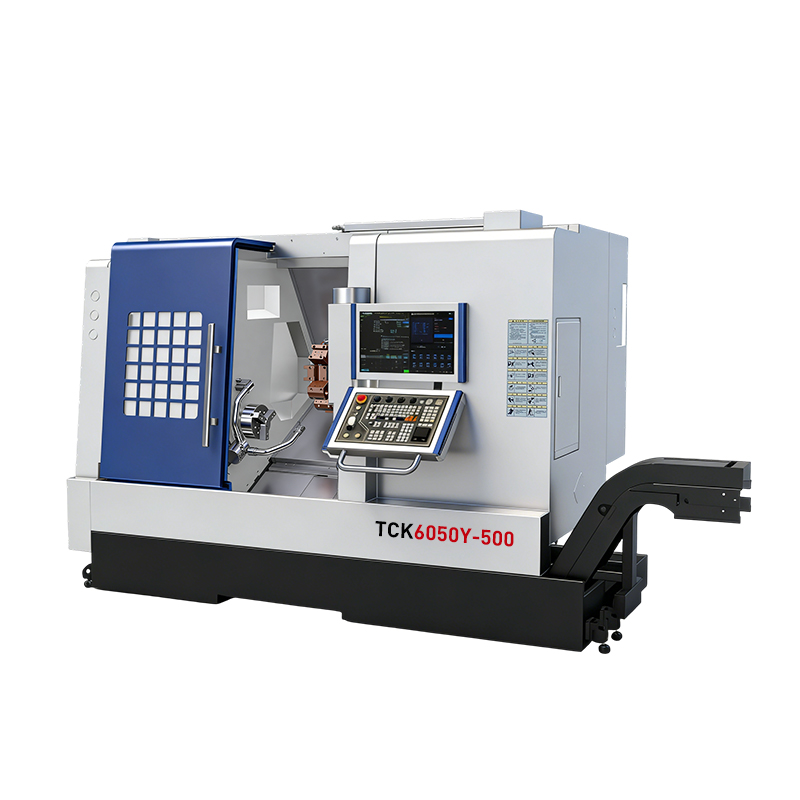
Four machines in the BONANZA catalogue start from the same turning platform: an A2-6 spindle nose, a 65 mm bore and a 50 mm bar capacity. After that they go their separate ways. One keeps the bed short and the price low. One stretches the bed to 980 mm. One adds a Y axis. One adds a second spindle and shrinks everything else to fit a smaller footprint.
Buyers usually arrive at this decision from the part drawing rather than from the catalogue. If the part needs a cross-drilled hole or a milled flat off-centre, the plain lathe is out. If the part needs a back-side operation, the Y-axis machine without a sub-spindle means a second op. Here is how the four models in the CNC mill-turn range differ on published figures.
The Shared Platform
All four use the A2-6 spindle nose. On the TCK6050, TCK6050D and TCK6050Y, that nose carries a 65 mm bore and a 50 mm maximum bar capacity. The TCK6050SY keeps the A2-6 on the main spindle but opens the bore to 67 mm, and its second spindle is an A2-5 with a 56 mm bore and 45 mm bar capacity.
That 50 mm bar number is the practical floor for this family. Bar-fed work above 50 mm needs the TCK6350D with its 96 mm bore, or the 120 mm bore machines further up the range. Bar work below 50 mm fits all four, and the choice then comes down to length, Y travel and whether a back side needs turning.
Specifications Side by Side
| Item | TCK6050 | TCK6050D | TCK6050Y | TCK6050SY |
|---|---|---|---|---|
| Max. swing over bed | 560 mm | 560 mm | 560 mm | 600 mm |
| Max. turning length | 540 mm | 500 mm (D-500) 980 mm (D-1000) |
980 mm | 450 mm |
| Max. turning diameter | 500 mm | 410 mm | 410 mm | 400 mm |
| Swing over cross slide | 400 mm | 320 mm | 400 mm | 330 mm |
| Standard turning diameter | — | — | 300 mm | 300 mm |
| Spindle nose | A2-6 | A2-6 | A2-6 | A2-6 main / A2-5 sub |
| Spindle bore | 65 mm | 65 mm | 65 mm | 67 mm main / 56 mm sub |
| Max. bar capacity | 50 mm | 50 mm | 50 mm | 50 mm main / 45 mm sub |
| Spindle speed | 50–4000 r/min | — | — | 50–4000 r/min (both) |
| Spindle motor | — | 11/15 kW | — | 18.5 kW main |
| Max. output torque | 182 Nm | — | — | — |
| X-axis travel | 280 mm | 280 mm | 280 mm | 230 mm |
| Z-axis travel | 620 mm | 630 mm (D-500) 1120 mm (D-1000) |
1130 mm | 450 mm |
| Y-axis travel | — | — | ±50 mm | ±50 mm |
| Rapid traverse X/Y/Z | 15/—/15 m/min | 15/—/15 m/min | 15/—/15 m/min | 20/20/10 m/min |
| Tailstock travel | — | 450 mm (D-500) 900 mm (D-1000) |
900 mm | — |
| Tailstock quill stroke | — | 100 mm | 100 mm | — |
| Machine dimensions | 3240×1940×1965 mm | — | — | 3307×1912×2250 mm |
| Machine weight | 3800 kg | — | — | — |
Where a cell shows a dash, BONANZA has not published that figure for that model. That is a gap in the sheet, not a zero, and it matters most for spindle power on the D, Y and SY builds.
TCK6050: The Short-Bed Reference Point
This is the machine the other three are measured against, and it is the only one in the family with a published torque figure: 182 Nm, delivered from 50 to 4000 r/min. A 540 mm cutting length and a 620 mm Z travel suit chucked work that arrives in one op and leaves in one op — short shafts, bushings, flanges, valve bodies under 500 mm turning diameter.
It is also the only one with a published weight, 3800 kg, on a 3240×1940×1965 mm footprint. If the shop floor is already tight and the drawing has no off-axis features, this machine does the job with the fewest moving parts to maintain. Note that it is listed as a slant bed lathe, not a mill-turn, because there is no Y axis and no live-tool turret in the published configuration.
TCK6050D: Two Beds, One Model Name
The D is sold in two lengths. The D-500 gives 500 mm of turning length on a 630 mm Z travel and 450 mm of tailstock travel; the D-1000 takes both numbers to 980 mm and 1120 mm, with 900 mm of tailstock travel to match. Spindle motor output is listed as 11/15 kW, which is the only published power figure in the 65 mm bore group apart from the SY.
Two things change when the bed grows. Swing over the cross slide drops from 400 mm on the base machine to 320 mm on the D, and maximum turning diameter drops from 500 mm to 410 mm. A long bed buys length and gives back some diameter. For a 900 mm shaft that is a fair trade. For a 480 mm flange it is not, and the short-bed machine stays the better answer.
TCK6050Y: 50 mm of Y on a 980 mm Bed
The Y axis is ±50 mm, so the tool can sit 50 mm either side of centre. That is enough to mill a flat on the face of a shaft, drill a cross hole off-centre, or cut a keyway without a second setup on a machining centre. On a 980 mm part that second setup is where the tolerance usually goes, because the part has to come out of the chuck and go back in.
Worth noting: the Y keeps the 400 mm cross-slide swing that the D-1000 gives up, and its Z travel is 1130 mm against the D-1000’s 1120 mm for the same 980 mm turning length. Ten millimetres is not a purchasing factor, but it does suggest the two long-bed builds are not the same casting. Ask for the drawing if the difference matters to your fixture.
TCK6050SY: The Second Spindle Trade
The SY is the odd one out and the most interesting. It carries two spindles — A2-6 main at 18.5 kW and A2-5 sub — plus ±50 mm of Y, and it does all of that in a 450 mm turning length on a 450 mm Z travel. Rapids are 20/20/10 m/min, the fastest X and Y in the family.
That is a parts-complete machine, not a long-part machine. A back-side bore, a chamfer or a second-face turn happens on the sub-spindle while the main spindle is already cutting the next part. For a 40 mm bar job running thousands of pieces a month, the cycle-time arithmetic usually favours this over buying a second lathe. For a 900 mm shaft it is simply the wrong machine, whatever the price.
The trade-off is published plainly: 400 mm maximum turning diameter, 330 mm swing over the cross slide, and bar capacity on the sub-spindle drops to 45 mm. Parts above 45 mm bar cannot transfer.
How the Choice Usually Falls
Start with the longest part. Under 450 mm with a back-side operation and bar stock under 45 mm, the SY removes a whole second operation. Over 500 mm with no off-axis features, the base TCK6050 at 500 mm turning diameter is the most capable short machine. Over 500 mm with a milled or drilled feature, the choice is between the D-1000 and the Y, and the deciding question is diameter rather than length: 410 mm on the D, and the Y keeps the 400 mm cross-slide swing.
One caution for anyone comparing the D and the Y on price alone: the D publishes 11/15 kW, and the Y does not publish spindle power at all. On heavy interrupted cuts in steel that is the number that decides whether the machine holds speed, so get it in writing before the order, not after.
What the Published Data Leaves Open
Four items are missing across the family and all four change the quote: chuck size and type on each spindle, turret station count and how many stations are live, the controller model, and positioning and repeatability figures with the inspection standard behind them. Spindle power and torque curves for the Y and SY builds, and machine weight for the D, Y and SY, are also unpublished.
None of that is unusual for a catalogue page, and none of it is a reason to walk away. It is a reason to send the part drawing and ask for a written specification against it. BONANZA builds these four on one platform precisely so the answer can be matched to the part instead of the other way round.
Send the drawing, the bar size and the annual volume to our engineering team and we will come back with the model, the tooling list and the cycle estimate.