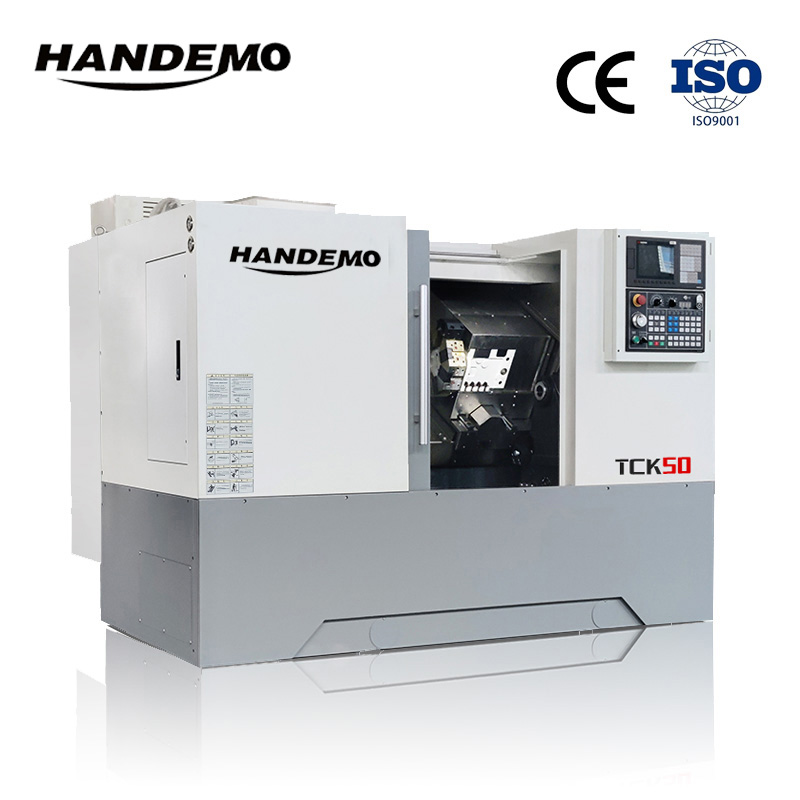
TCK50 CNC Slant Bed Lathe – 8-Inch Chuck, 50 mm Bar and 30 m/min Rapids
The TCK50 is the smallest slant bed lathe BONANZA builds, and it does not feel like a stripped-down version of the bigger models. It carries an A2-6 spindle with a 65 mm bore, a 15 kW motor and an 8-inch chuck, turns parts up to 360 mm diameter over a 500 mm bed swing, and runs 30 m/min rapids on both axes, the fastest in the entire TCK line. All of that sits on a 3,600 kg casting with a 2,300 × 1,700 mm footprint, which is the part most job shops notice first.
If your work is 50 mm bar, small-to-medium shafts, bushings, fittings, hydraulic spools or second-op turning, here is what the sheet actually buys you and where it stops short of what you need to quote a job.
TCK50 at a glance
| Parameter | TCK50 |
|---|---|
| Max. turning diameter on bed | 500 mm |
| Max. cutting length | 500 mm |
| Max. cutting diameter | 360 mm |
| Standard cutting diameter | 240 mm |
| Max. turning diameter on the slide | 300 mm |
| Spindle nose type | A2-6 |
| Spindle bore diameter | 65 mm |
| Max. bar capacity | 50 mm |
| Spindle speed | 4,500 rpm (published as a single figure) |
| Spindle motor power | 15 kW |
| Chuck type | 8 inch |
| X-axis travel | 200 mm |
| Z-axis travel | 550 mm |
| X / Z rapid traverse | 30 / 30 m/min |
| Tailstock travel | 450 mm |
| Tailstock sleeve stroke | 100 mm |
| Tailstock sleeve taper | Morse 5# |
| Standard tool holder | Horizontal 8-station turret |
| Machine dimensions | 2,300 L × 1,700 W × 1,930 H mm |
| Machine weight | 3,600 kg |
| X / Y / Z positioning accuracy | 0.008 / 0.007 / 0.002 mm |
Four diameters, and why the differences matter
The sheet lists four turning figures and they are easy to mix up, so it is worth separating them before you compare the TCK50 against anything else. Bed swing is 500 mm, the largest disc the bed casting clears without contact. Max. cutting diameter is 360 mm, the largest part the machine will actually cut. Standard cutting diameter is 240 mm, which is where BONANZA expects most customers to live day to day, and the slide (saddle) figure drops to 300 mm because the tooling and turret eat into the envelope.
Read that way, the practical working band is roughly 240 to 360 mm, and anything approaching 500 mm is a swing clearance number rather than a cutting claim. Cutting length is 500 mm, matched by 550 mm of Z travel, so the machine can reach the end of the part without running out of stroke.
30 m/min rapids on a lathe this size
Rapid traverse is where the TCK50 separates itself from its own family. It runs 30 m/min on X and Z, against 15/15 m/min on the TCK6050 and 18/15 m/min on the TCK6350D. On a 550 mm Z axis, a full-stroke 30 m/min move is about 1.1 seconds against roughly 2.2 seconds at 15 m/min, and the difference compounds on parts with a lot of short positioning moves, drilling cycles or multiple tool changes.
None of that raises the cutting rate directly. What it does is cut non-cutting time out of short-cycle work, which is exactly the work a compact lathe tends to get.
A2-6 spindle, 65 mm bore, 50 mm bar
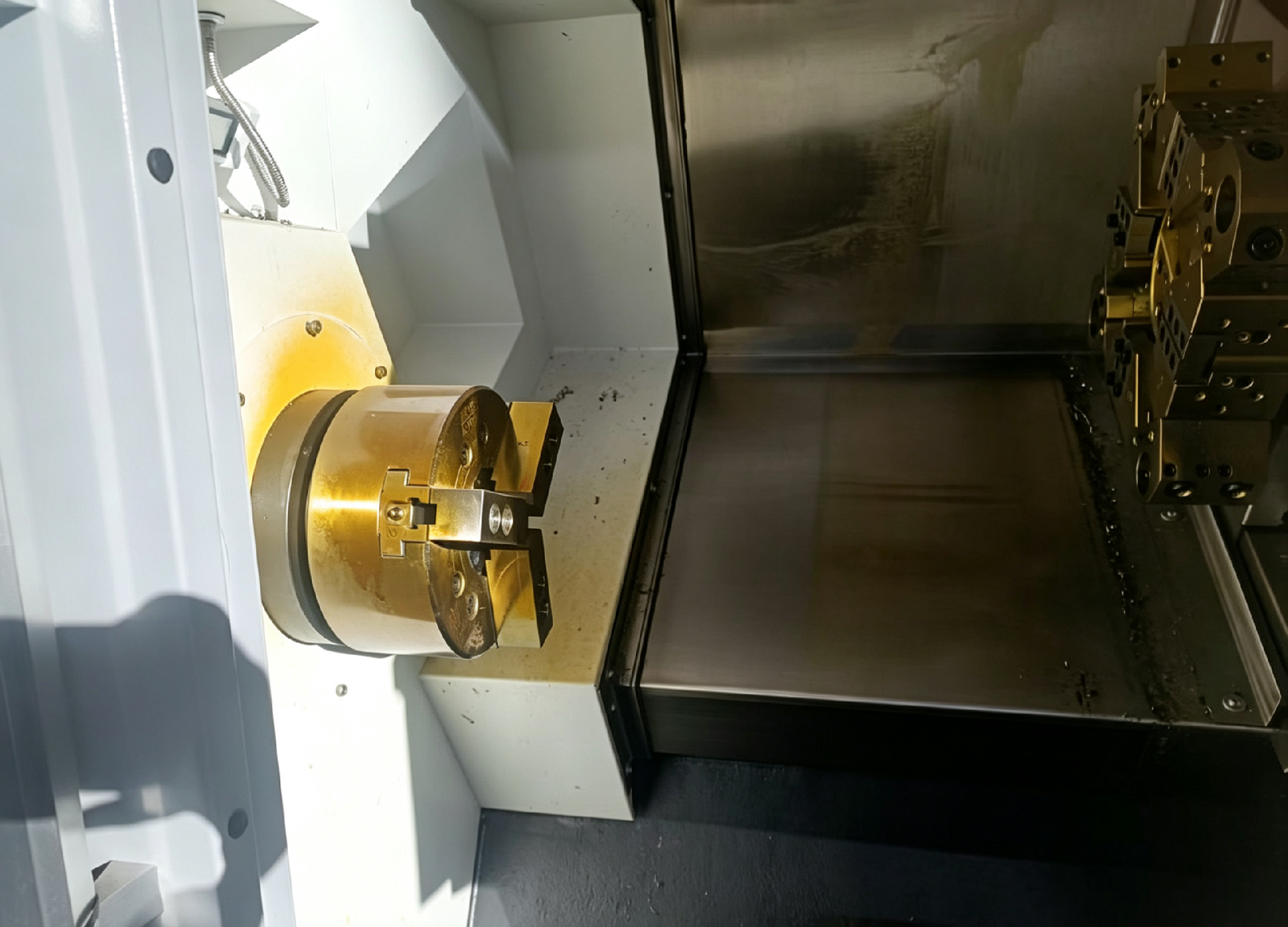
The spindle nose is A2-6 with a 65 mm bore and 50 mm of bar capacity, driven by a 15 kW motor and an 8-inch chuck. That is the same bore-and-bar combination as the TCK6050, but the TCK50 lists its motor as a single 15 kW figure while the TCK6050 is rated 11/15 kW. On the same bore size, the higher single rating is aimed at shops that keep the spindle loaded, though the sheet does not publish a torque figure or a duty cycle, so treat the two as different machines rather than one being a better version of the other.
Bar capacity is what decides whether a part is fed through a bar feeder or cut from blanks. At 50 mm, a large share of fittings, pins, inserts and hydraulic components can run bar-fed and come off complete, which removes handling and re-chucking from the process. The published spindle speed is 4,500 rpm, listed as a single number rather than a range, which is a detail worth clearing up with the factory before you write a process sheet (more on that below).
Where the TCK50 sits in the slant bed range
The CNC slant bed lathe series climbs from this machine up to the 120 mm bore models, and the first few steps are worth seeing side by side because the overlap is not obvious from the model numbers.
| Model | Bed swing / cutting dia. | Cutting length | Spindle | Bar capacity | Power | Rapid X / Z | Weight |
|---|---|---|---|---|---|---|---|
| TCK50 | 500 mm / 360 mm | 500 mm | A2-6, 65 mm bore | 50 mm | 15 kW | 30 / 30 m/min | 3,600 kg |
| TCK6050 | 560 mm / 500 mm | 550 mm | A2-6, 65 mm bore | 50 mm | 11/15 kW | 15 / 15 m/min | 3,800 kg |
| TCK6050D | 560 mm / 410 mm | 500 / 980 mm | A2-6, 65 mm bore | 50 mm | 11/15 kW | 15 / 15 m/min | – |
| TCK6350D | 630 mm / 330 mm | 450 mm | A2-8, 96 mm bore | 85 mm | 22 kW | 18 / 15 m/min | 4,400 kg |
Two things stand out. The TCK50 is not the weakest machine in the group on capability: it turns a bigger diameter (360 mm) than the TCK6350D (330 mm) and matches the TCK6050’s bore and bar capacity, while being the lightest and most compact and running the fastest rapids. Where it gives ground is length and stiffness. The TCK6050 offers 550 mm of cutting length against 500 mm, and the TCK6350D steps up to a 96 mm bore with an A2-8 nose and 22 kW for heavier, more stubborn material.
In short, the TCK50 is the machine for shops that need speed and a small footprint on 50 mm bar, not the one to buy if parts are long or the cuts are heavy.
Who the TCK50 suits
- Bar-fed work up to 50 mm: fittings, pins, bushings, inserts, fasteners, small hydraulic parts
- Chucked parts up to 360 mm cutting diameter, with 240 mm the comfortable working band
- Shops tight on floor space, since the footprint is 2,300 × 1,700 mm and the machine weighs 3,600 kg
- Short-cycle, high-mix work where 30 m/min rapids and quick tool changes pay off
What to confirm before you order
The sheet covers the cutting envelope well and thins out after that. Ask for these with the quotation:
- Spindle speed range and maximum output torque, because the sheet lists 4,500 rpm as a single figure and no torque value at all
- The Y-axis positioning accuracy of 0.007 mm, since a two-axis slant bed lathe has no Y axis and the line is likely carried over from a template
- Repeat positioning accuracy and the acceptance test standard behind the X 0.008 / Z 0.002 mm positioning figures
- Turret tool size and whether live tooling is available on the standard 8-station horizontal holder
- Chuck and bar feeder interface, chip conveyor and coolant-through-spindle options for your build
- Foundation drawing, since only the outside dimensions and gross weight are published
Frequently asked questions
What is the maximum bar capacity of the TCK50?
50 mm, through a 65 mm spindle bore on an A2-6 spindle nose with an 8-inch chuck.
How big a part will the TCK50 turn?
360 mm maximum cutting diameter and 500 mm cutting length, with 500 mm of swing over the bed, 240 mm as the standard working diameter and a 300 mm limit over the slide.
How fast are the rapids compared with the rest of the range?
30 m/min on both X and Z, which is roughly double the 15/15 m/min of the TCK6050 and TCK6050D and faster than the 18/15 m/min of the TCK6350D.
Bottom line
The TCK50 is the compact, fast end of the BONANZA slant bed range: 500 mm swing, 360 mm cutting diameter, an A2-6 65 mm bore spindle feeding 50 mm bar, 15 kW, 30 m/min rapids and a 3,600 kg frame in a 2,300 × 1,700 mm footprint. If your work is bar-fed parts up to 50 mm or chucked parts around 240 mm, price it against the TCK6050 for the extra cutting length and the TCK6350D for a bigger bore. Send the BONANZA team your drawing, material and batch quantity and you will get a straight answer on which of the three fits.