The TCK50 Is a Floor-Space Decision First
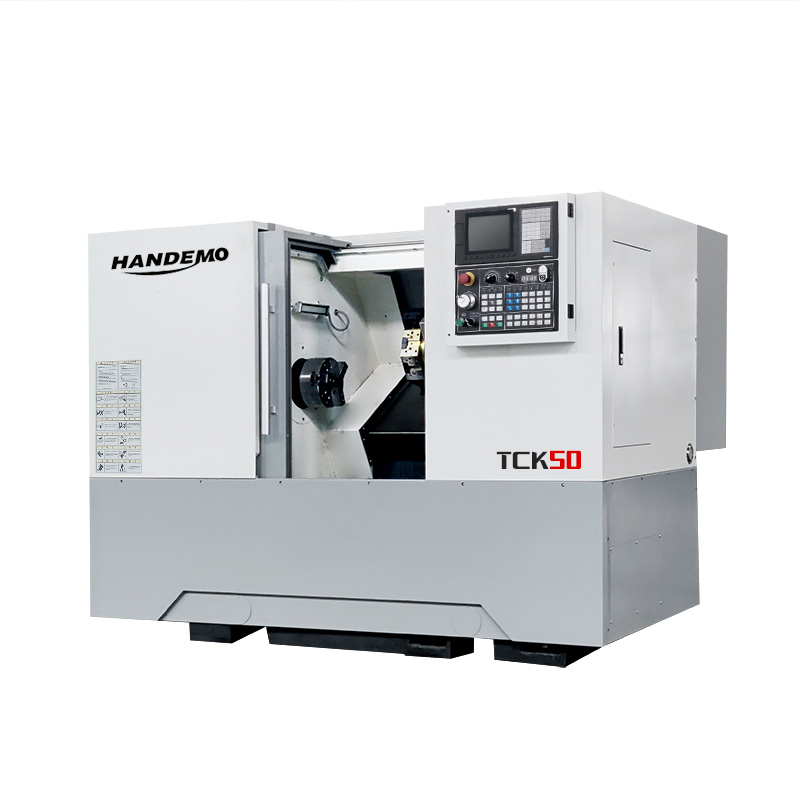
Most lathe enquiries start with the part. This one usually starts with the floor. If you have a 2,400 mm gap between the surface grinder and the wall, a 6050-class lathe is not going to fit no matter how good the price is. The BONANZA TCK50 CNC slant bed lathe was drawn for that gap: 2,300 mm long, 1,700 mm deep and 1,930 mm tall, 3,600 kg on the scale.
Below is what those dimensions actually mean on a shop floor, and where the machine runs out of envelope.
Reading the Footprint Properly
The 2,300 mm length is the casting, not the working envelope. Two things add to it: the control cabinet door and the chip bin. Leave 600 mm at the tailstock end so the door can open past 90°, and put the chip bin where a wheelbarrow can reach it.
The Z axis travels 550 mm and the tailstock slides another 450 mm, but the tailstock runs on the same bed rather than hanging off the end. That is why the machine does not grow a metre longer when you start turning between centres — a detail that matters in a rented unit where every square metre is on the invoice.
At 3,600 kg you are in engine-crane or 5-tonne-forklift territory. No separate concrete plinth. A level, cured 150 mm slab with isolation pads under the levelling bolts is enough, and the machine should be re-levelled after the first two weeks of cutting.
Why the Bed Is Set at 30°
A 30° bed is a compromise, and a useful one. Steeper beds (45°) throw chips clear faster, but they also narrow the casting under the workpiece. At 30°, more iron stays directly beneath the spindle centre line, so the TCK50 holds a 500 mm swing over bed, a 360 mm maximum cutting diameter and a 300 mm swing over the saddle without turning into a wide machine.
Chips still fall away from the cutting zone instead of piling up beside the insert. On a machine running 500 mm of cutting length, that mostly means the operator spends the last twenty minutes of a shift making parts instead of raking the pan.
The Hard Rail Tailstock
The tailstock runs on hardened box ways rather than a linear guide. Box ways give you contact area and damping, which is what you want when a 5 MT taper is pushing a 100 mm quill into a shaft. Thrust goes into the bed instead of into a rail that flexes.
With 450 mm of tailstock travel and 100 mm of quill stroke, the TCK50 handles shaft work across its 500 mm cutting length without re-pinning the tailstock for every part. For a machine this size, that is the difference between a lathe that can do shafts and a lathe that is really a chuck machine.
Spindle, Chuck and Turret
The spindle is A2-6 with a 65 mm bore, which lets 50 mm bar stock through the draw tube. That is the same bar capacity as several larger machines in the range, and it is the number to check first if you are buying for bar-fed work.
An 8-inch chuck covers the chuck side. The 15 kW spindle motor reaches 4,500 r/min, a ceiling that suits finishing passes on aluminium and small-diameter steel where surface speed runs out before torque does. Standard cutting diameter is 240 mm, so the 15 kW is not being asked to hog a 360 mm billet — that is what the bigger frames are for.
Tooling sits in a horizontal 8-station turret. Eight stations is modest, but with 30 m/min rapids on both axes and a 200 mm X stroke, index and positioning time stays short, so the turret rarely becomes the bottleneck on a part this size.
TCK50 Specifications
| Parameter | TCK50 |
|---|---|
| Max. turning diameter on bed | 500 mm |
| Max. cutting length | 500 mm |
| Max. cutting diameter | 360 mm |
| Standard cutting diameter | 240 mm |
| Max. turning diameter over saddle | 300 mm |
| Spindle nose | A2-6 |
| Spindle bore | 65 mm |
| Max. bar capacity | 50 mm |
| Spindle speed | 4,500 r/min |
| Spindle motor power | 15 kW |
| Chuck size | 8 inch |
| X / Z rapid traverse | 30 / 30 m/min |
| X-axis travel | 200 mm |
| Z-axis travel | 550 mm |
| Tailstock travel / quill stroke | 450 mm / 100 mm |
| Tailstock taper | MT5 |
| Tool turret | Horizontal, 8 station |
| Positioning accuracy, X / Z | 0.008 mm / 0.002 mm |
| Dimensions (L × W × H) | 2,300 × 1,700 × 1,930 mm |
| Machine weight | 3,600 kg |
Where the TCK50 Stops
Three limits decide it. Fifty millimetre bar. A 360 mm cutting diameter. Five hundred millimetres of cutting length.
If your part crosses any of those lines, moving up is cheaper than fighting the envelope. The TCK6050 keeps the A2-6 spindle but opens the cutting length to 540 mm and quotes 182 Nm of spindle torque at 15 m/min rapids. If the bore is the problem rather than the length, the TCK6350D runs a 96 mm bore and 85 mm bar on the same slant bed layout. And for castings that need a 12 mm depth of cut on one side all day, the TCK6350B is the hard rail answer.
The full lineup, sorted by swing and bar capacity, sits on the CNC slant bed lathe series page.
Commissioning Notes
Budget a 3-phase supply sized for the 15 kW spindle plus servo and coolant pump draw, not for the spindle alone. Give the coolant tank room to be pulled out for cleaning — on a machine this compact, that access is from the front, and a wall behind the operator is not a problem but a bench in front of it is.
Check the first-part geometry after levelling rather than before. A 3,600 kg casting settles into its pads over the first few days, and a machine that was straight on day one can be a few hundredths out by day fourteen. Re-level, then cut a test shaft between centres and measure taper at both ends.
Is It the Right Lathe?
If your work is bar stock up to 50 mm, chucker parts up to 360 mm, and shafts up to 500 mm long, and the space you have is closer to a two-car garage than a dedicated machine hall, the TCK50 fits without compromise on the spindle side. The 65 mm bore and A2-6 nose are not entry-level parts.
If you need more length, more bore or heavier interrupted cuts, the series has an answer one size up. Either way, start with the part drawing and the tape measure, then confirm the model against the TCK50 product page.