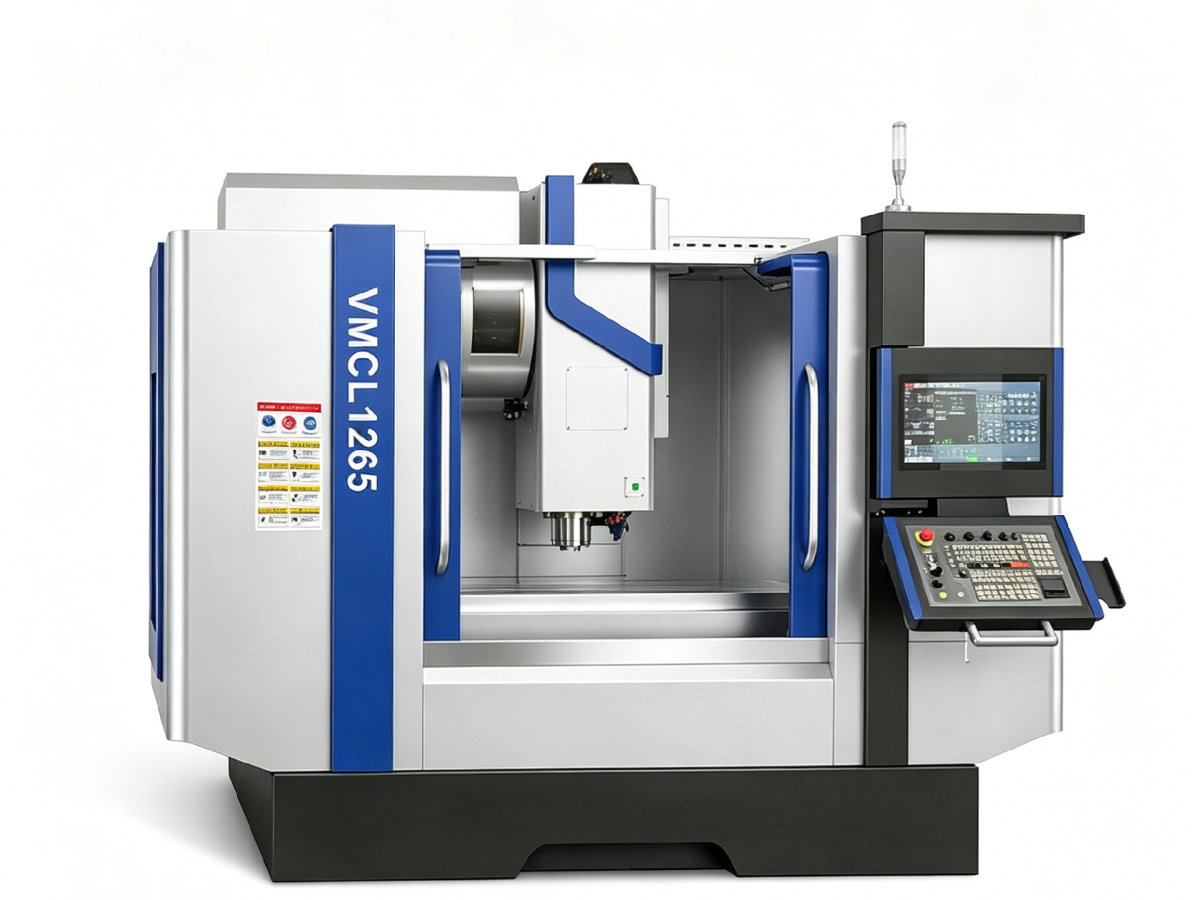
L1265 Vertical Machining Center – 5-18-100 T-Slots and an 800 kg Table for Two-Station Work
The L1265 is a BT40 vertical machining center with a 1,200 × 600 mm table rated for 800 kg, travels of 1,200 / 650 / 650 mm on X, Y and Z, and rapid traverse of 24 m/min on X and Y, 18 m/min on Z. It weighs 6,800 kg and measures 3,300 × 2,600 × 3,360 mm.
Those numbers get quoted in every brochure. The ones that decide whether the machine suits your parts are smaller: the T-slot pattern, and the fact that X travel equals table length exactly.
What 5-18-100 actually tells you
The L1265 table carries five T-slots, 18 mm across the top, spaced on 100 mm centres.
An 18 mm slot takes an M16 T-bolt. That is the practical ceiling for clamping force on this table — M20 studs will not enter the slot, and M12 hardware in an 18 mm slot leaves side clearance that lets the clamp walk under vibration. If your fixture design assumes M20, the table has already said no.
Five slots on a 600 mm wide table means the outer pair sits roughly 400 mm apart, with the fifth slot in the middle. That 400 mm band is where your clamping spread lives. A part 500 mm wide cannot be clamped on both outer edges from the top — you clamp it on the inner slots and accept a shorter moment arm, or you move to a fixture plate that distributes load across all five.
Compare the 1370D, which uses 5-18-130 on a 700 mm table. Same five slots, 30 mm more pitch, so the outer pair spans 520 mm. That extra 120 mm of clamping spread is the quiet advantage of a wider table, and it matters more than the 200 mm of extra X travel if your parts are plates with a high length-to-width ratio.
The 1560 keeps the same 5-18-100 pattern but stretches the table to 2,200 mm, so you get identical clamping geometry spread over nearly twice the length — useful for long base plates, useless if your problem is a 550 mm wide part.
X travel equals table length
1,200 mm of X on a 1,200 mm table is a one-to-one ratio. The spindle can reach every point on the table surface and nothing beyond it.
The upside is that no part of your table is dead space. Two 500 mm machine vises fit side by side with 200 mm left for the gap and the ends, and the machine can work both stations without a re-clamp. The downside is equally clear: there is no overhang to hang a fixture past the table edge, so anything you build has to sit inside 1,200 mm.
Y is different. 650 mm of travel on a 600 mm table leaves about 25 mm of reach past each edge. That is enough to bring a face mill to the edge of a wide plate or clear a burr on the side of a part, but it is not a licence to overhang a heavy fixture and expect the column to stay happy.
What 800 kg leaves for the part
Table ratings are often read as a fixture budget. They are not — the 800 kg covers fixture plus workpiece.
Two 500 mm hydraulic vises weigh roughly 60 to 70 kg each. A 1,200 × 600 mm steel fixture plate at 25 mm thick lands near 140 kg before you bolt anything to it. That leaves something in the region of 500 kg for parts, which is a comfortable two-station setup for castings and plate work in the 50 to 200 kg range, and thin for anything above 300 kg per station.
The load also has to be distributed. A single 700 kg block bolted at one end of the table loads the guideways unevenly and will show up as taper on a long bore. Spread mass towards the centre and keep the fixture footprint under the spindle envelope.
Spindle and speed envelope
The spindle is a BT40 with a Ø150 mm nose. That nose diameter is the widest in the BT40 part of the range — the 650 uses Ø120 — which buys stiffness at the tool tip and costs reach into deep, narrow pockets. For mould work with long small-diameter cutters, a slimmer nose is the better tool holder; for face milling and heavy drilling on plate, the Ø150 is what you want.
Rapid traverse is 24 m/min on X and Y, 18 m/min on Z. The Z figure is a quarter slower, and Z is the axis that does most of the retract work in a drilling or tapping cycle. On a part with a few hundred holes, that shows up in cycle time; on a part dominated by long profile milling, it does not.
L1265, 1265 and 1265D: the published sheets are identical
All three list a 1,200 × 600 mm table, 800 kg load, 5-18-100 T-slots, 1,200 / 650 / 650 mm travels, 24 / 24 / 18 m/min rapids, a BT40Ø150 spindle interface, 3,300 × 2,600 × 3,360 mm dimensions and 6,800 kg.
Published data therefore cannot separate them. The difference sits in the configuration package — control system, guideway and ballscrew grade, coolant and chip handling, and the options list. If you are choosing between the three, ask for the written configuration sheet rather than comparing spec tables, because the tables will match line for line.
Published specifications
| Table size | 1,200 × 600 mm |
|---|---|
| Max. worktable load | 800 kg |
| T-slot | 5-18-100 mm |
| Spindle taper | BT40, Ø150 mm nose |
| X / Y / Z travel | 1,200 / 650 / 650 mm |
| Rapid traverse X / Y / Z | 24 / 24 / 18 m/min |
| Machine dimensions | 3,300 × 2,600 × 3,360 mm |
| Machine weight | 6,800 kg |
What the page does not publish
Several figures you will need before quoting a job are absent from the L1265 specification: spindle speed range and motor power or torque curve, ATC capacity and maximum tool diameter and length, positioning and repeatability values with the test standard behind them, guideway type, and control model. The table above is what BONANZA publishes; the rest should come back in writing with the quotation. We do not fill those gaps with estimates.
Where it fits
The L1265 suits work that needs a full 1,200 mm of X with moderate mass: plate and frame components, hydraulic manifolds, medium mould bases, two-station batches where the operator loads one side while the other cuts. It is not the machine for parts over 300 kg at each station, and it is not the machine for a 550 mm wide plate that needs clamping on both outer edges — the 1370D answers that one with a 700 mm table and 130 mm T-slot pitch.
Full dimensions and photographs are on the L1265 vertical machining center page, and the rest of the range sits under vertical machining centers. Send a drawing with the fixture layout and part weight and we will tell you whether the table rating and the 400 mm clamping band work for it.