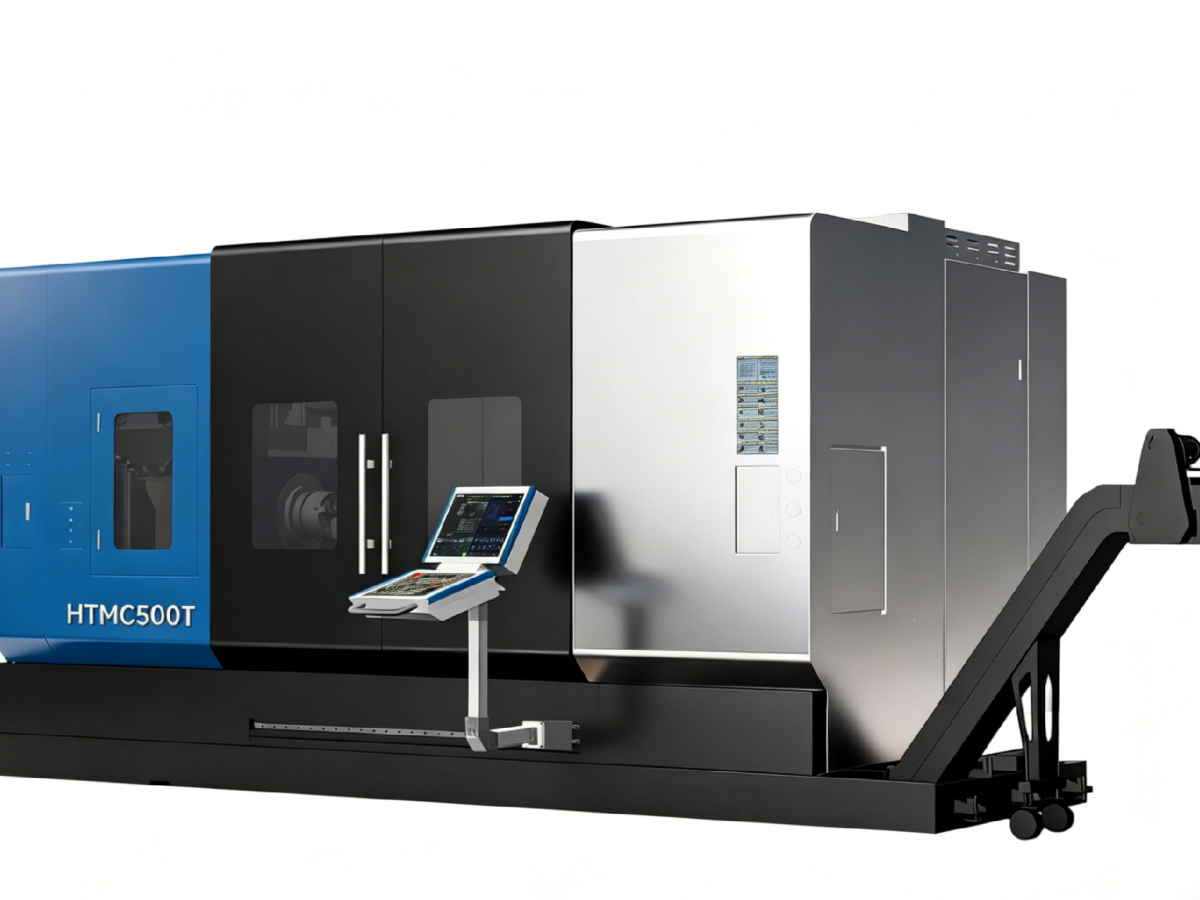
HTMC500T CNC Mill-Turn Machine: 700 mm Swing and 1,250 mm Turning Length
Shops that turn a part and then mill it usually move it between two machines. Every move costs a setup, and every setup costs you a tolerance. The HTMC500T CNC mill-turn machine is aimed at the jobs where that second setup is the expensive part. It carries a Y-axis, a 700 mm swing over the bed, and enough Z travel to hold parts up to 1,250 mm long.
The numbers below come straight from the datasheet. What I have added is what they tend to mean on the shop floor, plus the places where you should get a written answer before you place an order.

HTMC500T specifications
| Item | Specification |
|---|---|
| Max. swing over bed | 700 mm |
| Max. swing over cross slide | 700 mm |
| Max. turning diameter | 500 mm |
| Max. turning length | 1,250 mm |
| Spindle nose type | A2-8 |
| Spindle bore | 86 mm |
| Max. bar capacity | 75 mm |
| X-axis travel | 700 mm |
| Z-axis travel | 1,400 mm |
| Y-axis travel | ±125 mm |
| Rapid traverse X / Y / Z | 12 / 12 / 12 m/min |
| Machine dimensions | 6,900 × 3,800 × 2,900 mm |
| Approx. gross weight | 14,000 kg |
The spindle is the first number to check
An A2-8 nose with an 86 mm bore will pass a 75 mm bar. That is a real bar-feeding size, not a token one. If your work is mostly shaft-type parts in the 40-75 mm range, the HTMC500T can machine them from bar without a second op. Below 40 mm you are paying for capacity you may not need. Above 75 mm the part has to be chucked, and at that point you are looking at a swung part rather than a bar-feed job.
What the sheet does not list is spindle speed, motor power, or torque. Those matter as much as the bore when you are cutting hard material or running small tools in the milling direction, so ask for them in writing.
Travels: 700 mm in X, 1,400 mm in Z, ±125 mm in Y
The Z travel of 1,400 mm is the one that opens up longer work. The bed swing is 700 mm and the maximum turning diameter is 500 mm, so there is useful clearance around a large part rather than just the ability to spin it. Note that maximum swing over the cross slide is also listed at 700 mm, which means the cross slide does not eat into your practical envelope the way it does on some lathes.
Y-axis travel of ±125 mm gives a 250 mm band of off-centre milling. That covers cross-drilling, keyways, flat faces, and holes that need to sit off the centreline without a second machine. Rapids of 12 m/min on all three axes are consistent, so you are not waiting on one slow axis during positioning.
Machine weight tells you something too
14,000 kg on a footprint of 6,900 × 3,800 mm puts the HTMC500T in the heavier class for its size. Mass is what absorbs interrupted cuts and lets a mill-turn machine hold a bore position after a heavy turning pass. It also means you want a properly prepared foundation, so plan the floor before the machine arrives.
Where the HTMC500T sits in the range
The mill-turn range is worth comparing before you commit to a size:
- HTMC800S: 600 mm swing over bed, 1,200 mm turning length, 580 mm max turning diameter, A2-6/A2-8 spindle, 87 mm bore, 67 mm bar, X 720 mm / Z 1,550 mm, about 17,000 kg.
- HTMC800T: 700 mm swing over bed, 1,500 mm turning length, 600 mm max turning diameter, X 820 mm / Z 1,800 mm, Y ±125 mm, and a stated maximum tool diameter of 75 mm with 300 mm tool length.
- QK1322: 1,000 mm swing over bed, 1,350 mm turning length, 800 mm max turning diameter, A2-15 spindle with a 240 mm bore and 220 mm bar capacity, about 12,000 kg.
- TCK2300B: 700 mm swing over bed, 500 mm turning length, 400 mm max turning diameter, 65 mm bore, 50 mm bar, X 240 mm / Z 500 mm, and a standard horizontal 12-station live tool turret.
Read across that list and the HTMC500T lands in a specific slot. It is the one with the largest swing in a bar-feeding frame before you step up to the 800 series, which trades some bar capacity (67 mm on the HTMC800S) for a bigger envelope. If your parts are long rather than large in diameter, the QK1322 is the opposite trade: a 240 mm bore and 220 mm bar capacity on a smaller swing.
The full lineup is on the CNC mill-turn machines series page.
Questions worth settling before you order
The published sheet for the HTMC500T is shorter than a full quotation datasheet. These are the items I would ask about, because each one changes what the machine can do for your parts:
- Turret type and number of stations, and whether live tools are standard or optional.
- Live tool spindle speed and whether the Y-axis is a true Y or a polar interpolation substitute.
- Spindle motor power and the continuous versus intermittent rating.
- Chuck size and type supplied as standard.
- Guideway type on each axis.
- Positioning and repeat positioning accuracy, with the inspection standard used.
- Controller model, and the list of what is standard versus optional.
None of those are deal-breakers on their own. They do decide whether the machine fits a job, so it is worth confirming them in writing against your part drawings rather than assuming the general mill-turn pattern applies.
Matching the machine to a part family
The HTMC500T makes most sense for parts that need turning plus milling features off-centre, at diameters up to 500 mm and lengths up to 1,250 mm, and either from 75 mm bar or from chucked stock. Hydraulic fittings, pump housings, valve bodies, and long shaft components with cross features all fall into that gap.
If you want to talk through a specific part, send the drawing with diameters, lengths, material, and the features that currently need a second setup. The team can confirm which machine in the range actually covers it. You can reach them on the contact page.