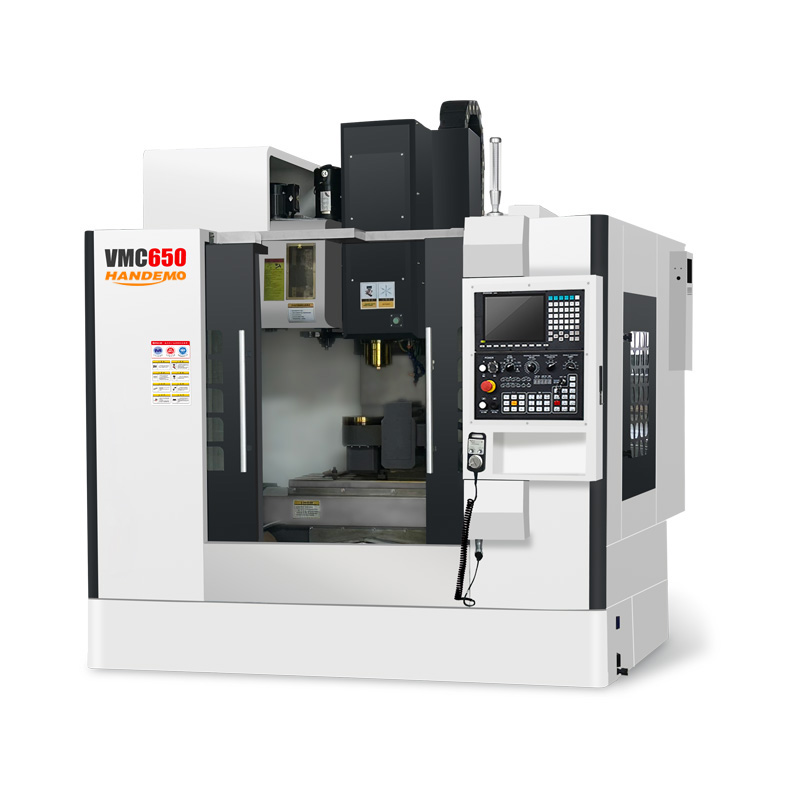
The VMC650 sits at the small end of our vertical machining centre range: a 1000 × 400 mm table, 650 mm of X travel, and a 3,800 kg casting. It is the machine we quote when a shop needs to run aluminium and mild steel parts at speed without tying up floor space on a 1,200 mm machine.
Two numbers define it: 32 m/min rapids on X and Y, and a 16-station disc-type tool changer that can be upgraded to 32 stations. Together they set the machine’s rhythm — short moves, frequent tool changes, small chips.
What the 650 mm X Travel Buys You
A 1000 × 400 mm table with 650 mm of X travel leaves 350 mm of table unused at either end of the stroke. In practice you can mount two fixtures side by side and machine one while loading the other, or clamp a long shaft and index it without re-fixturing. The 400 mm Y travel is the tighter constraint, so the honest use case is parts up to roughly 350 mm wide, or wider parts machined in two setups.
Table load is rated at 400 kg — not a heavy-duty figure. This is a linear-guide machine intended for aluminium, brass, plastics and light-to-medium steel work. If your parts arrive as 600 kg castings, the VMC855 is the better match.
Rapids and Acceleration
32 m/min on X and Y is roughly double the 15–18 m/min found on older box-way machines of this size. The gain shows up in peck drilling and in programmes with many short moves, where the machine spends more time accelerating than at full speed. Z is held to 24 m/min, which is normal — the head carries the spindle and the counterbalance, so Z is always the slowest axis.
One caveat: rapid speed is a positioning number, not a cutting number. Whether a 32 m/min machine finishes faster than an 18 m/min machine depends on how much of the cycle is air cutting — modest in a cutting-heavy mix, large in a drilling-heavy one.
Spindle and Tooling
The spindle is BT40 with a Φ120 nose, running to 8,000 rpm. The 120 mm nose diameter is the detail to notice. The larger 855, 1160 and 1265 models use a BT40Φ150 spindle — bigger bearing set, stiffer nose, less reach. The Φ120 nose on the VMC650 reaches further into a cavity before the spindle body fouls the workpiece, which helps on mould inserts and deep ribbed parts, but it limits the radial load the spindle will comfortably take. Heavy side milling in hardened steel is not its job.
17-station disc ATC covers most work, but count your tools before you commit. A programme needing a face mill, three end mills, two drills, a tap, a boring head and a chamfer tool is already at eight stations; add a second operation’s tooling and 16 gets tight. The optional 32-station magazine exists for exactly that reason, and it is worth specifying at order rather than retrofitting.
Linear Guides and Thermal Behaviour
All three axes run on linear guides. On a 3,800 kg frame this gives fast, low-friction positioning with little stick-slip at slow feeds — the reason light finishing passes hold a consistent finish. The trade-off is damping: linear guides transmit more vibration than box ways, so steel work on a 650-class machine wants a conservative depth of cut and a sharp tool rather than brute force.
Specifications: VMC650
| Parameter | VMC650 |
|---|---|
| Table size | 1000 × 400 mm |
| Max. worktable load | 400 kg |
| X-axis travel | 650 mm |
| Y-axis travel | 400 mm |
| Z-axis travel | 550 mm |
| X / Y rapid traverse | 32 / 32 m/min |
| Z rapid traverse | 24 m/min |
| Spindle taper | BT40Φ120 |
| Spindle speed | 8,000 rpm |
| Tool capacity | 16 stations (disc type); 32-station magazine optional |
| Machine size (L × W × H) | 2400 × 2100 × 2300 mm |
| Machine weight | 3,800 kg |
How It Compares Across the Range
The table below puts the VMC650 next to the models buyers most often weigh it against. All figures are from our own published specification sheets.
| Model | Table (mm) | Load (kg) | Travels X/Y/Z (mm) | Spindle | Weight (kg) |
|---|---|---|---|---|---|
| VMC650 | 1000 × 400 | 400 | 650 / 400 / 550 | BT40Φ120, 8,000 rpm | 3,800 |
| 855D | 1000 × 550 | 600 | 800 / 550 / 550* | BT40Φ150, 8,000 rpm | 5,300 |
| 1160 | 1200 × 600 | 800 | 1100 / 600 / 600 | BT40Φ150, 8,000 rpm | 6,500 |
| 1265D | 1200 × 600 | 800 | 1200 / 650 / 650 | BT40Φ150, 24 / 24 / 18 m/min | 6,800 |
| L1265 | 1200 × 600 | 800 | 1200 / 650 / 650 | BT40Φ150, 24 / 24 / 18 m/min | 6,800 |
*The 855D page lists Y travel as 55 mm while its own text gives 550 mm. Confirm in writing before ordering.
Reading the table left to right, the VMC650 is the only model under 5 tonnes and the only one with the smaller Φ120 spindle nose. Above it, the 1160 is the natural step up: same 8,000 rpm BT40 spindle, 200 mm more table width, 400 kg more load capacity, and 2,700 kg more iron to absorb the cut. If your parts are consistently over 300 mm wide, the 1160 usually pays back the difference through fewer setups.
Where This Machine Fits
Three applications come up repeatedly in enquiries for the 650 class:
- Automotive brackets and housings in aluminium, run in batches of 200 to 2,000 with a fixture per operation.
- Mould inserts and electrode blanks, where the slim Φ120 nose reaches into pockets a Φ150 spindle cannot enter.
- General job-shop work — plates, flanges, small weldments — where the 1000 × 400 mm table covers most jobs and the 32 m/min rapids keep setup-to-setup time short.
It is not the right machine for 500 kg castings or continuous heavy roughing in 4140.
Options Worth Specifying at Order
It is not the right machine for 500 kg castings or continuous heavy roughing in 4140.
What the Specification Sheet Does Not Cover
Our published VMC650 data does not state spindle motor power or torque, positioning and repeat accuracy, guide class, ballscrew grade, controller model, or the full standard-versus-optional list. For reference, the 855 page publishes positioning accuracy of 0.020 / 0.008 / 0.017 mm on X / Y / Z — but those are the 855’s figures, not the 650’s, and should not be read across.
If any of these numbers decide your purchase, ask for them in writing with the quote.
Questions Buyers Ask
Can the VMC650 cut steel, or is it an aluminium machine?
It cuts steel. The 8,000 rpm BT40 spindle and linear guides suit light-to-medium steel work — fixtures, plates, brackets, mild steel and 4140 pre-hard at conservative depths. It is not a heavy roughing machine; the 3,800 kg frame and Φ120 nose set the limit.
Why are Z rapids slower than X and Y?
Z carries the spindle head and its counterbalance, so there is more mass to accelerate and stop. Holding it at 24 m/min keeps servo load and stopping distance sensible. It rarely affects cycle time, because Z moves are short.
Is the 32-station magazine worth it?
If a single programme uses more than 12 tools, yes. Retrofitting later costs more than specifying it at order, and the disc magazine is a factory-fitted item.
What floor space does it need?
The machine envelope is 2400 × 2100 × 2300 mm. Add clearance for the control cabinet, the chip conveyor if fitted, and service access to the rear of the column — plan on roughly 4 × 3.5 m for a comfortable installation.
Next Step
Full specifications and the enquiry form are on the VMC650 product page. For a wider comparison, see the vertical machining centres series page, or send us a drawing and we will tell you which model fits — including if the answer is a bigger machine than this one. Reach the team through the contact page or WhatsApp +86 173 0632 8370.