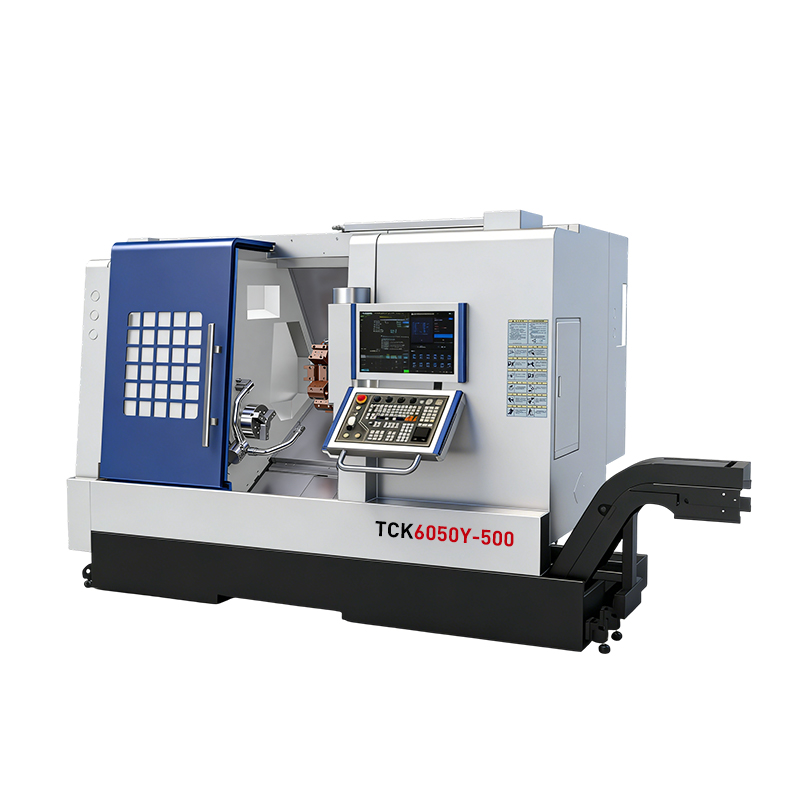
TCK6050Y CNC Mill-Turn Machine: 980 mm of Turning Length With a Y-Axis on Top
A lathe that only turns is just a lathe. The TCK6050Y CNC mill-turn machine adds ±50 mm of Y-axis travel to a 560 mm swing chassis, and that axis is the difference between drilling a hole on the centerline and milling a flat exactly where the drawing wants it. Turning length runs up to 980 mm, the spindle nose is A2-6 with a 65 mm bore, and rapids are 15/15 m/min on X and Z. The envelope is aimed at shaft, flange and sleeve work that needs a milled feature without a second setup on a machining center.
Here is the spec sheet, then what each number means on the shop floor.
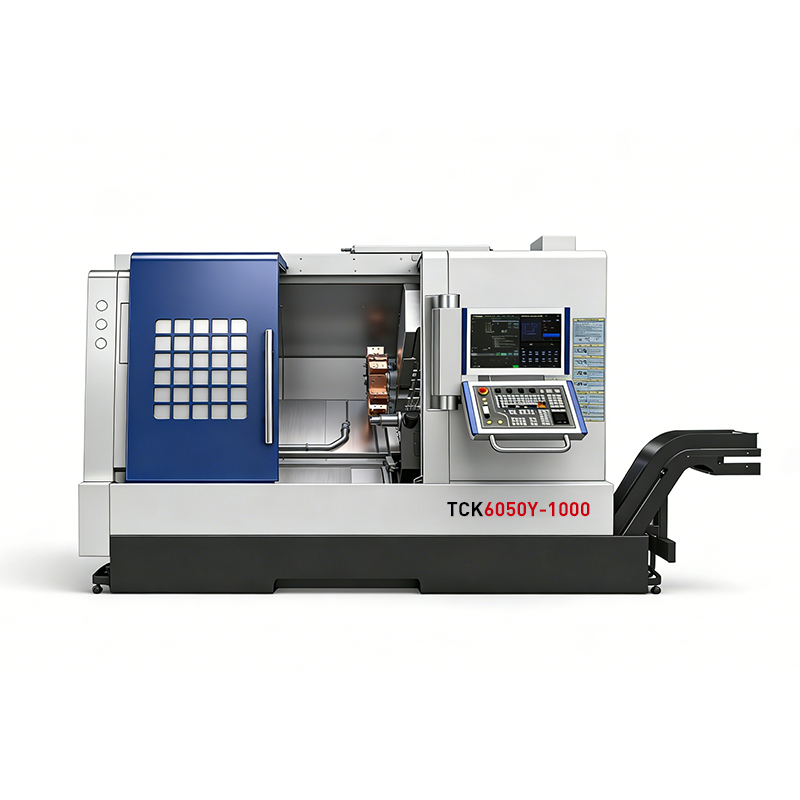
TCK6050Y Specifications at a Glance
BONANZA lists the TCK6050Y in two build lengths. The short build suits chucked work where floor space is tight; the long build is the one to look at when parts need tailstock support over a longer span.
| Parameter | TCK6050Y-500 | TCK6050Y long build |
|---|---|---|
| Max. swing over bed | 560 mm | 560 mm |
| Max. turning length | 500 mm | 980 mm |
| Max. turning diameter | 410 mm | 410 mm |
| Standard turning diameter | 300 mm | 300 mm |
| Max. swing over cross slide | 400 mm | 400 mm |
| Spindle nose type | A2-6 | A2-6 |
| Spindle bore diameter | 65 mm | 65 mm |
| Max. bar capacity | 50 mm | 50 mm |
| X-axis travel | 280 mm | 280 mm |
| Y-axis travel | ±50 mm | ±50 mm |
| Z-axis travel | 630 mm | 1130 mm |
| X / Z rapid traverse | 15 / 15 m/min | 15 / 15 m/min |
| Tailstock travel | 450 mm | 900 mm |
| Tailstock quill stroke | 100 mm | 100 mm |
The Y-Axis Is the Reason to Buy This Model
Most CNC turning centers move on two axes. X and Z put a tool where it is on the centerline or in front of the part, and that covers the great majority of turning work. Add a Y-axis and a driven tool can leave that centerline. With ±50 mm of travel, a live tool holds a flat surface, cuts a keyway, mills a slot in a shaft, or drills a bolt circle off the axis instead of on it.
That is the practical difference on real parts. A coupling flange with four milled pockets, a shaft end that needs a keyway and a cross-drilled hole, a sleeve with flats machined on opposite sides: on a two-axis lathe these get a second trip to a machining center, a second fixture, and the runout that comes with rechucking. On the TCK6050Y they run in one clamping. Tolerances stay tied to one setup, and the queue for the mill stays free for work that actually needs it.
If you already build parts like this, compare the TCK6050D, which shares the same 560 mm swing, 410 mm turning diameter and A2-6 spindle but turns without a Y-axis. The TCK6050Y is what you order when the drawings keep asking for features off the centerline.
980 mm of Turning Length With Tailstock Support Behind It
The long build carries a 1130 mm Z travel and 900 mm of tailstock travel with a 100 mm quill stroke. Those three numbers belong together. Z travel sets how far the turret can reach down the part; tailstock travel sets where the center can be positioned to suit different workpiece lengths; the quill stroke handles the last 100 mm of support and clamping room. For a long shaft, the tailstock is not a nicety. It is what keeps deflection out of the middle of the part and holds the diameter spread tight from end to end.
Swing and diameter figures are worth reading carefully. The machine swings 560 mm over the bed and 400 mm over the cross slide, while maximum turning diameter is 410 mm and the standard turning diameter is 300 mm. That pattern is normal for a slant-bed lathe: the part body sits in front of the slide, so the slide clearance, not the bed swing, is usually what limits the chucked workpiece. Plan on 300 mm as the comfortable working diameter for everyday parts and 410 mm as the ceiling.
A2-6 Spindle, 65 mm Bore, 50 mm Bar
The A2-6 spindle nose with a 65 mm bore is the mainstream front end for this size of lathe. It takes the common 8-inch-class chucks and their accessories, and a 50 mm bar capacity means bar work up to that size passes through the spindle rather than hanging out of the chuck, which shortens setups and cuts the risk of the bar whipping.
For context within the BONANZA mill-turn series, the TCK3100LY steps up to an A2-8 nose with an 85 mm bore and 75 mm bar capacity when parts get bigger, while the TCK6050SY uses a similar A2-6 front end but adds a second spindle for back-end work. The TCK6050Y sits in the middle: single spindle, Y-axis capability, and a long bed for shaft work.
Where the TCK6050Y Fits in the Line
The mill-turn range runs from compact composite lathes to heavy big-bore machines, and the models cover different part sizes rather than competing for the same job:
- 2100LY is the compact Y-axis composite machine with an interpolating Y-axis, aimed at small parts that need turning plus light milling.
- TCK6050Y is the single-spindle Y-axis lathe with ±50 mm travel and up to 980 mm of turning length, for shaft and flange work that needs off-center features.
- TCK3100LY moves up to 750 mm swing, 1000 mm turning length, ±100 mm of Y travel and a bigger A2-8 spindle bore.
- TCK6050SY is the twin-spindle answer when parts need machining on both ends in one cycle.
- HTMC800S and HTMC800T lean toward machining-center-style capability, with larger X travel for prismatic parts that need substantial milling.
- QK1322 is the large-bore end of the range, with a 240 mm spindle bore for heavy tubular work.
Pick by the part, not by the spec sheet. If the features you mill are small and off-center, the TCK6050Y is the honest fit. If you need a bigger bore or heavy milling, one of the others is the better answer.
Shop Floor Notes Before You Quote It
X and Z rapid traverse is 15/15 m/min. That is a working speed, not a headline. The machine is built for cutting metal steadily rather than flying between positions, and for most shaft and flange work the difference is negligible against the time saved by not moving parts to a second machine.
Think about bar feeding before you order. The 65 mm bore and 50 mm bar capacity are there on the drawing, but a bar feeder, or a steady rest, is what makes them usable on long stock. The same goes for the tailstock: on the long build, plan the support method for your shaft length at the quoting stage, not after the machine lands.
Chip handling deserves attention on any lathe running steel at production rates. A conveyor is worth adding if the machine will run hard rather than jobbing one-offs, and it is a simpler decision at order time than a retrofit later.
Decide the build length early. The 500 mm machine and the 980 mm machine have different footprints and different tailstock travel, and the floor space requirement follows the Z travel. Measuring the parts you actually run is the fastest way to settle that question.
Frequently Asked Questions
What does the Y-axis do on a TCK6050Y?
The Y-axis moves the tool ±50 mm off the spindle centerline. That lets a driven tool mill flats, cut keyways and slots, and drill holes off the axis, so features that would otherwise need a separate machining operation can be produced in the same clamping as the turning.
How large a part will the TCK6050Y take?
Maximum swing over the bed is 560 mm, maximum turning diameter is 410 mm and the standard turning diameter is 300 mm. Turning length is 500 mm on the TCK6050Y-500 build and 980 mm on the long build. Maximum bar capacity through the 65 mm spindle bore is 50 mm.
Is the TCK6050Y a lathe or a machining center?
It is a turning machine with Y-axis milling capability. The work rotates in the spindle, and a driven tool handles off-center features. For parts that need heavy milling and large X travel rather than turning, the HTMC models in the same mill-turn series are the closer fit.
Get a Straight Answer for Your Parts
Spec tables settle the easy questions. The real one is whether the TCK6050Y suits the parts you cut, and that depends on diameters, lengths and where the milled features sit. Send BONANZA your drawings or a list of typical jobs and get a direct recommendation on whether the TCK6050Y CNC mill-turn machine is the right machine, and which build length makes sense for your work. Browse the full CNC mill-turn collection or reach the team through the contact page.