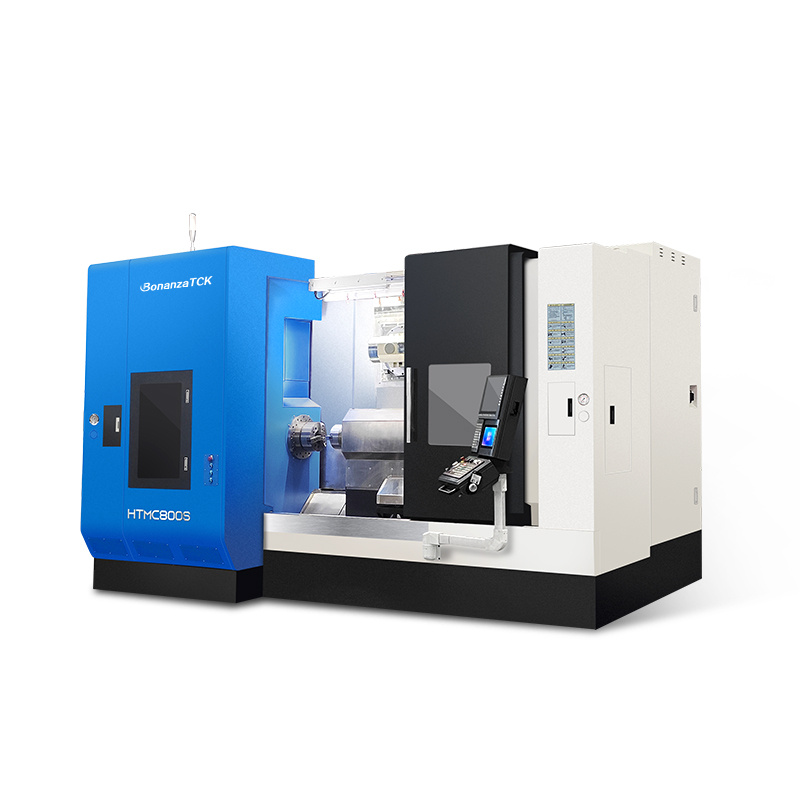
HTMC800S CNC Mill-Turn Machine – 87 mm Bore, ±125 mm Y Axis and 1,550 mm of Z Travel | BONANZA CNC
HTMC800S sits in the middle of the BONANZA mill-turn range, and it is the model most buyers land on when parts need both a large through-hole and real milling capability. It carries a 600 mm swing, a 580 mm maximum turning diameter and 1,200 mm of turning length, with an 87 mm spindle bore and 67 mm bar capacity. The Y axis travels ±125 mm — 250 mm of total cross movement, enough to mill flats, pockets and cross holes off the centreline without re-fixturing.
Below are the numbers that matter on the shop floor, and how the HTMC800S lines up against the other mill-turn models so you can see which one fits your part family.
What the swing and diameter numbers actually allow
Three different diameters are listed, and they are not interchangeable:
- 600 mm — maximum swing over the bed. This is the clearance between spindle centreline and the bed covers, so it sets the largest disc that can physically rotate without touching anything.
- 580 mm — maximum turning diameter. Slightly smaller than the swing, because the tool turret has to reach the workpiece. This is the practical ceiling for a part you intend to turn.
- 600 mm — maximum swing over the cross slide. With the cross slide in play, a short part can be larger in diameter than the turning diameter suggests, as long as it does not overhang into the turret path.
For valve bodies, flanges, hubs or large couplings in the 400–560 mm range, 580 mm of turning diameter leaves room for a roughing and a finishing pass. If parts regularly sit above that, the next step up is the QK1322 at 1,000 mm swing with a 240 mm bore.
Spindle: A2-6 or A2-8, 87 mm bore, 67 mm bar
The spindle nose is listed as A2-6/A2-8, meaning the machine is built to order with either interface. That choice decides which chuck and which bar feeder you can hang on the front:
- A2-6 accepts the common 8-inch and 10-inch chucks used across the smaller lathes in the range.
- A2-8 takes 10-inch and 12-inch chucks, and it is the interface you want if you plan to run heavy interrupted cuts on castings.
The 87 mm bore is the number that separates this model from the smaller mill-turns. TCK3100LY runs an 85 mm bore with 75 mm bar capacity and the TCK6050SY twin-spindle machine uses 67 mm on its main spindle. On HTMC800S, a 67 mm bar drops straight through, so 2.5-inch stock can be fed without a second op — which matters for fittings, shafts and hydraulic components made from bar rather than billet.
Spindle speed and motor output are not published on the product page. The 50–4,000 r/min range and 18.5 kW motor used on the TCK6050SY are family figures, not confirmed values here, so treat them as a reference point.
The Y axis is where the milling happens
±125 mm of Y travel gives 250 mm of cross movement on top of the 720 mm X and 1,550 mm Z strokes. The live tool can therefore work above or below the spindle centreline, so one setup can produce:
- Flats and keyways on a turned shaft, without moving the part to a machining centre.
- Cross holes and radial ports drilled at a known offset from centre.
- Pockets and slots that run parallel to the axis but off-centre.
- Multi-face features on a part held once, which is usually the biggest accuracy gain — every feature comes off the same datum.
All three axes rapid at 12 m/min. On a machine weighing around 17,000 kg that is a sensible trade — the acceleration budget goes into the cut rather than into positioning speed. If cycle time on small parts is dominated by positioning, a lighter lathe will feel quicker; if it is dominated by setup changes and second operations, this machine usually wins on total time per part.
Specifications
| Parameter | HTMC800S |
|---|---|
| Max. swing over bed | 600 mm |
| Max. turning length | 1,200 mm |
| Max. turning diameter | 580 mm |
| Max. swing over cross slide | 600 mm |
| Spindle nose type | A2-6 / A2-8 |
| Spindle bore diameter | 87 mm |
| Max. bar capacity | 67 mm |
| X-axis travel | 720 mm |
| Z-axis travel | 1,550 mm |
| Y-axis travel | ±125 mm |
| X / Y / Z rapid traverse | 12 / 12 / 12 m/min |
| Approx. gross weight | 17,000 kg |
One detail worth flagging: the specification table on the product page carries the header “TCK70Y-2000”, which looks like a leftover from another model’s page template. The values in the table match the bullet summary at the top of the page, so the numbers are consistent — but ask for a written specification sheet before you commit to a purchase order.
How it compares with the rest of the mill-turn range
| Model | Swing | Turning length | Turning dia. | Spindle / bore | Y axis | Weight |
|---|---|---|---|---|---|---|
| HTMC800S | 600 mm | 1,200 mm | 580 mm | A2-6/A2-8, 87 mm | ±125 mm | 17,000 kg |
| HTMC500T | 700 mm | 1,250 mm | 500 mm | A2-8, 86 mm | ±125 mm | 14,000 kg |
| HTMC800T | 700 mm | 1,500 mm | 600 mm | A2-6/A2-8 | ±125 mm | — |
| QK1322 | 1,000 mm | 1,350 mm | 800 mm | A2-15, 240 mm | none | 12,000 kg |
The comparison makes the positioning clear. HTMC500T offers more swing (700 mm) but less turning diameter (500 mm) and a shorter Z stroke. HTMC800T adds 300 mm of turning length and reaches 600 mm, but its swing and turning diameter drop to 330 mm with the lower turret, and the page publishes neither bore nor weight. QK1322 is the heavy-bore option at 240 mm, with no Y axis at all.
HTMC800S is the balanced choice: 87 mm bore, 580 mm diameter, 1,200 mm length, full ±125 mm Y axis, and a published 17,000 kg weight so you can plan the foundation.
Foundation, rigging and what is not on the page
At 17,000 kg the machine needs an assessed floor slab and lifting gear rated for the lift with margin. Dimensions are not published for this model, so get the footprint and height for your ceiling clearance before the truck arrives — the HTMC500T measures 6,900 × 3,800 × 2,900 mm, which gives an order of magnitude but is not a planning figure for this machine.
Also missing from the published specification, and worth confirming in writing before ordering: turret type, station count and live-tool drive power; spindle motor output with continuous versus intermittent torque; tailstock travel, quill stroke and taper; maximum tool diameter and length; positioning and repeatability accuracy with the standard they are measured against; controller model and the standard versus optional list; chip conveyor, coolant-through-spindle and bar feeder interface.
Two questions buyers usually ask
Is 1,200 mm of turning length the same as 1,550 mm of Z travel?
No. Turning length is the workpiece length the machine can cut. Z travel is how far the turret carriage moves, and it has to cover the workpiece plus chuck clearance, tool approach and the retract distance at the end of the stroke. The 350 mm gap between the two figures is normal, not spare capacity for longer parts.
Which chuck goes with the A2-8 spindle?
A 12-inch three-jaw is the usual pairing at this size, with 10-inch if you mostly run smaller diameters and want more grip force per jaw. Order the chuck and the spindle nose together — the interface is fixed at build time.
Next step
If parts fall in the 300–560 mm diameter range, need milled features in the same setup, and come from 67 mm bar or near-net forgings, HTMC800S is worth a specification review. Send the drawings and the material, and we will come back with turret configuration, chuck size and options that fit — plus a written specification sheet for the exact build.
See the full CNC mill-turn machine range or contact the factory directly.