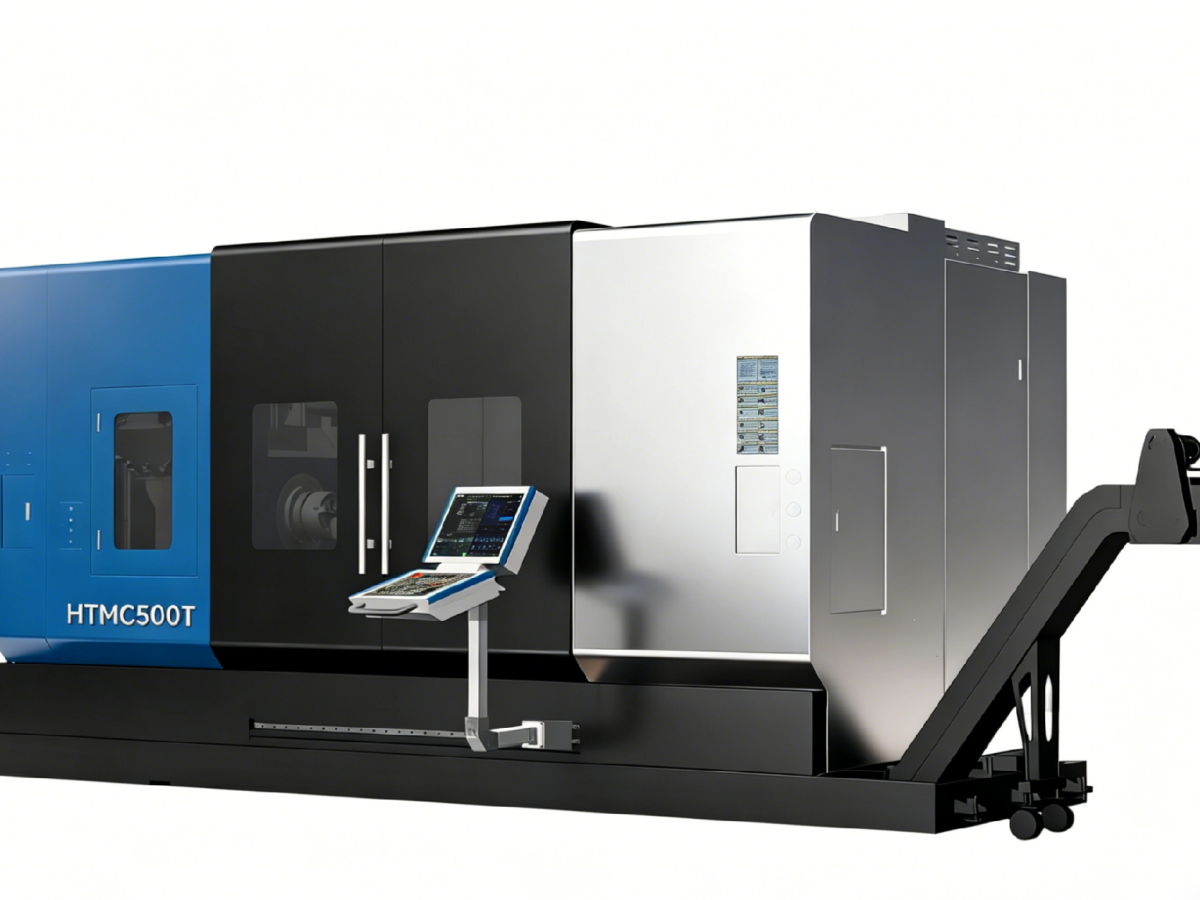
HTMC500T, HTMC800S and HTMC800T: Three Mill-Turn Machines With the Same ±125 mm Y Axis
All three HTMC mill-turn machines publish the same Y-axis travel, ±125 mm, and the same 12 m/min rapid on every axis. On paper the milling capability looks identical. It is not. The Y stroke is the same number, but the mass carrying it, the distance the turret has to reach and the way the part is gripped all differ, and those differences decide which of the three a shop can actually use.
Everything below is taken from the specification tables on the three product pages, including the places where those tables contradict themselves or leave a gap.
What the three machines share
All three are slant-bed mill-turn centres with an interpolated Y axis and a live tool turret, and all three list ±125 mm of Y travel with X, Y and Z rapids of 12 m/min. That puts them in a specific class of work: parts needing milled flats, cross holes, keyways or helical features in the same clamping as the turning, at a size where a 500 to 600 mm part is normal rather than exceptional.
A ±125 mm stroke lets the turret reach 125 mm either side of centreline, covering off-centre drilling on a part up to 250 mm across without a second operation. All three clear that bar. What differs is whether the machine can swing the part that needs those holes.
Swing and turning length split the range
The published envelope figures are where the three separate:
- HTMC500T: 700 mm swing over bed, 500 mm maximum turning diameter, 1,250 mm turning length
- HTMC800S: 600 mm swing over bed, 580 mm maximum turning diameter, 1,200 mm turning length
- HTMC800T: 700 mm swing over bed, 600 mm maximum turning diameter, 1,500 mm turning length, with 330 mm figures quoted for work at the lower turret
The HTMC500T and HTMC800S sit close together, and the smaller-sounding 500T is the one with more bed swing: it gives up 80 mm of turning diameter to the 800S and gains 100 mm of swing. For a shop chucking a large thin-walled ring that never needs a 580 mm depth of cut, the 700 mm swing machine is the easier fit. For a part that has to be turned to 580 mm, only the 800S will do it.
Swing over bed and maximum turning diameter are not the same measurement, and the gap between them shows how much clearance the turret and chuck leave around a part at full diameter. The 800T is the clearest case: 700 mm of bed swing but 600 mm of turning diameter.
The HTMC800T is a different machine underneath
The 800T is the only one of the three that publishes a lower turret, and that changes how the envelope must be read. Its table gives two values against the swing and diameter rows: 700 mm at the upper station and 330 mm for the lower turret. Two tools cutting at once on the same part means the lower turret sits in space the upper turret would otherwise use, so the workable diameter at that station is smaller. A programmer who reads only the 700 mm figure will write a toolpath the lower turret cannot follow.
The 800T also publishes tooling limits the other pages omit: a maximum tool diameter of 75 mm and a maximum tool length of 300 mm. Those are boring-bar and face-mill constraints, and they decide whether the machine can reach the bottom of a deep bore or clear a large face in one pass. It also carries the longest travel of the three, at 820 mm in X and 1,800 mm in Z.
Spindle bore and the bar question
Bar work is decided before any of the above matters. The HTMC500T takes a 75 mm bar through an 86 mm bore on an A2-8 nose. The HTMC800S is listed with an 87 mm bore and 67 mm bar capacity on an A2-6 or A2-8 nose. The HTMC800T lists the same nose options but publishes no bore or bar figure.
Two things there need a written answer before an order. An 87 mm bore is A2-8 territory, so an A2-6 option with the same bore should be confirmed rather than assumed, since the two noses carry different chuck and cylinder mounting. And the HTMC500T offers 75 mm of bar against 67 mm on the 800S even though the 800S has the nominally larger bore. A shop running 70 mm bar will find the bigger-looking machine cannot be fed from a magazine.
Weight, floor space and the foundation
The HTMC500T is quoted at 14,000 kg in a 6,900 × 3,800 × 2,900 mm envelope. The HTMC800S is quoted at 17,000 kg. The HTMC800T publishes neither.
That 3,000 kg step between the 500T and the 800S is not cosmetic. A 17-tonne machine on a 12 m/min rapid and an interrupted cut needs a slab designed for it, and the difference between 14 and 17 tonnes can be the difference between an existing floor and a new one. For the 800T the weight has to come from the quotation: it is the first input to a foundation design and to crane capacity.
Published specification, side by side
| Parameter | HTMC500T | HTMC800S | HTMC800T |
|---|---|---|---|
| Max. swing over bed | 700 mm | 600 mm | 700 mm (330 mm at lower turret) |
| Max. turning diameter | 500 mm | 580 mm | 600 mm (330 mm at lower turret) |
| Max. swing over cross slide | 700 mm | 600 mm | 700 mm (330 mm at lower turret) |
| Max. turning length | 1,250 mm | 1,200 mm | 1,500 mm |
| Spindle nose | A2-8 | A2-6 / A2-8 | A2-6 / A2-8 |
| Spindle bore | 86 mm | 87 mm | Not published |
| Max. bar capacity | 75 mm | 67 mm | Not published |
| X-axis travel | 700 mm | 720 mm | 820 mm |
| Z-axis travel | 1,400 mm | 1,550 mm | 1,800 mm |
| Y-axis travel | ±125 mm | ±125 mm | ±125 mm |
| Rapid traverse X / Y / Z | 12 / 12 / 12 m/min | 12 / 12 / 12 m/min | 12 / 12 / 12 m/min |
| Max. tool diameter | Not published | Not published | 75 mm |
| Max. tool length | Not published | Not published | 300 mm |
| Machine dimensions | 6,900 × 3,800 × 2,900 mm | Not published | Not published |
| Approx. gross weight | 14,000 kg | 17,000 kg | Not published |
Where the published pages need confirmation
None of the three pages publishes spindle motor power, spindle torque or a torque curve. Those decide whether a 75 mm bar in steel is taken in one pass or three, and they are not interchangeable across a range where the largest machine weighs 3,000 kg more than the smallest.
Another gap: the HTMC800S page carries a header reading TCK70Y-2000 above its table, which looks like a template left from another product. The values match the rest of the HTMC data, but the model name belongs on the quotation, not in a page header.
Also unpublished across the range: chuck size and type, turret station count and live-tool speed and power, tailstock type and thrust, control model, positioning and repeatability with the test standard, guideway type, and the standard versus optional split. For the 800T, the lower turret’s station count and live-tool rating are missing, and those decide what simultaneous cutting looks like in production.
Choosing between them
The decision comes down to two questions asked in order. First, what diameter must be turned, because that removes the machine that cannot do it: a 580 mm part eliminates the HTMC500T, and a 600 mm part eliminates both smaller machines. Second, does the job need two tools in the cut at once, which is what the 800T’s lower turret is for and what its 330 mm station envelope describes.
If neither applies, the HTMC500T’s 75 mm bar capacity and 700 mm bed swing make it the more capable machine for mixed bar and chuck work, despite being the smallest in the table.
Full specifications are on the mill-turn machine series page, alongside the pages for the HTMC500T, the HTMC800S and the HTMC800T. Shops working at larger diameters should look at the QK1322, which takes a 240 mm spindle bore and a 220 mm bar, or the TCK3100LY for a smaller Y-axis machine with 1,000 mm of turning length. Send the drawing and bar size through the contact page and the gaps above can be answered against a specific job.
