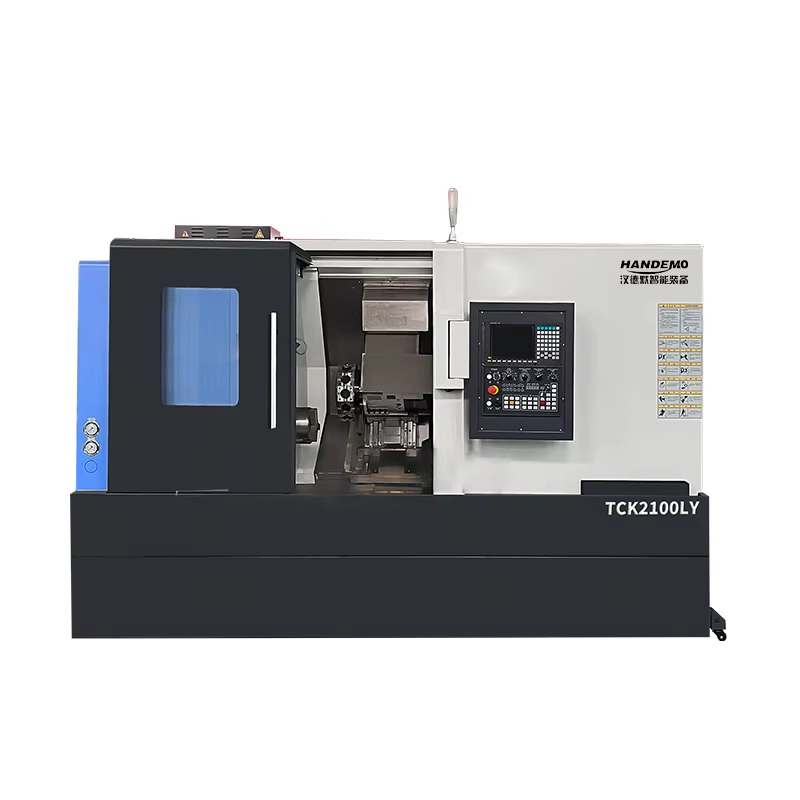
A shop with a 350 mm aluminium valve body and a shop with a 500 mm cast iron housing are both told they need a mill-turn centre. They are not buying the same machine. BONANZA builds three Y-axis mill-turn models within reach of each other on price and footprint, and the spread between them is wider than the model numbers suggest: 4,000 kg against 10,000 kg, a 65 mm bore against 85 mm, ±50 mm of Y travel against ±100 mm, and on one of the three a second spindle that changes how the whole job is planned.
The three are the 2100LY, the TCK3100LY and the 3100SY. Everything below comes from the published specification tables on those pages.
The numbers side by side
| Specification | 2100LY | TCK3100LY | 3100SY |
|---|---|---|---|
| Max. swing over bed | 650 mm | 750 mm | 750 mm |
| Max. cutting diameter | 350 mm | 500 mm | 500 mm |
| Standard turning diameter | not published | 380 mm | not published |
| Max. cutting length | 500 mm | 1,000 mm | 1,000 mm |
| Max. swing over cross slide | not published | 400 mm | not published |
| Spindle nose | A2-6 | A2-8 | A2-8 (table also lists 6) |
| Spindle bore | 65 mm | 85 mm | 85 mm |
| Max. bar capacity | not published | 75 mm | not published |
| Spindle speed | 4500/5000 r/min | not published | 3,000 r/min (sub-spindle 4,000) |
| Spindle motor | 30/11 kW | not published | 37 kW (sub-spindle 30 kW) |
| X travel | 280 mm | 400 mm | 400 mm |
| Y travel | ±50 mm | ±100 mm | ±100 mm |
| Z travel | 550 mm | 1,050 mm | 1,350 mm |
| Rapid traverse X/Y/Z | not published | 12/12/16 m/min | 12/12/16 m/min |
| Tool turret | 12-station power turret | not published | 12-station power turret |
| Machine dimensions | 3,293 × 1,951 × 2,329 mm | not published | 4,450 × 2,320 × 2,713 mm |
| Machine weight | 4,000 kg | 8,000 kg | 10,000 kg |
2100LY: the 350 mm machine that cuts 7 to 10 mm deep
The 2100LY is the smallest of the three and the only one whose turret is mounted directly on the pallet rather than on a separate carriage. That detail is why the machine can take a 7 to 10 mm depth of cut on one side. Mounting the turret on the pallet drops the cutting centre of gravity, so less of the cutting force turns into a bending moment on the slide. Shops that came from a 45° slant bed lathe and fought chatter on interrupted cuts notice this on the first test part.
What you give up is size. A 350 mm cutting diameter and 500 mm of cutting length put the 2100LY in the small-parts category: valve bodies, hydraulic manifolds, small flanges, instrument housings. X travel of 280 mm with ±50 mm of Y is enough for cross-drilling and milling flats on a 350 mm part and not much more. At 4,000 kg it sits on a normal industrial floor without a special foundation.
One figure needs care. The 2100LY spindle is listed at 4500/5000 r/min with a 30/11 kW motor, which reads as two configurations rather than one continuous rating. Ask which setup the quote covers before comparing it with another brand.
TCK3100LY: A2-8 spindle, 1,000 mm of length, no counter-spindle
Step up to the TCK3100LY and part capacity roughly doubles in every direction that matters: 500 mm cutting diameter instead of 350, 1,000 mm cutting length instead of 500, Z travel of 1,050 mm instead of 550. The spindle nose goes from A2-6 to A2-8, the bore from 65 to 85 mm, and 75 mm bar capacity makes bar-fed work realistic. Machine weight doubles to 8,000 kg, which is the honest price of that rigidity.
This is the model for shafts and housings that are long as well as wide — a 1,000 mm pump shaft with milled keyways, a 500 mm gearbox casting needing face milling and boring on four sides in one clamping. Y travel of ±100 mm gives usable interpolation room, and 12/12/16 m/min rapids keep non-cutting time down on a part that needs many tool changes.
The TCK3100LY has no second spindle. If your process needs the back of the part finished without a second op, this is not the machine, and the 3100SY is the answer instead.
3100SY: what a second spindle actually buys
The 3100SY shares the TCK3100LY’s 750 mm swing, 500 mm cutting diameter, 1,000 mm cutting length, A2-8 spindle, 85 mm bore, 400 mm X travel, ±100 mm Y travel and 12/12/16 m/min rapids. Then it adds a counter-spindle rated at 4,000 r/min and 30 kW against the main spindle’s 3,000 r/min and 37 kW, extends Z travel to 1,350 mm, and puts 2,000 kg more iron under the cut.
The extra Z is the part people miss. A counter-spindle needs room to receive the part, so the slide has to travel further than the part length. The 350 mm of extra Z against a 1,000 mm cutting length is that allowance, not a bonus.
Where the second spindle pays for itself is cycle time and tolerance stack. Turning one face, milling the cross holes, then parting off and finishing the back face in the same clamping removes a second operation, a second fixture and the re-datum that comes with it. On a part with a coaxial bore tolerance held across both ends, that removed re-chuck is often worth more than the cycle time saved. The published description also lists planing, grinding, drilling and gear hobbing as operations the machine completes in one clamping — worth confirming which are standard tooling and which are optional before you plan a process around them.
Two documentation points. The specification table labels the model TCK3100SY while the page and heading say 3100SY, and the spindle nose is written as A2-8 (6). Both need written confirmation from the factory so the quote, the drawing and the machine plate agree.
Reading the travels honestly
Y travel is the number buyers focus on and the least useful one in isolation. What limits a mill-turn machine is the reachable envelope at the diameter you actually cut. A ±50 mm Y on a 350 mm part leaves proportionally more room for a cross-feature than ±100 mm on a 500 mm part, because the feature sits closer to the axis. Draw your part at maximum diameter and check whether the turret can reach the far side of the feature without the tool holder fouling the chuck or the sub-spindle.
Rapids deserve the same scepticism. 12/12/16 m/min looks slow next to a dedicated lathe, but a mill-turn cycle spends most of its time in cut and in tool change, not in positioning.
What the pages do not publish
BONANZA has not published positioning or repeatability accuracy for any of the three models, nor the control model, nor a torque curve for any spindle. On the 2100LY and 3100SY the turret is confirmed as a 12-station power turret, but the maximum driven-tool speed, the number of driven stations, and the maximum tool diameter and length are not listed. On the TCK3100LY the turret specification is absent entirely.
All of that belongs in the quote, confirmed in writing rather than assumed from a catalogue photo. If a tolerance is on your drawing, ask for the accuracy statement and the inspection standard that goes with it, and ask whether a test cut on your part is included.
Choosing between them
If the largest part you will ever run is around 350 mm across and 500 mm long, and you want heavy single-side cuts on a machine that needs no special foundation, the 2100LY covers it at 4,000 kg. If parts reach 500 mm by 1,000 mm and the back face can wait for a second operation, the TCK3100LY gives you the A2-8 spindle, 85 mm bore and 75 mm bar capacity for half the weight of the 3100SY. If the back face has to come off in the same clamping — or the tolerance runs across both ends — the 3100SY’s counter-spindle and 1,350 mm of Z are why you pay for the extra 2,000 kg.
For the wider range, including the twin-spindle TCK6050SY, the long-bed 70Y and the large-bore QK1322, see the full CNC mill-turn machine series. If your part needs five simultaneous axes rather than three plus Y, start with the 5-axis range.
Send a drawing with the blank size, the material and the tolerance that matters most, and BONANZA will tell you which machine reaches every feature and which one only looks like it does. Request a quote or message us on WhatsApp at +86 173 0632 8370.