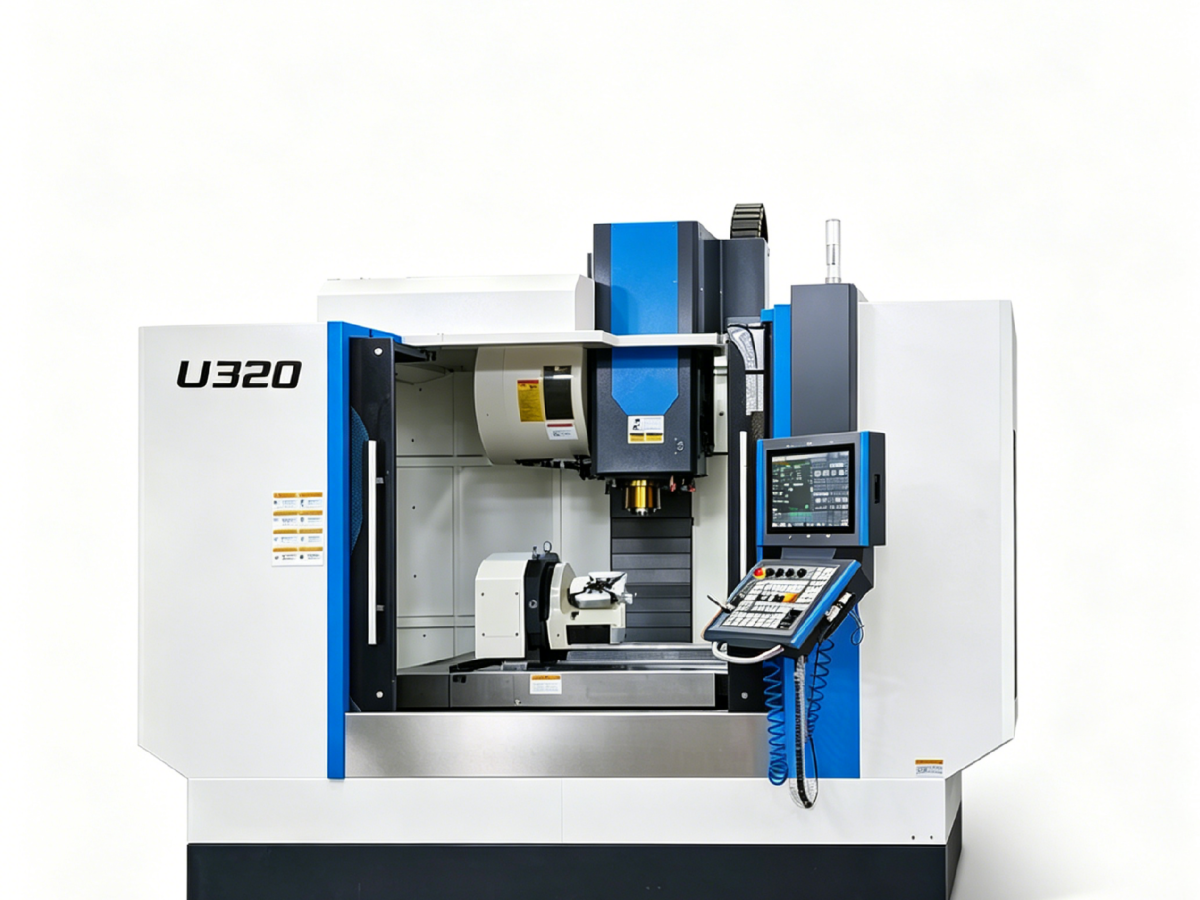
U320 5-Axis Turning and Milling Machine: A 320 mm Direct-Drive Table with 1,100 mm of X Travel
The U320 5-Axis Turning and Milling Machine sits in the middle of BONANZA’s U-series. The rotary table carries a Ø320 mm mounting flange rated to 150 kg, X travel is 1,100 mm, and the direct-drive spindle runs to 12,000 rpm. The published machining range is 480 × 325 mm.
Two figures on that sheet decide most of the buying decision: how much X travel the machine gives, and how much table the buyer actually needs.
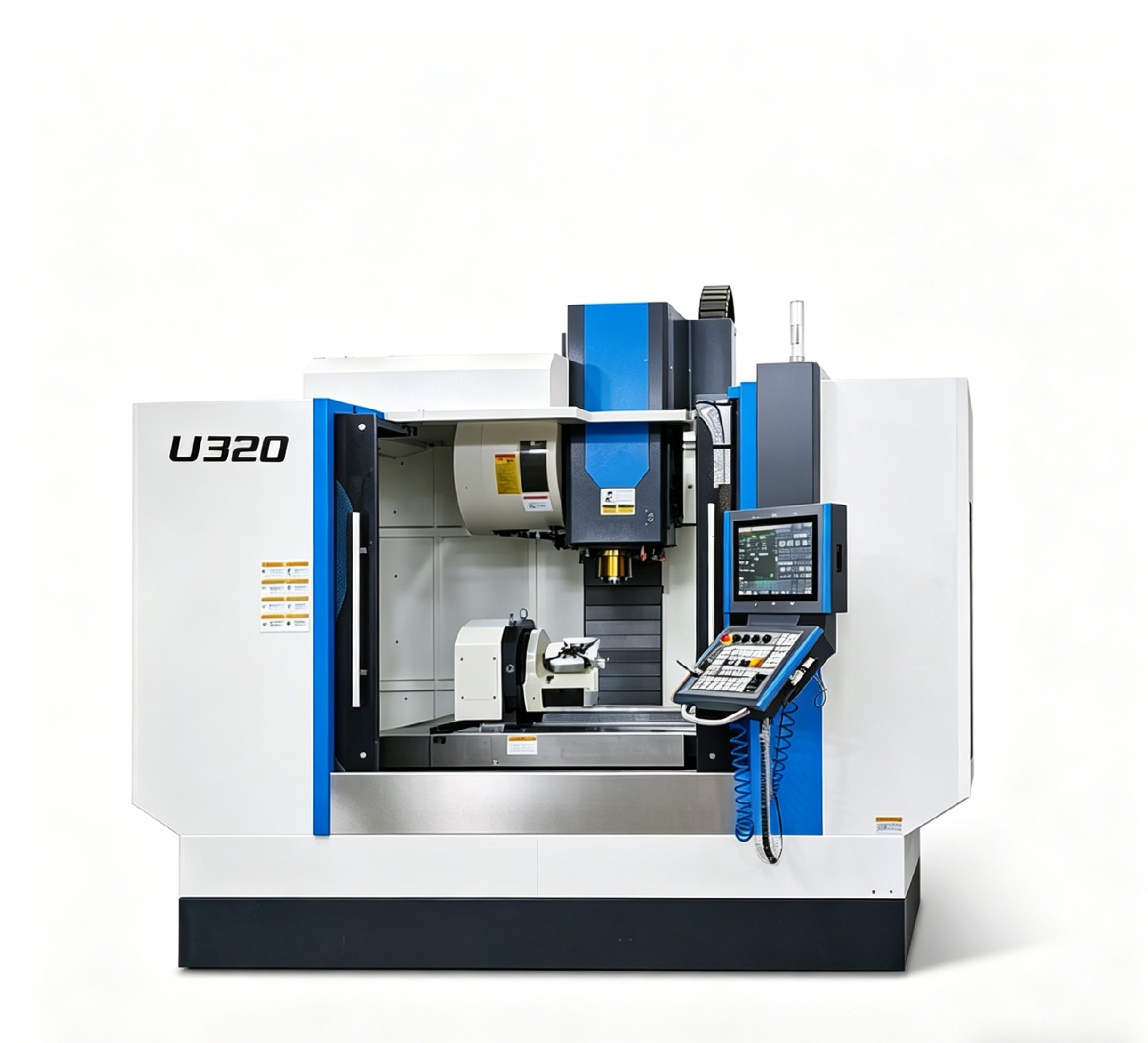
U320 at a glance
| Parameter | U320 |
|---|---|
| X-axis travel | 1,100 mm |
| Y-axis travel | 650 mm |
| Z-axis travel | 650 mm |
| Machining range | 480 × 325 mm |
| Rotary table | Dual direct drive |
| Table mounting flange diameter | Ø320 mm |
| Table center hole | Ø40 mm |
| Max. table load | 150 kg |
| Spindle type | Direct-drive mechanical spindle |
| Max. spindle speed | 12,000 rpm |
1,100 mm of X travel is the number that stands out
The entry machine, the U260, gives 850 mm. The U400 gives 1,300 mm. The U320 sits between them at 1,100 mm, but the table does not grow in proportion: its flange is Ø320 mm against the U260’s Ø260 mm, a 60 mm increase, while X grows by 250 mm.
That ratio is the point. The table sets what the part weighs and how large a diameter fits under the spindle. X travel sets how far the head reaches along a long workpiece and how much room is left for fixtures at the ends. Shops cutting long extrusions, rails or plate work will use the extra stroke more than a bigger table, and the U320 gives it without charging for a heavier rotary axis.
Rapids are not published for this model, so positioning speed is a question for BONANZA.
The Ø320 mm dual direct-drive table
A 150 kg rating on a Ø320 mm table covers the usual part mix at this size: small housings, brackets, valve bodies, impellers, tooling and medical components. It is not a table for a 300 kg casting, however the travels read.
BONANZA lists this table as dual direct drive, so the A and C axes run straight from their motors with no worm gear or harmonic drive between them. There is no gear mesh to wear, so the datum does not walk away over a long shift and a reversal does not leave a witness mark on a curved surface. The trade-off is heat, since direct-drive torque motors need cooling, and that is a maintenance item rather than a fault.
One published detail is worth flagging if you fixture through the table. The U320 center hole is Ø40 mm. The smaller U260 lists Ø50 mm, and the larger U400 lists Ø80H7 with a Ø60 mm through hole. If coolant, air or fixture hydraulics run through the middle of the table, the U320 gives less clearance than the model below it.
A direct-drive spindle at 12,000 rpm, and two figures the sheet does not give
The spindle is a direct-drive mechanical unit rated to 12,000 rpm. The motor rotor sits on the spindle shaft, so there is no belt to stretch and no retensioning schedule, and speed recovery after a tool change is quick.
What the sheet does not publish for the U320 is spindle power and tool holder type. The U260 lists 11 kW and BBT40, and the U400 lists 11 kW. Ask BONANZA to confirm both for this model rather than assume it matches its siblings, because spindle power is what decides the depth of cut your tooling can take. At 12,000 rpm this class of machine is a small-tool spindle either way: aluminium and non-ferrous work at proper surface speeds, light finishing passes in steel, small-diameter cutters in harder materials. It is not a roughing spindle, and no travel figure changes that.
Travel is not the same as working envelope
X, Y and Z travel is 1,100, 650 and 650 mm, the strokes available to the spindle. Published machining range is 480 × 325 mm, the space a part has to live inside once the table and head geometry are accounted for. Plan the part against 480 × 325 mm and treat the travel as headroom for fixtures and offset parts.
The sheet does not say which axes the 480 × 325 mm covers, or whether one figure is a diameter in the C axis rather than a linear dimension. A 325 mm linear limit and a 325 mm swing describe very different parts, so settle this with the factory.
Where the U320 sits in the five-axis range
Published figures for the closest alternatives in BONANZA’s 5-axis turning and milling series:
| Model | Table | Max. table load | X / Y / Z travel | Spindle |
|---|---|---|---|---|
| U260 | Ø260 mm flange, Ø50 mm center hole, dual direct drive | 80 kg | 850 / 600 / 600 mm | BBT40, 12,000 rpm, 11 kW |
| U320 | Ø320 mm flange, Ø40 mm center hole, dual direct drive | 150 kg | 1,100 / 650 / 650 mm | 12,000 rpm (power not published) |
| U400 | Ø400 mm flange, Ø80H7 mm center hole, dual direct drive | 200 kg | 1,300 / 700 / 750 mm | BBT40, 12,000 rpm, 11 kW |
| LH400 | Ø400 mm table, no center hole published | 200 kg | 600 / 1,000 / 600 mm | BT40D, 12,000 rpm |
| TMC630 | Ø650 mm trunnion, A-axis tilts ±110° | 500 kg | 700 / 350+590 / 550 mm | HSKT63, 15,000 rpm |
The U-series all use direct-drive tables and differ mainly in table size and travel, making the U320 the middle option: more reach and more capacity than the U260, well short of the U400. The TMC630 is a different machine altogether, a tilting trunnion rated to 500 kg with an HSK-T63 spindle at 15,000 rpm.
Who the U320 suits
- Parts up to 150 kg that need simultaneous five-axis motion rather than angled drilling on a three-axis machine.
- Long work where the head has to reach 1,100 mm along the part without running out of axis.
- Aluminium, brass, copper and light steel components where 12,000 rpm is enough surface speed.
- Shops that want direct-drive table accuracy without a trunnion machine they will never load to capacity.
If the parts are simple prismatic work, a vertical machining center will do it for less. The U320 earns its price when a part has to come off the table finished.
What to confirm before you order
- Spindle power and tool holder type, both published for the U260 and U400 but not for the U320.
- Spindle speed range and maximum torque, plus bar capacity if bar work is in the mix.
- Rapid traverse rates on X, Y and Z, which are not published.
- Positioning and repeat positioning accuracy, and the acceptance standard behind them.
- Machine dimensions and gross weight.
- Controller, tool magazine capacity and options such as through-tool coolant.
Frequently asked questions
How big a part will the U320 take?
The published machining range is 480 × 325 mm with a 150 kg table load limit and a Ø320 mm mounting flange. The travels are larger, at 1,100 / 650 / 650 mm, but they are spindle strokes rather than part envelope, so plan the part against the 480 × 325 mm figure.
Does the U320 use a worm gear in its rotary table?
No. The table is published as dual direct drive, so both rotary axes are driven directly by their motors with no gear train. That removes the backlash and wear a worm drive would introduce.
What spindle power does the U320 have?
BONANZA does not publish a power figure for the U320, although the U260 and U400 in the same series both list 11 kW. Ask for the spindle power and the tool holder type in writing with the quotation.
Bottom line
The U320 is a five-axis machine for parts up to 150 kg on a Ø320 mm direct-drive table, with 1,100 mm of X travel and a 12,000 rpm direct-drive spindle. Its appeal is the balance between X reach and table size: the stroke of a bigger machine without the mass of a bigger rotary axis. Get the spindle power, tool holder type and rapid rates in writing before you commit.
Send the BONANZA team your part drawings, the material, and the fixture you plan to run. They can confirm those open figures and tell you whether the U320, the smaller U260, or the larger U400 fits the work.