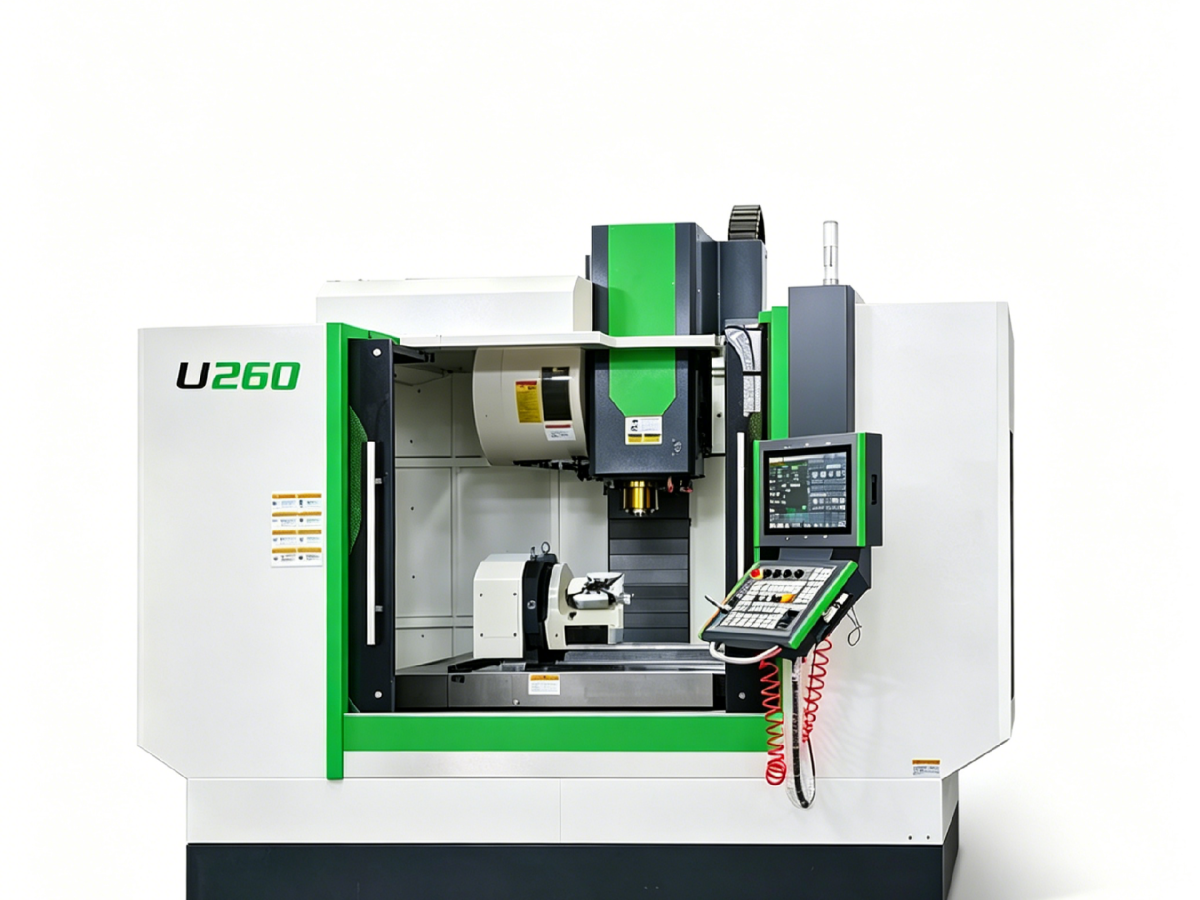
U260 5-Axis Turning and Milling Machine: A Ø260 mm Dual Direct-Drive Table with 850 mm of X Travel
The U260 5-Axis Turning and Milling Machine is the smallest table in the BONANZA five-axis lineup. It pairs a Ø260 mm dual direct-drive rotary table with a direct-drive mechanical spindle rated to 12,000 rpm and 11 kW, on a frame with 850 mm of X travel and a stated machining range of 380 × 300 mm.
The published sheet for this model is short, and three of its numbers matter more than the rest: the table flange diameter, the 80 kg load rating, and the Ø50 mm hole through the middle of the table. Here is what those decide when a real part goes on the machine.
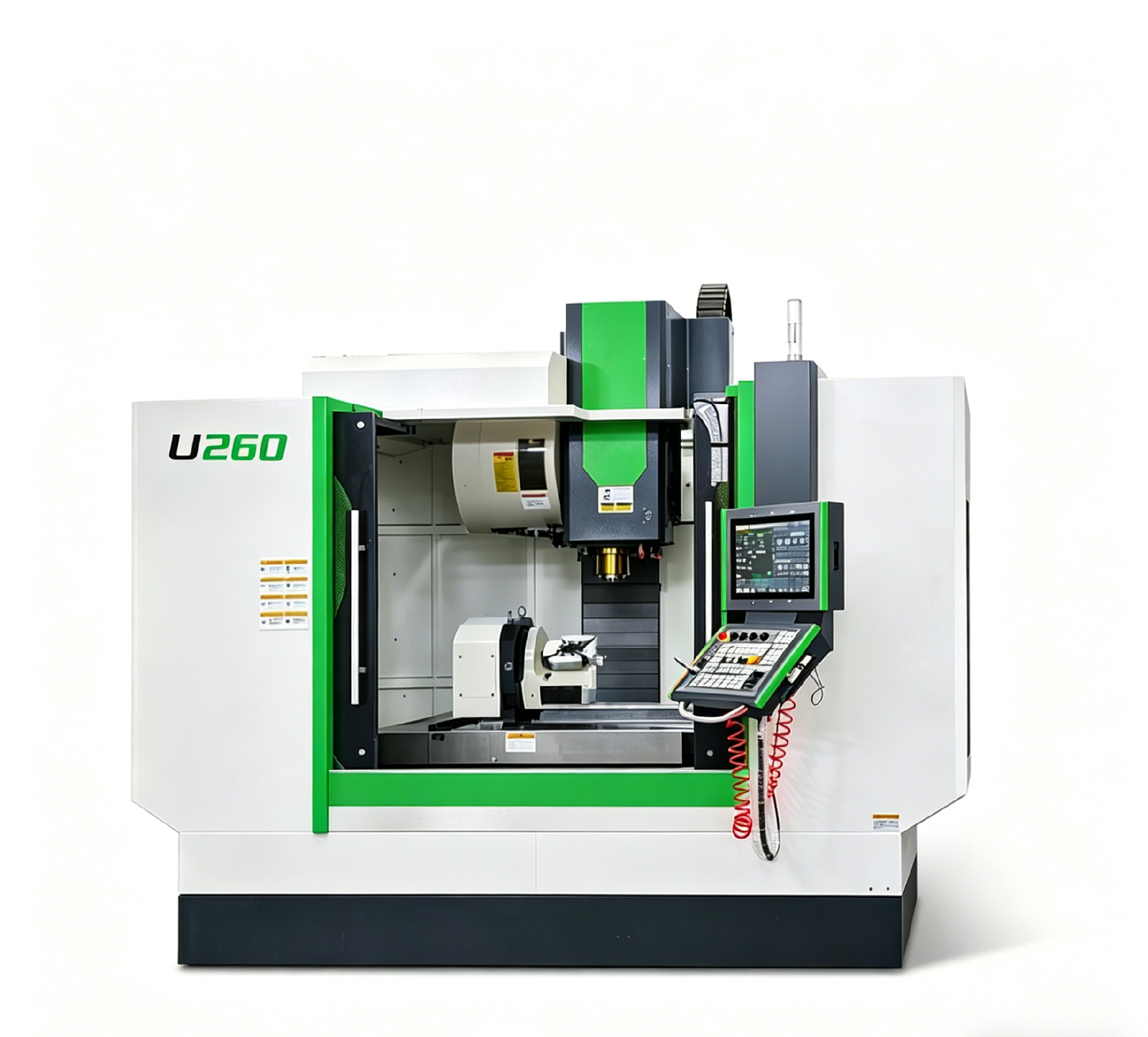
U260 at a glance
| Parameter | U260 |
|---|---|
| X-axis travel | 850 mm |
| Y-axis travel | 600 mm |
| Z-axis travel | 600 mm |
| Machining range | 380 × 300 mm |
| Rotary table type | Dual direct drive |
| Table mounting flange diameter | Ø260 mm |
| Table center hole | Ø50 mm |
| Max. table load | 80 kg |
| Spindle type | Direct-drive mechanical spindle |
| Max. spindle speed | 12,000 rpm |
| Spindle output power | 11 kW |
| Tool holder type | BBT40 |
The table is the part of the machine you are really buying
On any five-axis machine the spindle gets the attention and the table decides what is possible. A Ø260 mm flange with an 80 kg capacity sets a hard ceiling: impellers, small aluminium housings, brackets, valve bodies, instrument and medical parts. It is not a machine for a 300 kg casting, however good the travels look on paper.
The useful detail here is the center hole. At Ø50 mm it is larger than the hole in the next model up, the U320, which is Ø40 mm on a bigger table. That clearance lets you route coolant, air or fixture hydraulics through the middle of the table and park tall work on a fixture that uses the center instead of clamping around the rim.
Why direct drive on both rotary axes
The usual way to index a table in this size class is a worm gear or a harmonic drive. Both are cheap to build and both wear. Gear mesh carries backlash, heat from a full day of rotation moves the table and the part with it, and the operator learns to compensate. On a five-axis part with a curved surface, that compensation shows up as a witness mark where the axis reversed.
The U260’s table is listed as dual direct drive, so the A and C axes are driven straight from the motors with no gear train between. What the encoder reads is what the table does, and there is no mechanical slack to take up on a reversal. Repeatability holds as the machine ages, because there is no gear wear to accumulate. Direct drive is not maintenance-free; the motors make heat and need cooling. What it avoids is a datum that walks away over a shift.
12,000 rpm, 11 kW and a BBT40 spindle
The spindle is a direct-drive mechanical unit at 12,000 rpm, 11 kW, taking BBT40 tooling. Speed recovery after a tool change is quick, with no belt to re-tension.
Read the power figure honestly. 11 kW at 12,000 rpm is a small-tool spindle: aluminium and non-ferrous work at proper surface speeds, light finishing passes in steel, small-diameter cutters in hard materials. It is not a hogging spindle.
Travel is not the same as working envelope
X, Y and Z travel is 850, 600 and 600 mm, which is the stroke available to the spindle. The published machining range is 380 × 300 mm, which is what a part has to live inside once the table and head geometry are accounted for. The extra travel is what lets the head reach the far corner of an offset part or clear a fixture without running out of axis. Plan the part against 380 × 300 mm and treat the travels as headroom.
The sheet does not say which axes the 380 × 300 mm covers, or whether one figure is a diameter in the C axis rather than a linear measurement. A 300 mm linear limit and a 300 mm swing cover very different parts, so confirm this before quoting against the envelope.
Where the U260 sits in the five-axis range
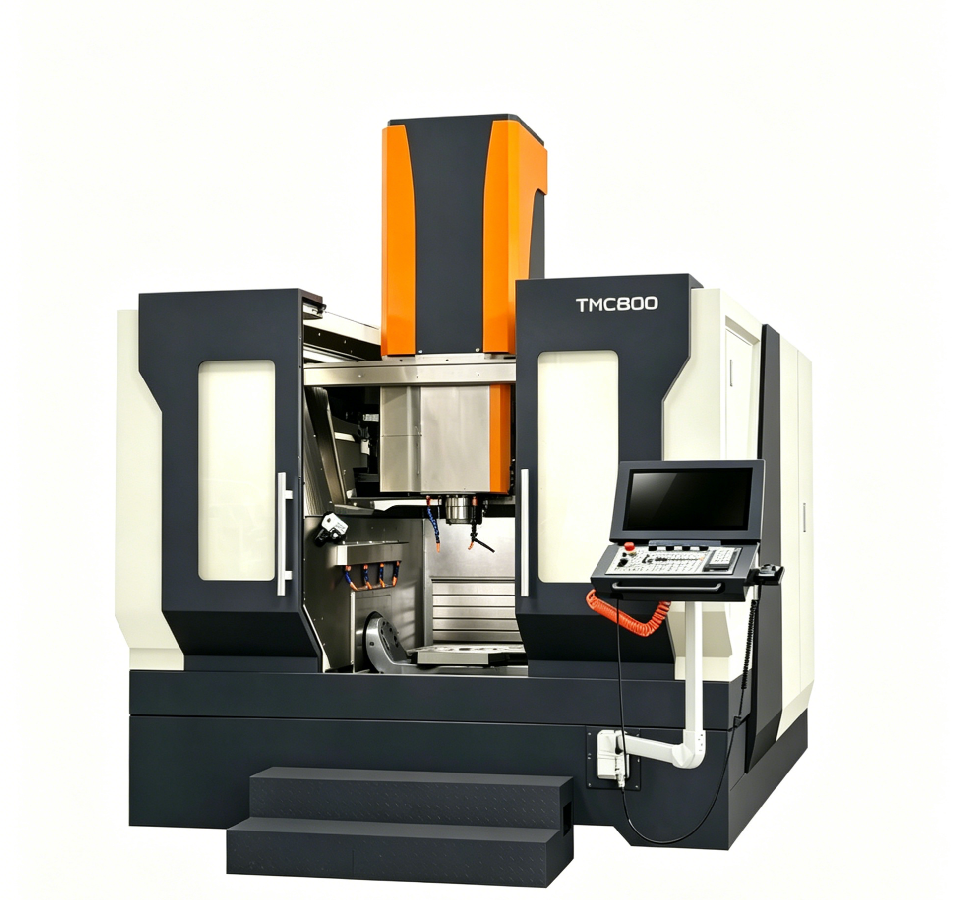
The 5-axis turning and milling series runs from this machine up to the TMC models, and the models are not interchangeable. Published figures for the closest alternatives:
| Model | Table | Max. table load | X / Y / Z travel | Spindle |
|---|---|---|---|---|
| U260 | Ø260 mm flange, Ø50 mm center hole, dual direct drive | 80 kg | 850 / 600 / 600 mm | BBT40, 12,000 rpm, 11 kW |
| U320 | Ø320 mm flange, Ø40 mm center hole, dual direct drive | 150 kg | 1,100 / 650 / 650 mm | BBT40, 12,000 rpm |
| U400 | Ø400 mm flange, Ø80H7 mm center hole, dual direct drive | 200 kg | 1,300 / 700 / 750 mm | BBT40, 12,000 rpm, 11 kW |
| LH400 | Ø400 mm table, no center hole published | 200 kg | 600 / 1,000 / 600 mm | BT40D, 12,000 rpm |
| TMC630 | Ø650 mm trunnion, A-axis tilts ±110° | 500 kg | 700 / 350+590 / 550 mm | HSKT63, 15,000 rpm |
The U-series machines all use direct-drive tables and differ mainly in table size and travel, so the U260 is the entry point. The LH400 keeps a flat Ø400 mm table but swaps the layout to 1,000 mm on Y instead of X. The TMC630 is a different machine entirely, a tilting trunnion with a 500 kg rating and an HSK-T63 spindle at 15,000 rpm.
Who the U260 suits
- Small parts under 80 kg that need simultaneous five-axis motion, not angled drilling on a three-axis machine
- Aluminium, brass, copper and small steel components where 12,000 rpm and BBT40 tooling are enough
- Shops that want direct-drive table accuracy without paying for a trunnion machine they will never load to capacity
If the parts are simple prismatic work, a vertical machining center will do it for less. The U260 earns its price when the geometry is curved and the part has to come off the table finished.
What to confirm before you order
The published sheet covers travel, table capacity and the spindle well, and it is silent on several things that matter at quotation and installation:
- Machine dimensions and weight, neither of which is published, unlike the LH400 at 3495 × 2829 × 4150 mm and 9,000 kg. Get both before planning rigging and floor loading.
- Maximum rotary speed of the C and A axes, which the TMC models publish but the U260 sheet does not.
- What the unlabelled “diameter 150 mm” note in the table row refers to, since it appears in the U260, U320 and U400 sheets with no definition.
- Positioning and repeat positioning accuracy, and the acceptance standard behind them.
- The spindle torque curve, because 11 kW at 12,000 rpm says nothing about what happens at 500 rpm.
- Which axes the 380 × 300 mm machining range covers, as noted above.
Frequently asked questions
How much weight can the U260 table carry?
80 kg, on a Ø260 mm mounting flange with a Ø50 mm center hole. That rules out heavy castings.
Is the U260 table really direct drive?
The specification says dual direct drive, so both the A and C axes are driven without an intermediate gear train. That removes backlash and gear wear, and it is the main technical difference between this machine and an entry-level five-axis machine with a worm-gear table.
What is the difference between the U260 and the U320?
Table size and travel. The U320 has a Ø320 mm flange, a 150 kg rating and 1,100 mm of X travel against the U260’s Ø260 mm, 80 kg and 850 mm, though both use direct-drive tables and BBT40 spindles. The U260 has the larger center hole, Ø50 mm against Ø40 mm.
Bottom line
The U260 is the small end of the BONANZA five-axis range, and it is honest about being small: a Ø260 mm dual direct-drive table rated to 80 kg, a 380 × 300 mm working envelope inside 850 mm of X travel, and a direct-drive BBT40 spindle at 12,000 rpm and 11 kW.
If your work is heavier, send the BONANZA team your drawings, material and part weight and ask where the U320 and U400 start. The table rating usually decides it.