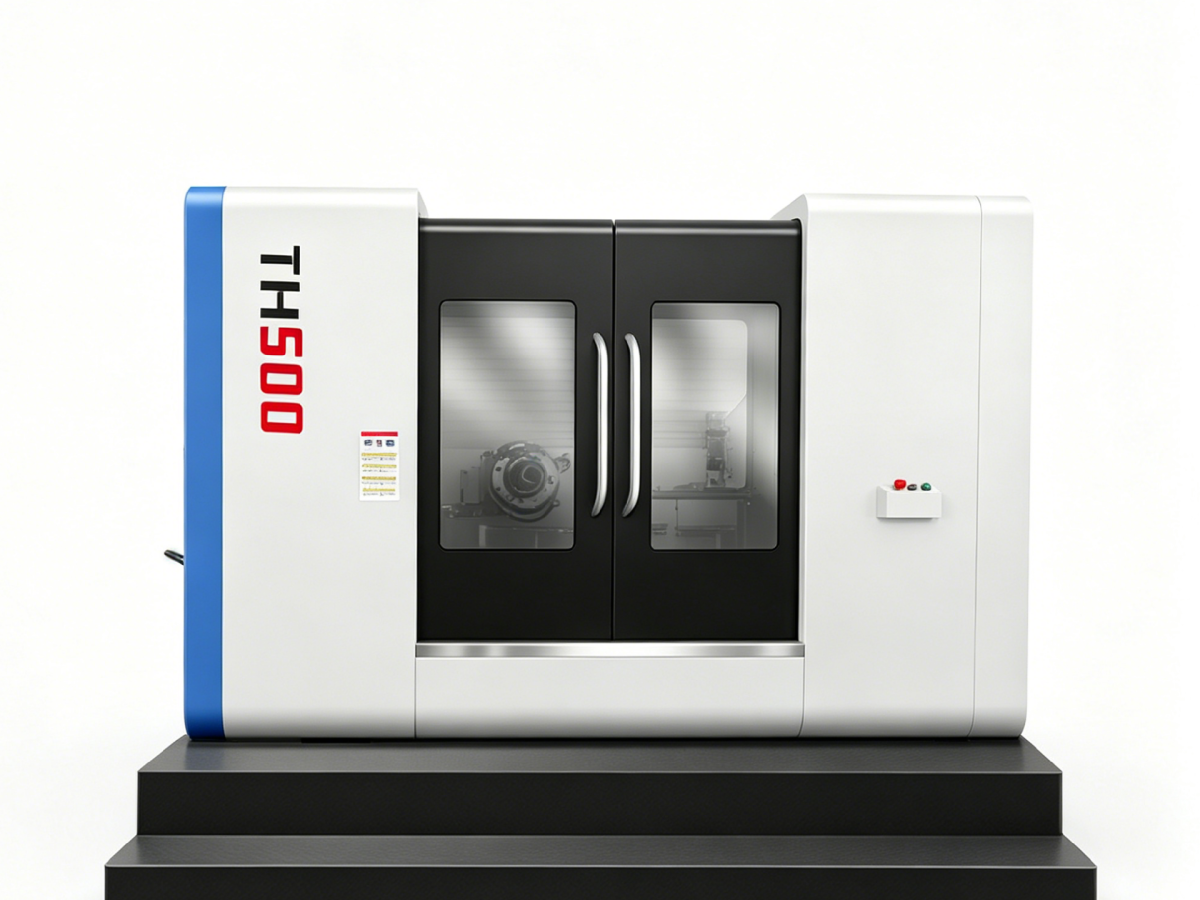
TH500 Horizontal Machining Center – 1,200 x 600 mm Table with 24 m/min Rapids | BONANZA CNC
Ask most people to picture a horizontal machining center and they describe something enormous. A 630 mm pallet, a BT50 spindle, twelve tonnes of cast iron sitting on its own foundation. That is the classic horizontal, and for production work in steel it is exactly right.
But a good share of the work that would benefit from a horizontal spindle never needs that much machine. The chips still need to fall away from the cut. The part still needs more than one face. You just do not need four tonnes of table capacity to get there.
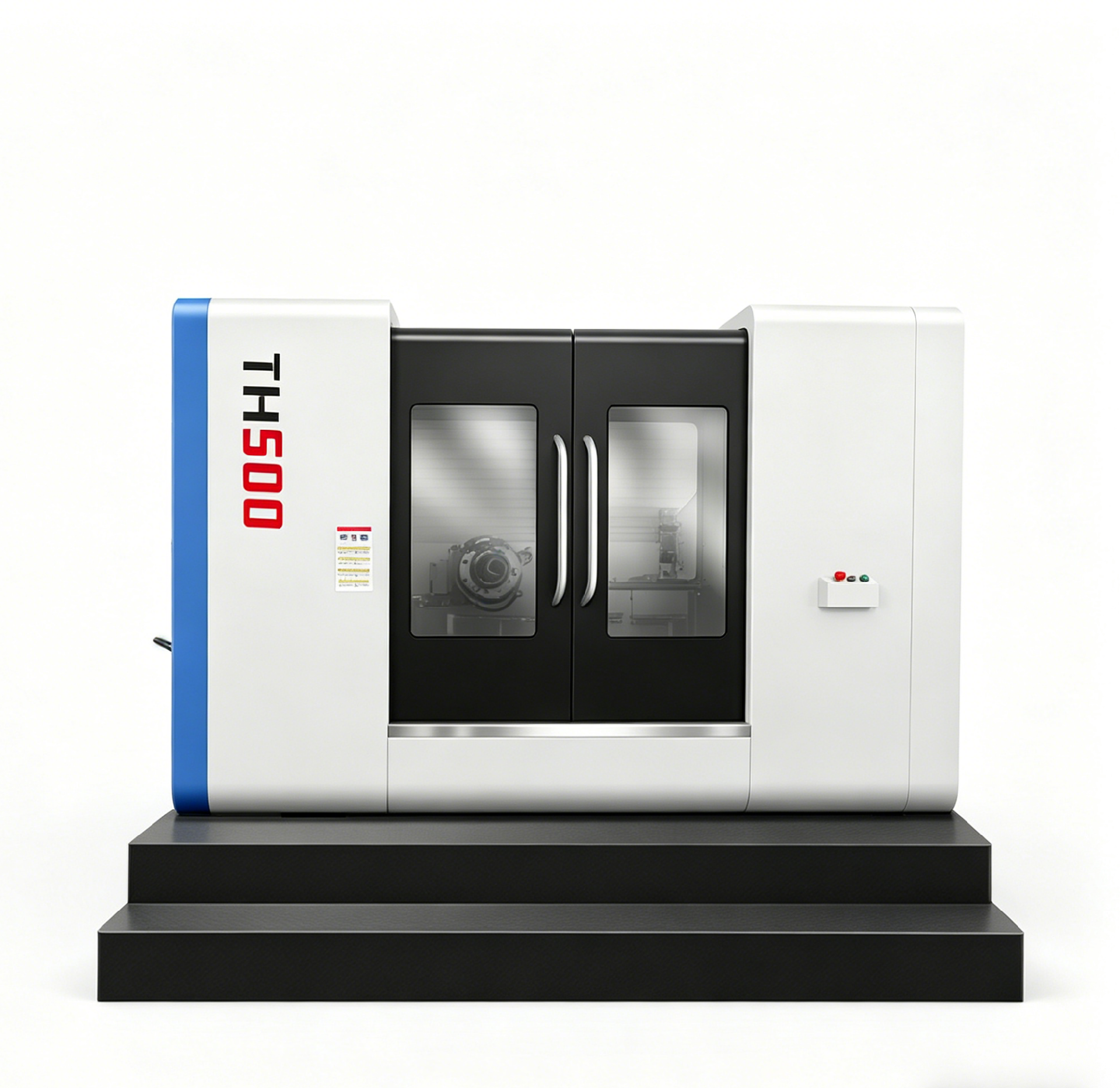
The TH500 from BONANZA is built for that gap. It pairs a 1200 × 600 mm table rated to 800 kg with a BT40Φ150 spindle, travel of 1100 / 750 / 650 mm, and rapids of 24 / 18 / 24 m/min. At 7200 kg it is the lightest machine in the horizontal line, and on positioning speed it is the quickest.
Why a horizontal at all
On a vertical machine, chips land on the part, the fixture and the table. Someone has to clear them, or the next pass recuts them and you spend the afternoon chasing surface finish. Turn the spindle 90 degrees and gravity does that job for free. Swarf drops away from the cutting zone, coolant washes the pocket clean, and deep cavities stop being a problem.
That single change also makes multi-face work practical. Mount the part once, index the table, and machine four sides without losing your datums to a second setup. Every re-fixturing step you remove is a tolerance stack-up you no longer have to budget for.
What the TH500 actually is
The TH500 is a compact horizontal with a rectangular table. That shape choice matters more than it looks. A 1200 × 600 mm surface suits long plates, shaft-type parts and castings that are wider than they are deep, and it leaves room to mount two smaller fixtures side by side and run them on a single cycle. The 5-18-100 mm T-slots take standard clamping hardware, and the 800 kg rating covers the aluminium and light-to-medium steel parts this machine is aimed at.
The spindle is BT40Φ150. On the heavier horizontals in the range you will see BT50 tapers, and those are the right call once you are roughing large steel castings all day. BT40 is the practical choice further down the scale: tooling is cheaper and more widely available, holders are lighter to handle, and the smaller nose lets the spindle reach into pockets where a BT50 nose will not fit.
Travel is 1100 mm on X, 750 mm on Y and 650 mm on Z, which is a working envelope matched to the table rather than a box that promises more than the machine can hold. The whole thing sits inside a 3400 × 2750 × 2900 mm footprint at 7200 kg, so it does not demand the foundation work or the floor space of its bigger brothers.
Specifications at a glance
| Parameter | TH500 Value |
|---|---|
| Table size | 1200 × 600 mm |
| Max. table load | 800 kg |
| T-slot (number × width × distance) | 5-18-100 mm |
| X-axis travel | 1100 mm |
| Y-axis travel | 750 mm |
| Z-axis travel | 650 mm |
| X-axis rapid shift | 24 m/min |
| Y-axis rapid shift | 18 m/min |
| Z-axis rapid shift | 24 m/min |
| Spindle taper hole | BT40Φ150 |
| Machine size (L × W × H) | 3400 × 2750 × 2900 mm |
| Machine weight | 7200 kg |
Those numbers come straight off the product specification sheet. Spindle speed, spindle power, tool magazine capacity, positioning accuracy and the control system are not listed there, so we have deliberately left them out of this table rather than quote a figure we cannot stand behind. If any of them is the deciding factor for your job, ask and we will confirm the current build specification in writing.
Where the TH500 earns its keep
Box bodies and housings in aluminium
Aluminium housings, gearbox covers and electronic enclosures with pockets on several faces are the natural first job for this machine. Fast positioning, good chip evacuation, and a table that takes two fixtures at once so the spindle is not waiting while you load.
Valve bodies and pump housings
These parts need bores on more than one face and often a couple of intersecting bores where alignment matters. Doing them on a horizontal with an indexing table holds that alignment in a single setup, which is where the accuracy actually comes from.
Mold plates, jigs and fixtures
A 1200 × 600 mm table takes long mold plates and base plates comfortably. The horizontal spindle makes deep pockets and ribs easier to machine cleanly, and the 800 kg rating leaves headroom for a substantial fixture without eating into the part weight you can carry.
Job shop work that arrives in small batches
This is the case for the TH500 over a larger horizontal. When batch sizes are modest and the parts change weekly, setup time and programme prove-out dominate the cost per part. A machine that is quick to fixture, quick to position and cheap to tool wins over one that could technically cut the material faster.
What 24 m/min of rapid buys you
The TH500’s 24 m/min on X and Z and 18 m/min on Y are the fastest figures in the BONANZA horizontal range. On a heavy machine that would be an odd claim to make, because you cannot accelerate a four-tonne axis that hard without paying for it in wear. On a 7200 kg machine it makes sense, and it pays off in exactly the work this machine gets: short toolpaths, lots of positioning, drilling patterns, small pockets, and programme runs where the spindle spends as much time travelling as cutting.
How it fits in the BONANZA horizontal range
It helps to see the TH500 next to the rest of the line:
| Model | Table | Max. load | Spindle | X / Y / Z travel | Machine weight |
|---|---|---|---|---|---|
| TH500 | 1200 × 600 mm | 800 kg | BT40Φ150 | 1100 / 750 / 650 mm | 7200 kg |
| HTMC630-VI | 630 × 630 mm | 500 kg | BT50φ190 | 1050 / 800 / 850 mm | – |
| HMC630II-ZT | 630 × 630 mm | 1200 kg | BT50Φ190 | 1100 / 900 / 1000 mm | 12000 kg |
| 800S-DT | 800 × 800 mm | 2000 kg | BT50-45° | 1300 / 1000 / 1000 mm | 15500 kg |
| TH1000S | 1000 × 1000 mm | 4000 kg | BT50-45° | 1800 / 1000 / 1300 mm | 16000 kg |
| TH1400S | 1400 × 1400 mm | 5000 kg | BT50-45° | 1800 / 1300 / 1500 mm | 19500 kg |
| TH1600S | 1600 × 1600 mm | 10000 kg | BT50-45° | 2000 / 1500 / 1800 mm | 24000 kg |
Read down the load column and the pattern is plain: the range steps from 500 kg to 10000 kg, and the spindle taper grows with it. The TH500 sits at the light end by design, and it is the only machine in the group with a rectangular 1200 × 600 mm table rather than a square pallet.
If your parts are small and predominantly aluminium, and your bottleneck is positioning time rather than metal removal rate, the TH500 is the machine that fits. If you need to take heavy cuts in steel castings, step up to a BT50 machine — the 630 mm class is the next stop, and beyond that the full horizontal range runs up through the TH-series machines to the 24-tonne TH1600S.
Things worth settling before you order
First, workholding. The TH500’s advantage is quick, repeatable multi-face work, and a manual indexer gets you part of the way while a rotary table with pallet changing gets you all of it. Decide that up front, because it changes the axis configuration and the price.
Second, tooling. Moving into a BT40 horizontal means BT40 holders, and if you already run BT40 on a vertical machine, tooling is one thing you are not rebuying. If your shop is on BT50, price the changeover before you commit.
Third, the specification gaps. Spindle speed and power, tool magazine size, accuracy values and the control platform all matter, and none of them appear on the published sheet. Send us the parts you have in mind and we will match the build to them instead of guessing.
Get a straight answer on fit
The reliable way to choose between a compact horizontal and its larger siblings is to take one real job — the most awkward part you would put on it, with the fixture you would actually use — and walk the setup through each candidate. Table size and load rating on their own will not tell you whether your fixture clears the guards or whether the Z travel reaches the face you need to cut.
BONANZA builds the TH500 and the rest of the horizontal line for exactly this kind of multi-face work. Send over your drawings and we will tell you which model genuinely fits, including when the answer is a smaller one. Full mechanical details are on the TH500 product page, or contact us and we will work through the numbers with you.