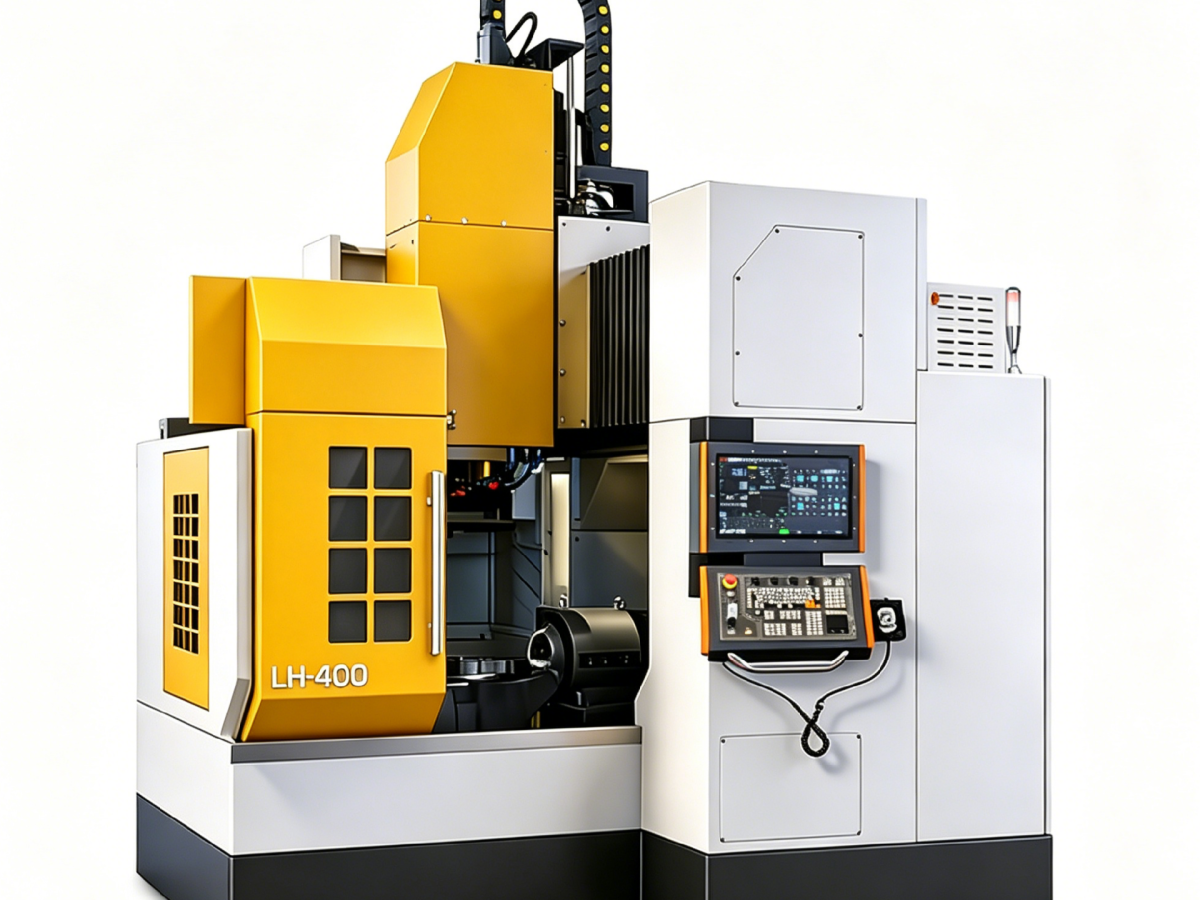
Most five-axis purchases get decided on table size and travels. Then the machine arrives and the questions that actually stop the install are different ones: will it clear the crane, what does the fixture weigh, and why does the vertical axis have 400 mm more travel than the other two. The BONANZA LH400 5-axis turning and milling machine answers all three on a short datasheet, provided you read it for what it leaves out as well as what it states.
4,150 mm of Height Is the First Constraint
Overall height is 4,150 mm on a machine whose table is only 400 mm across. That is not a styling choice. A 1,000 mm vertical stroke has to be stacked somewhere, and on this layout it sits in the column above the table.
In a bay with 5 m under the hook you have room to spare. In a rented unit with 4.5 m to the trusses, you have 350 mm of margin for the slings, the hook block and the lift itself. That is workable, but it needs measuring before the machine is on the water, not after. The same applies to the door: the footprint is 3,495 × 2,829 mm, and a machine that fits the floor plan can still fail to fit the opening it has to pass through.
Floor loading is the other number worth checking. 9,000 kg spread over 3,495 × 2,829 mm is roughly 900 kg per square metre, which sounds harmless for any industrial slab, and it is also the wrong figure to hand a foundation contractor. The mass lands on the leveling pads, and during an interrupted cut those pads see dynamic loads well above the static share. Specify an isolated pad, and plan to re-level after the first two weeks, when the machine has settled.
200 kg of Table Capacity Is Not 200 kg of Part
The table is rated for 200 kg. A 400 mm trunnion fixture with a tailstock support, a hydraulic clamp and a sub-plate is not a light object: 60 to 90 kg is normal for that class of workholding. That leaves 110 to 140 kg for the workpiece before you touch the limit, and the limit itself is a static figure.
The dynamic case is worse. Once the table tilts, an off-centre part converts its mass into torque on the tilt axis. A 120 kg part hanging 150 mm off centre is a much harder job than a 180 kg part sitting concentric. Before ordering, put the heaviest part you plan to run on the table at the worst angle you plan to machine it at, and confirm the clamp holds.
1,000 mm of Y Against 600 mm of Z
X and Z both travel 600 mm. Y travels 1,000 mm. The asymmetry tells you what kind of work the machine was laid out for. The vertical axis carries the spindle over the column, so extra Y buys reach in height rather than floor area. Tall, narrow parts suit this: a tall mould insert, a deep housing, a weldment with features on the top face and both sides. Wide, flat parts gain nothing, because X and Z stop at 600 mm.
A 300 mm cube needs nothing beyond 600 mm in any direction and will run comfortably. A part 900 mm tall with features near the top is where the extra Y stops being a specification and starts being the reason to buy this machine instead of a three-axis vertical centre with a rotary table bolted to it.
What 12,000 rpm on a BT40D Taper Implies
The spindle is BT40D at 12,000 rpm. That combination puts the machine in the small-tool, high-speed range: 10 mm carbide end mills run at or near the top of the speed range, 16 mm tools at reduced depth, aluminium and finishing passes on tool steel rather than heavy roughing.
This is the honest limit of the machine. If your process is dominated by a 50 mm face mill taking 3 mm depth of cut in cast iron, the spindle is not what will hold you back; the 200 kg table capacity and the 9,000 kg frame will be, and a three-axis machine with a BT50 head does that work for less money. Five-axis capability is worth paying for when the part genuinely has angled features that would otherwise need three setups.
LH400 Specifications
| Parameter | LH400 |
|---|---|
| Table size | Φ400 mm |
| Max. worktable load | 200 kg |
| X-axis travel | 600 mm |
| Y-axis travel | 1,000 mm |
| Z-axis travel | 600 mm |
| X / Z rapid traverse | 15 m/min |
| Y rapid traverse | 12 m/min |
| Spindle taper | BT40D |
| Spindle speed | 12,000 rpm |
| Machine dimensions (L × W × H) | 3,495 × 2,829 × 4,150 mm |
| Machine weight | 9,000 kg |
LH400 Against the LH500 and the Rest of the Range
The LH500 is the direct comparison, and the two machines share almost everything: identical 600/1,000/600 mm travels, identical 3,495 × 2,829 × 4,150 mm dimensions, identical 9,000 kg mass, the same 12,000 rpm spindle speed. What changes is the top end of the work. The LH500 takes a Φ500 mm table with 350 kg capacity and a BBT40 taper; the LH400 takes Φ400 mm and 200 kg with BT40D.
So the choice is a load question, not a size question. If your parts cluster between 200 and 350 kg including the fixture, the LH500 is the only one of the two that will carry them. If they sit under 150 kg, the LH400’s smaller table puts the part closer to the centre of rotation, and that is where a five-axis machine is at its most accurate.
Above this pair, the TMC630 changes the architecture rather than the size: 700 / 350+590 / 550 mm travels, a 650 mm C-axis table rated 500 kg, a ±110° A-axis tilt and an HSK-T63 spindle at 15,000 rpm. Below it, the U400 trades the tall Y stroke for X travel and a dual direct-drive table: 1,300 / 700 / 750 mm, a Φ400 mm flange with a Φ80H7 centre hole, 200 kg capacity. The full list sits on the 5-axis turning and milling machine series page.
What to Confirm Before Ordering
Rigging first: clear height to the trusses, door width against the 2,829 mm machine width, and the capacity of the crane at the reach you need. A 9,000 kg lift at 4 m radius is a different crane from a 9,000 kg lift straight up.
Then the workholding budget. Write down the fixture weight, add the part weight, and check the total against 200 kg with something left over. Then check the same total at the worst tilt angle your process requires.
Then the control side: confirm whether your CAM post handles simultaneous five-axis or only 3+2 positioning, and ask for the post-processor to be proven on your own part file before acceptance.
Finally, confirm the small things: coolant tank and chip conveyor placement inside a 2,829 mm width, air supply for the spindle, and who trains the operators on setting the tilt and rotary zero. On a five-axis machine, the setup procedure is the skill.