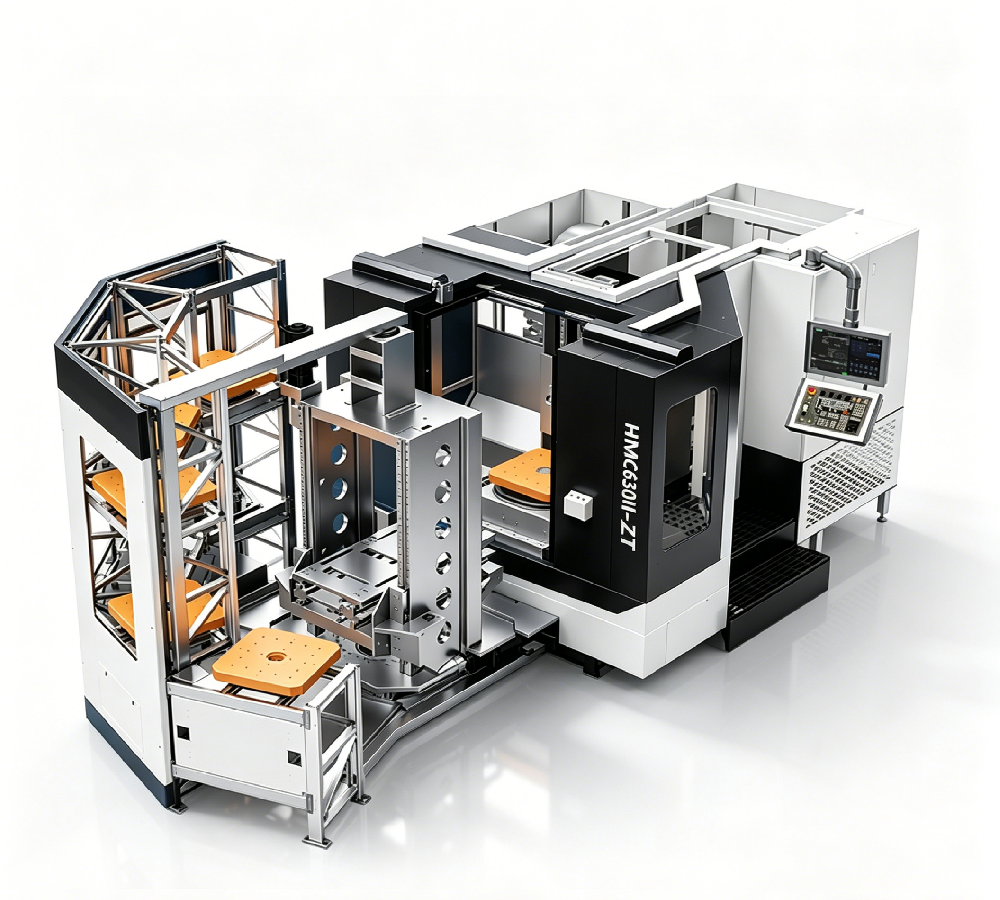
HMC630II-ZT Horizontal Machining Center: 1,200 kg on a 630 mm Table with a BT50-190 Spindle
The HMC630II-ZT Horizontal Machining Center is built around a 630 × 630 mm table rated to 1,200 kg, with 1,100 mm of X travel, 900 mm of Y and 1,000 mm of Z. The spindle is a BT50 Φ190 unit running to 6,000 rpm, rapids are 18 m/min in X and 15 m/min in Y and Z, and the whole machine weighs 12,000 kg.
That is a 630-class machine carrying the table capacity of a much larger one. Plenty of 630 horizontals top out around 500 kg on the table. The HMC630II-ZT is rated to nearly two and a half times that, which changes what you can put on it and how you fixture it.
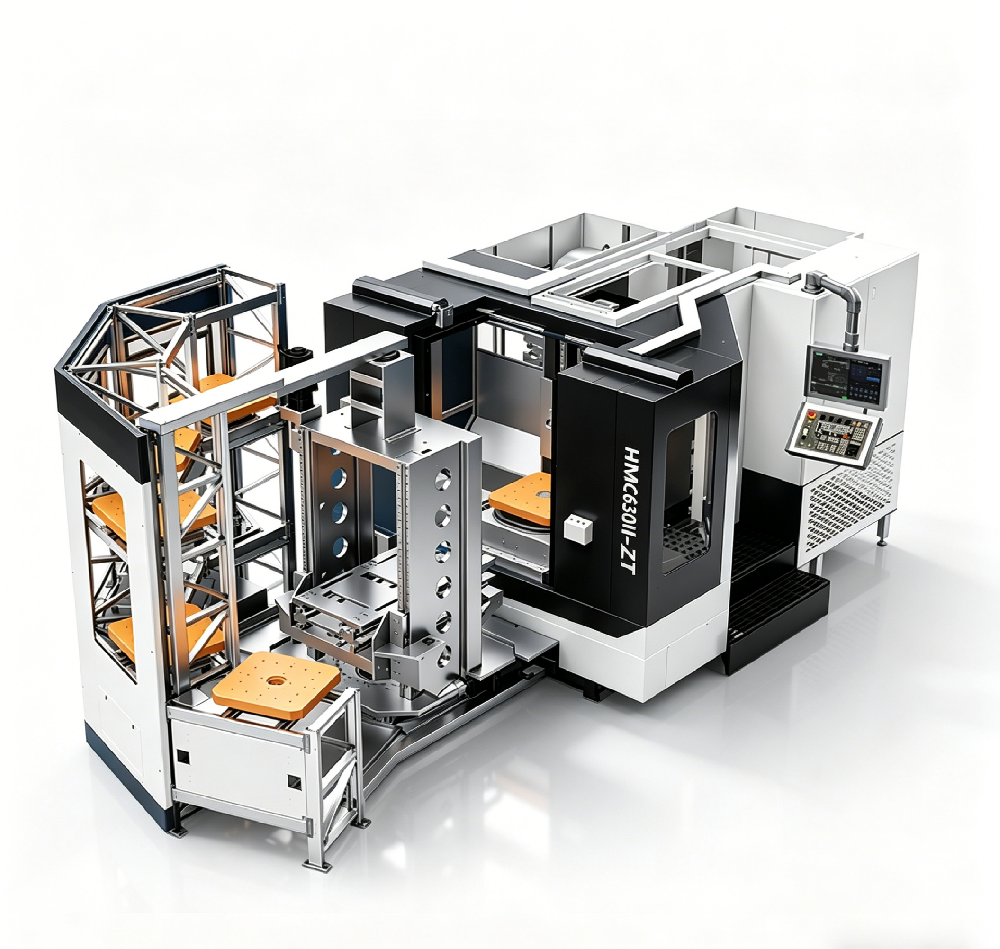
HMC630II-ZT at a glance
| Parameter | HMC630II-ZT |
|---|---|
| Table size | 630 × 630 mm |
| Max. worktable load | 1,200 kg |
| X-axis travel | 1,100 mm |
| Y-axis travel | 900 mm |
| Z-axis travel | 1,000 mm |
| X-axis rapid shift | 18 m/min |
| Y-axis rapid shift | 15 m/min |
| Z-axis rapid shift | 15 m/min |
| Spindle taper hole | BT50 Φ190 |
| Spindle speed | 6,000 rpm |
| Machine weight | 12,000 kg |
Why the 12,000 kg matters more than the travel figures
Horizontal machining centers live or die on rigidity, because the work is usually heavy and the cuts are usually deep. A 12,000 kg machine on a 630 mm table is roughly 19 kg of iron for every kilo of rated table load. The lighter TH500 in the same range carries an 800 kg table on a 7,200 kg machine.
Mass is what keeps a boring bar from chattering when it is 400 mm out of the spindle, and what stops a face mill from leaving marks on a cast iron housing. It is also what you plan for on the shop floor: at 12,000 kg this machine needs a proper foundation and a position you decide in advance.
1,200 kg of table load is the number to plan around
This is where the machine separates itself from other 630 horizontals. A 1,200 kg rating means a 700 kg casting plus a 300 kg tombstone plus clamps still leaves headroom. Once you move up to parts that heavy, you are usually boring box bodies, valve bodies and mould bases, and you want a machine that does not have to be rethought every time a new job comes in.
The published figures put the table at 1,200 kg while the HTMC630-VI in the same series, also a 630 × 630 mm table, is rated to 500 kg. Same size table, less than half the load. If your parts sit in the 600 to 1,200 kg bracket, that difference decides which of the two you buy.
BT50 Φ190 at 6,000 rpm
BT50 is the sensible choice on a machine this heavy. The bigger taper takes a heavier tool and transmits more torque than BT40, which is what you want on 100 mm-plus boring heads and 80 mm face mills in steel. The Φ190 spindle nose also gives a stiffer front bearing arrangement than a slim BT40 nose.
6,000 rpm is a working speed, not a finishing speed. In steel, cast iron and stainless you will be running production feeds on solid carbide and insert tooling all day, which is what these machines are for. If your part mix is small-diameter aluminium work, a 12,000 rpm BT40 machine will be more productive. If it is heavy, boxy and ferrous, 6,000 rpm BT50 is the right call.
1,100 / 900 / 1,000 mm: how much part you can actually machine
The Y axis at 900 mm is the interesting one. On a 630 table, a lot of machines stop at 710 or 800 mm of Y travel. With 900 mm of Y and 1,000 mm of Z, the HMC630II-ZT will reach the full face of a large casting without repositioning, and the Z stroke is enough to swallow a long boring bar and still have clearance at both ends of the cut.
As always the travel figure is not the part size. On a horizontal, a tombstone eats table space, and the part hangs off the face of it. Budget roughly 150 to 200 mm on each side for the fixture and the tool approach, and plan on a part somewhere in the 700 mm class in Y if you want it done in one setup. Parts bigger than that are not impossible; they just cost you a second op.
Where the HMC630II-ZT sits in the horizontal range
BONANZA builds the horizontal machining center series from a 630 mm table up to 1,600 mm, and the published tables show the steps clearly:
| Model | Table | Max. load | X / Y / Z travel | Spindle | Weight |
|---|---|---|---|---|---|
| HTMC630-VI | 630 × 630 mm | 500 kg | 1,050 / 800 / 850 mm | BT50 Φ190, 6,000 rpm | — |
| HMC630II-ZT | 630 × 630 mm | 1,200 kg | 1,100 / 900 / 1,000 mm | BT50 Φ190, 6,000 rpm | 12,000 kg |
| 630-DT | 630 × 630 mm | 1,200 kg | 1,100 / 900 / 1,000 mm | BT50 Φ190, 6,000 rpm | 12,000 kg |
| TH500 | 1,200 × 600 mm | 800 kg | 1,100 / 750 / 650 mm | BT40 Φ150 | 7,200 kg |
| 800S-DT | 800 × 800 mm | 2,000 kg | 1,300 / 1,000 / 1,000 mm | BT50-45° | 15,500 kg |
| 1000S-DT | 1,000 × 1,000 mm | 4,000 kg | 1,800 / 1,000 / 1,300 mm | BT50-45°, 3,000 rpm | 16,000 kg |
| TH1400S | 1,400 × 1,400 mm | 5,000 kg | 1,800 / 1,300 / 1,500 mm | BT50-45°, 2,000 rpm | 19,500 kg |
| TH1600S | 1,600 × 1,600 mm | 10,000 kg | 2,000 / 1,500 / 1,800 mm | BT50-45°, 1,500 rpm | 24,000 kg |
The step from the 630 class to the 800S-DT buys a 200 mm larger table, 800 kg more load and 3,500 kg more machine. Above that, the TH1400S and TH1600S switch to slower, larger spindles for genuinely heavy work. The HMC630II-ZT is the entry point to the heavy end of the range, not the top of the light end.
Three 630s, very similar sheets
The HMC630II-ZT and the 630-DT publish identical specification tables, down to the 12,000 kg weight. The HTMC630-VI shares the table size and spindle but is the lighter, lower-travel variant. If you are quoted two of these, ask the sales team to put the differences in writing. The published numbers will not tell you.
What the spec sheet does not say
BONANZA publishes the geometry, the spindle and the weight, and stops there. Before you order, get these in writing:
- Positioning and repeat positioning accuracy, and the acceptance standard behind them.
- Spindle power, torque and drive type.
- Automatic tool changer capacity and type.
- Guideway type on each axis, linear or box.
- Pallet changer supply and pallet count.
- Table indexing arrangement and number of positions.
- CNC controller and its configuration.
- Options such as through-spindle coolant, chip conveyor and oil cooler.
Frequently asked questions
How much part can the HMC630II-ZT hold and machine?
The table is 630 × 630 mm and rated to 1,200 kg including the fixture. Travel is 1,100 mm in X, 900 mm in Y and 1,000 mm in Z, so a part in the 700 mm class can be machined on multiple faces in one setup. Bigger parts are possible but will usually need a second operation.
Is BT50 at 6,000 rpm enough for steel?
Yes, for heavy and general-purpose steel work. BT50 takes a heavier tool and more torque than BT40, and 6,000 rpm covers production feeds with insert and solid carbide tooling in steel, cast iron and stainless. It is not the machine for high-speed finishing with small-diameter tools.
What is the difference between the HMC630II-ZT and the 630-DT?
Nothing you can see from the published tables. They list the same table, load, travels, spindle and weight. Ask BONANZA to confirm the actual differences in writing before you order either.
Bottom line
The HMC630II-ZT is a 630 × 630 mm table rated to 1,200 kg, carrying a BT50 Φ190 6,000 rpm spindle, with 1,100 / 900 / 1,000 mm of travel and 12,000 kg of cast iron underneath. If your parts are heavy box bodies, valve bodies or mould bases that need multi-face machining in one setup, this is the size to start at in the BONANZA horizontal range.
Send the BONANZA team your part drawings, the heaviest fixture you plan to bolt down and the materials you cut. They can confirm the accuracy, spindle and tool changer figures, and tell you whether the HMC630II-ZT or something further up the range, like the 800S-DT or 1000S-DT, fits the work.