Eleven mill-turn models sit in the BONANZA catalogue, and the model numbers do not sort them. The 2100LY, 3100SY and 70Y are one family, the HTMC trio another, the TCK trio a third, and QK1322 sits off on its own with a 240 mm bore.
Four published figures do sort them: bar capacity, Y-axis travel, maximum turning diameter, and whether there is a second spindle.
The four figures that decide it
Bar capacity is the hardest constraint. If your stock is 80 mm and the machine takes 67 mm, nothing else on the spec sheet matters. Then Y travel, because it decides whether the machine can mill off the centreline at all. Then maximum turning diameter, which sets the chuck work. Then spindle count, which decides how many setups your part costs.
Turning length comes last only because it is the easiest to read: if your part is 900 mm long, every model under 900 mm is out.
The range on published figures
| Model | Bar capacity | Y travel | Max. turning dia. | Turning length | Spindles |
| 2100LY | not published | interpolated Y | not published | not published | not stated |
| 70Y | not published | not published | not published | 1000 – 3000 mm | not stated |
| 3100SY | not published | interpolated Y | 500 mm | 1000 mm | dual, A2-8 + A2-6 |
| TCK2300B | 50 mm | ±60 mm | 400 mm | 500 mm | single |
| TCK6050Y | 50 mm | ±50 mm | 410 mm | 980 mm | single |
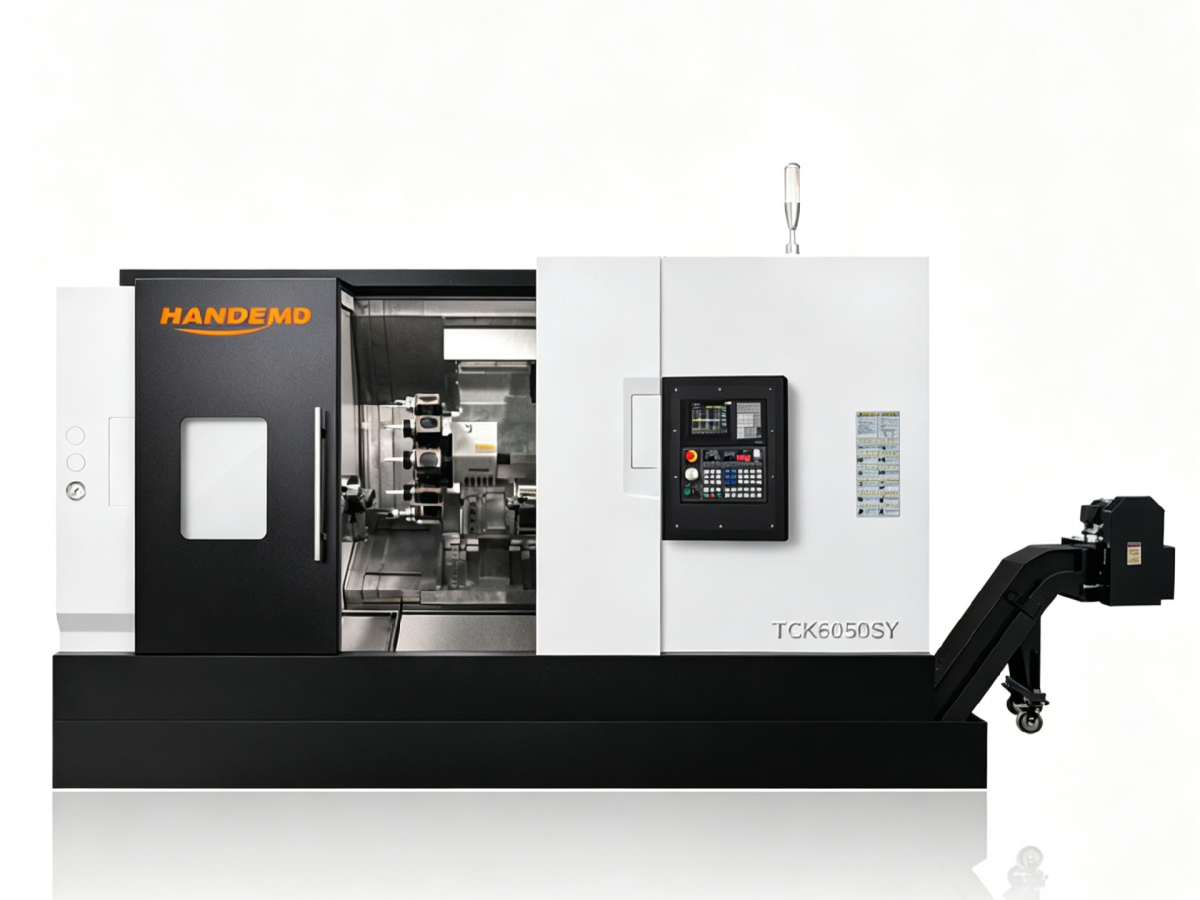
| TCK6050SY | 50 mm / 45 mm | ±50 mm | 400 mm | 450 mm | dual, A2-6 + A2-5 |
| TCK3100LY | 75 mm | ±100 mm | 500 mm | 1000 mm | single |
| HTMC800S | 67 mm | ±125 mm | 580 mm | 1200 mm | single |
| HTMC800T | not published | ±125 mm | 600 mm | 1500 mm | single |
| HTMC500T | 75 mm | ±125 mm | 500 mm | 1250 mm | single |
| QK1322 | 220 mm | none | 800 mm | 1350 mm | single |
Bar capacity runs from 45 mm to 220 mm
Two clusters, not a smooth ladder. Below 80 mm you have the TCK models and the HTMC500T, all built around a 50 to 75 mm bar and a chuck in the 8 to 12 inch class. Above 200 mm there is QK1322 alone, with a 240 mm bore on an A2-15 nose and 220 mm of bar capacity.
That gap is not an accident. A 75 mm bar and a 220 mm bar want different spindle bearings, different chuck masses and different rapid rates — QK1322 runs 12 m/min on both axes against 20 m/min on the TCK6050Y.
The published bore figures also hide the real limit. The HTMC500T has an 86 mm bore against 75 mm of bar capacity, and the TCK3100LY has 85 mm against 75 mm. That allowance covers bar straightness, feeder alignment and the spindle liner. Shops that quote the bore as their bar size find out about the liner on the first long bar at speed.
Y travel: ±50, ±60, ±100, ±125
Four values, and the jump from ±100 to ±125 is smaller in practice than the jump from ±50 to ±100.
At ±50 mm, as on the TCK6050Y and TCK6050SY, you have room for cross-drilling off centre, milling flats and slots near the axis, and cutting a keyway with an end mill. That covers a large share of valve, fitting and connector work.
At ±100 mm the 3100SY‘s class opens up: pockets away from the centreline, bolt circles wider than the part’s radius, and features that need the tool to reach past the chuck jaw envelope.
The HTMC trio goes to ±125 mm across all three models, a machining-centre Y axis grafted onto a lathe bed — which is why those machines carry 14,000 and 17,000 kg on the two published weights, against 8,000 kg for the TCK3100LY.
The 2100LY and 3100SY are listed with interpolated Y rather than a box Y axis, which is a different mechanism: the Y motion comes from combining X and Z. It reaches the same places, but if your process interpolates a contour in Y, ask for the accuracy figure for the combined move rather than the single-axis figure.
When the second spindle pays
Two models in the range have one: the TCK6050SY with an A2-6 main and A2-5 sub, and the 3100SY with A2-8 and A2-6. Both exist for back-face work without a second op. A part that carries a back bore, a back chamfer or a thread relief currently runs through two machines, two setups, or one setup and a manual lathe; the SY does it in one cycle, and it holds concentricity better than any re-chucking arrangement because the part is transferred on the spindle axis rather than released and picked up again.
What the second spindle costs you is envelope. The TCK6050SY turns 450 mm where the single-spindle TCK6050Y turns 980 mm, on the same 50 mm bar. That is the trade: double the operations per setup, half the part length.
Check the sub-spindle bore before you commit. The TCK6050SY sub takes a 56 mm bore and 45 mm bar against the main spindle’s 67 mm and 50 mm, so a 48 mm part can be turned on the main but must be gripped on the OD to go into the sub.
The long-part class: 1000 to 3000 mm
Only the 70Y is published in that band, and as a range rather than a single figure, which tells you it is built to order in bed lengths. Its tailstock is described as a Mohs 5# spindle structure, a heavier quill than the 100 mm stroke units on the TCK6050Y. For shaft work over a metre, that is the model the catalogue points at.
Above it in length and below it in bar capacity, the HTMC800T reaches 1500 mm on a 600 mm turning diameter with ±125 mm of Y. If your parts are short-ish, fat and need real milling, that is the machine; if they are long and slender, it is not.
What the catalogue does not tell you
Four of the eleven models have no published bar capacity, and one has no published turning length. That is not a reason to guess — it is a reason to put the question in writing with the enquiry.
What you should ask for on every model in this range: the spindle torque curve rather than the kW figure, since a mill-turn spends much of its life at low speed in a large diameter; the live tool drive type and maximum driven speed, because that is the milling capability you are paying the Y axis for; and the positioning accuracy to ISO 230-2 or JIS B 6336 rather than a marketing number.
Narrowing it down
Take your bar diameter and delete every model below it. That leaves at most three or four. Take your longest part and delete every model below that. What survives is your shortlist, and at that point the only question left is whether the back-face work justifies giving up turning length for a sub-spindle.
The full CNC mill-turn range is eleven models wide, but the decision is usually made on two numbers. Get a part drawing in front of the spec table before you go further.