Most five-axis enquiries start the same way. Someone has a part with bores on four faces and one port at an awkward angle, and somebody has told them to buy a five-axis machine. Then they open seven specification sheets, see three different table designs, and ask which one is better.
None of them is better. They are three different answers to the same problem, and the figures that separate them are usually not the ones printed in the largest type. The range today is the LH400, LH500, U260, U320, U400, TMC630 and TMC800: seven models, 80 to 500 kg of published table load, two spindle interfaces, three ways of putting a rotary axis under the part.
Three table designs, not three quality levels
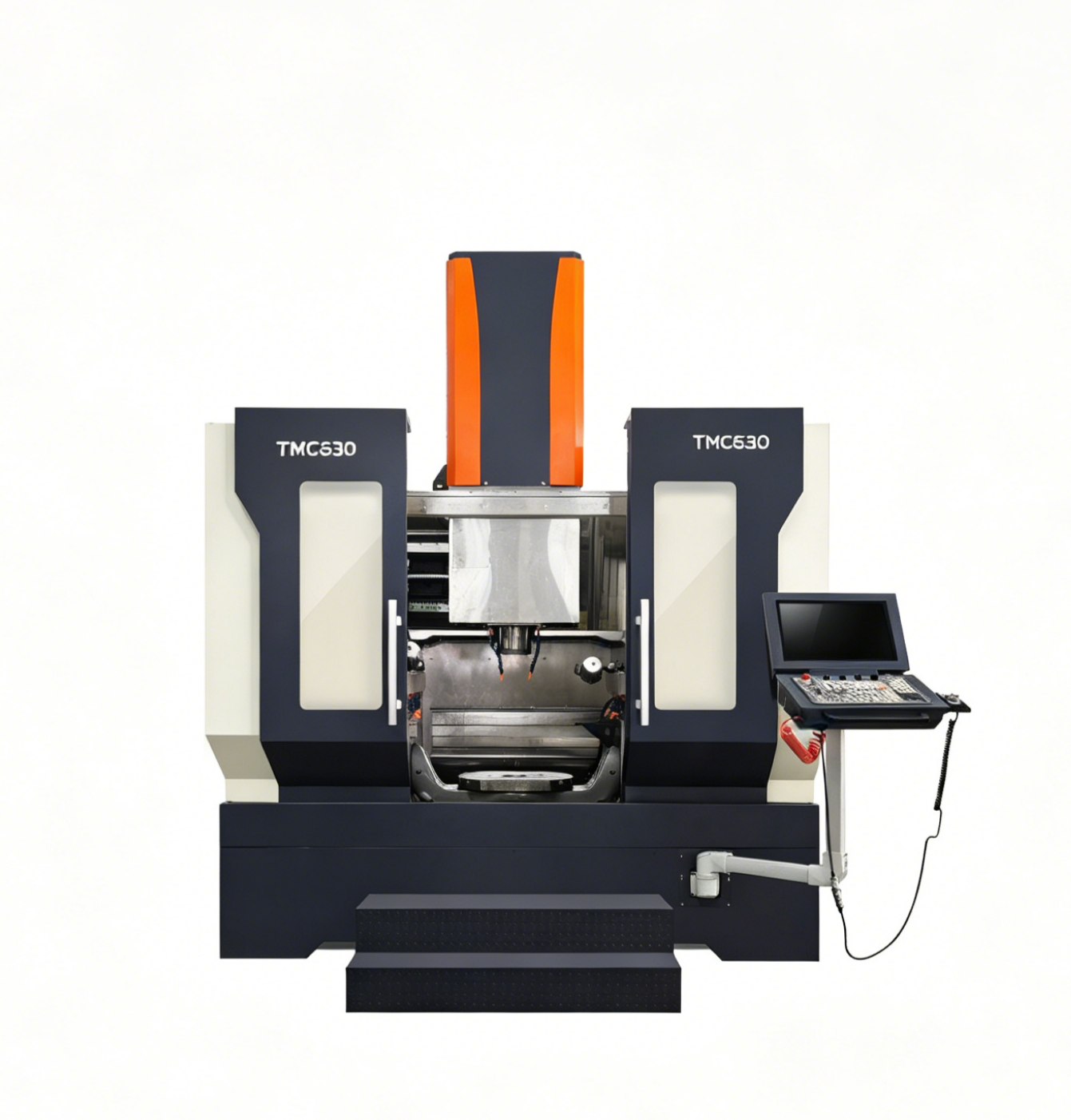
Trunnion, on the TMC machines. A tilting A-axis cradle carries a rotating C-axis table. On the TMC630 the A axis swings ±110°, which is twenty degrees past vertical, and the C table is 650 mm across, rated 500 kg, turning to 400 rpm. A-axis indexing runs up to 100 rpm. That extra twenty degrees is the whole reason a trunnion machine exists: it lets a short, stiff tool reach the back of a part instead of hanging a long extension out of the spindle and listening to it sing.
Direct drive, on the U machines. No worm gear, no backlash to compensate. Flange sizes step 260, 320 and 400 mm, centre holes 50, 40 and 80 mm H7, loads 80, 150 and 200 kg. All three run a 12,000 rpm spindle; U260 and U400 publish 11 kW, the U320 sheet gives no power figure. Travels are 850/600/600, 1,100/650/650 and 1,300/700/750 mm, so X is the long axis here — the opposite of the LH machines.
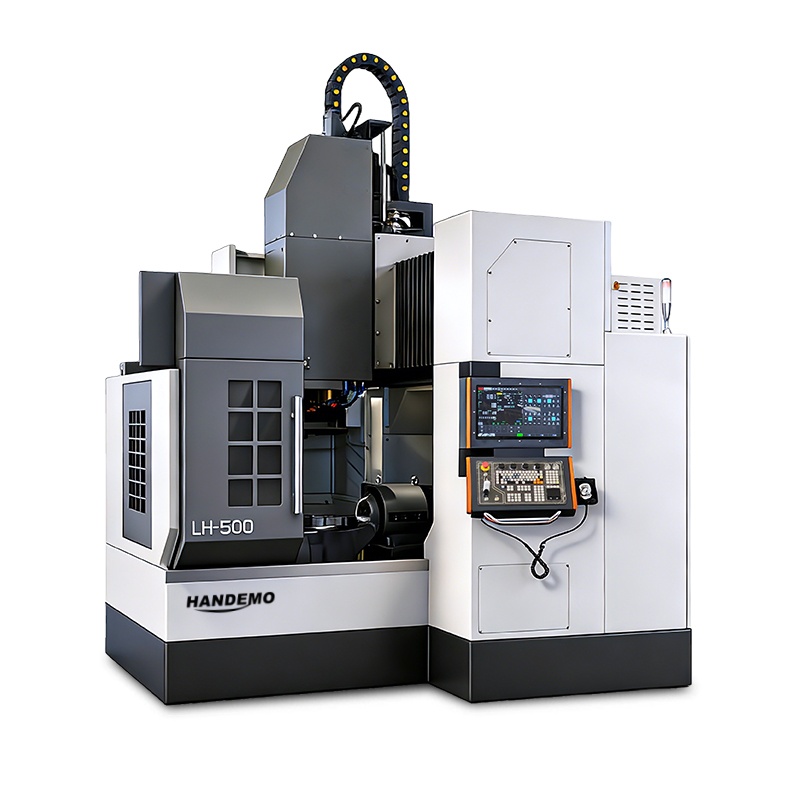
Long Y, on the LH machines. 600/1,000/600 mm of travel with a Φ400 or Φ500 table, 200 kg or 350 kg. Spindle taper reads BT40D on the LH400 and BBT40 on the LH500, both at 12,000 rpm. The two share one footprint, 3,495 × 2,829 × 4,150 mm, and one machine weight, 9,000 kg, which tells you most of the structure is common and the difference sits in the table assembly.
The published figures, side by side
| Model | Table / load | X / Y / Z travel | Spindle | Machine weight |
|---|---|---|---|---|
| LH400 | Φ400 mm / 200 kg | 600 / 1,000 / 600 mm | BT40D, 12,000 rpm | 9,000 kg |
| LH500 | Φ500 mm / 350 kg | 600 / 1,000 / 600 mm | BBT40, 12,000 rpm | 9,000 kg |
| U260 | Φ260 flange / 80 kg | 850 / 600 / 600 mm | BBT40, 12,000 rpm, 11 kW | not published |
| U320 | Φ320 flange / 150 kg | 1,100 / 650 / 650 mm | Direct drive, 12,000 rpm | not published |
| U400 | Φ400 flange / 200 kg | 1,300 / 700 / 750 mm | Direct drive, 12,000 rpm, 11 kW | not published |
| TMC630 | Φ650 C table / 500 kg | 700 / 350 + 590 / 550 mm | HSKT63, 15,000 rpm | not published |
| TMC800 | not published | 850 / 1,040 / 600 mm | HSK-T63, 15,000 rpm | 11,000 kg |
The Y figure that is not 940 mm
Read the TMC630 line carefully. Y is written as 350 + 590 mm, and the 590 is the tool-change stroke. The cutting travel is 350 mm. If you compare that 940 against the LH500’s 1,000 mm Y and conclude the two are close, you have just made an expensive mistake on paper.
What those numbers say is that the two machines are built for different jobs. The TMC630 keeps Y short so the trunnion stays rigid and the A axis can swing without the column getting in the way; you reach the part by tilting it, not by travelling across it. The LH500 keeps Y long — the longest cutting Y in the range at 1,000 mm — and reaches the part by walking the spindle along it. Housings, brackets and parts you fixture two-up along the table want the LH. Compact parts with features on every face want the trunnion.
On the U machines the long axis is X, at 1,100 and 1,300 mm on U320 and U400, with Z at 650 and 750 mm. That layout suits plates and housings where the tool works across a face rather than down the side of it.
Load ratings, and what the fixture takes first
The published table loads are 80, 150, 200, 200, 350 and 500 kg, in ascending order of table size. Those are maximums for everything sitting on the table, fixture included, and the fixture is where buyers get caught. A 120 kg valve body in a 45 kg tombstone is already over the U320’s 150 kg before the first chip. The same part on the LH500’s 350 kg leaves room for a second station, which is often the real reason to move up a size rather than the part weight alone.
Two details are worth knowing. The U400 centre hole is written as Ø80 H7 with a Ø60 through hole, which is a different proposition from the Φ40 and Φ50 holes on U320 and U260 if you plan to pass bar or long shafts through the table. And the TMC800 page publishes neither table diameter nor load, so a machine that weighs 11 tonnes cannot be specified from its sheet alone.
Two spindle interfaces, one decision
The TMC machines take HSKT63 toolholders and turn to 15,000 rpm. The LH and U machines take 40-taper tooling — BT40D, BBT40, direct-drive BBT40 — at 12,000 rpm.
HSK-T63 is a hollow-shank interface with simultaneous taper and face contact, and at 15,000 rpm that is what keeps tool length repeatable between changes. It also means a new holder family if your shop is entirely 40 taper. The 40-taper machines are the pragmatic choice for general subcontract work: holders are everywhere, and 12,000 rpm is enough for carbide in steel and cast iron as long as you are not chasing Ø4 mm cutters in aluminium all day. If small-diameter finishing in aluminium is the core of your work, the 15,000 rpm HSK spindle on a TMC is worth the tooling change.
What the sheets leave blank
This is what separates a shortlist from an order. Across all seven pages, positioning accuracy and repeatability are not published, and neither is the inspection standard behind them. Tool magazine capacity, chip-to-chip time, maximum tool diameter and weight, and the controller model are absent from every sheet.
Three gaps are model-specific. The LH400 and LH500 sheets give table size and load but no A-axis or C-axis range and no table speed, so the sheet does not say how far the table tilts or how fast it indexes. The TMC800 sheet has no table data. The U320 sheet has no spindle power. None of that is a reason to walk away; it is a reason to ask for the general-arrangement drawing and a written specification before the purchase order goes out.
Which one fits which part
Under 80 kg, small features on several faces, and you want the table to move quickly between them: U260. Up to 150 kg with the same profile: U320. Up to 200 kg and you need a bore through the table: U400.
200 to 350 kg, the part is long in Y, and turning plus milling in one setup is the point: LH500, or the LH400 if the part stays under 200 kg and the Φ400 face is enough. The two share travels, footprint and weight, so this is a table decision, not a machine decision.
Around 500 kg with a large C face, compound-angle ports, and finishing that benefits from 15,000 rpm: TMC630. Parts that consistently exceed the 650 mm C table: TMC800, once the load rating has been confirmed in writing.
Before the foundation is poured
The LH machines stand 4,150 mm tall and weigh 9,000 kg; the TMC800 is 11 tonnes. That is overhead clearance for rigging and a floor that will take the mass, planned before delivery rather than on the day. If you send us the part drawing, the material and the faces that need machining, we will tell you which of the seven we would put it on and which figures we still need from the factory — the contact page is here, and the full range is listed under 5-axis turning and milling machines.