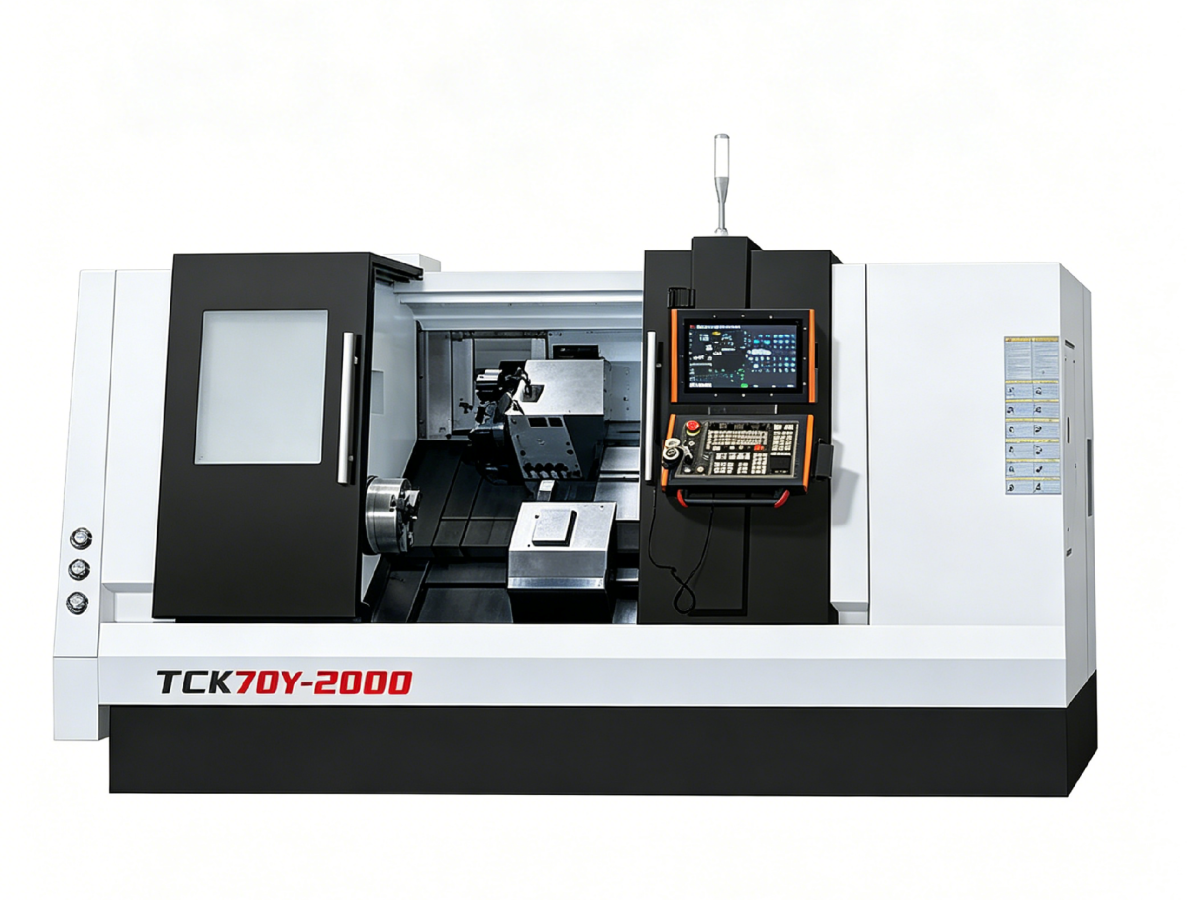
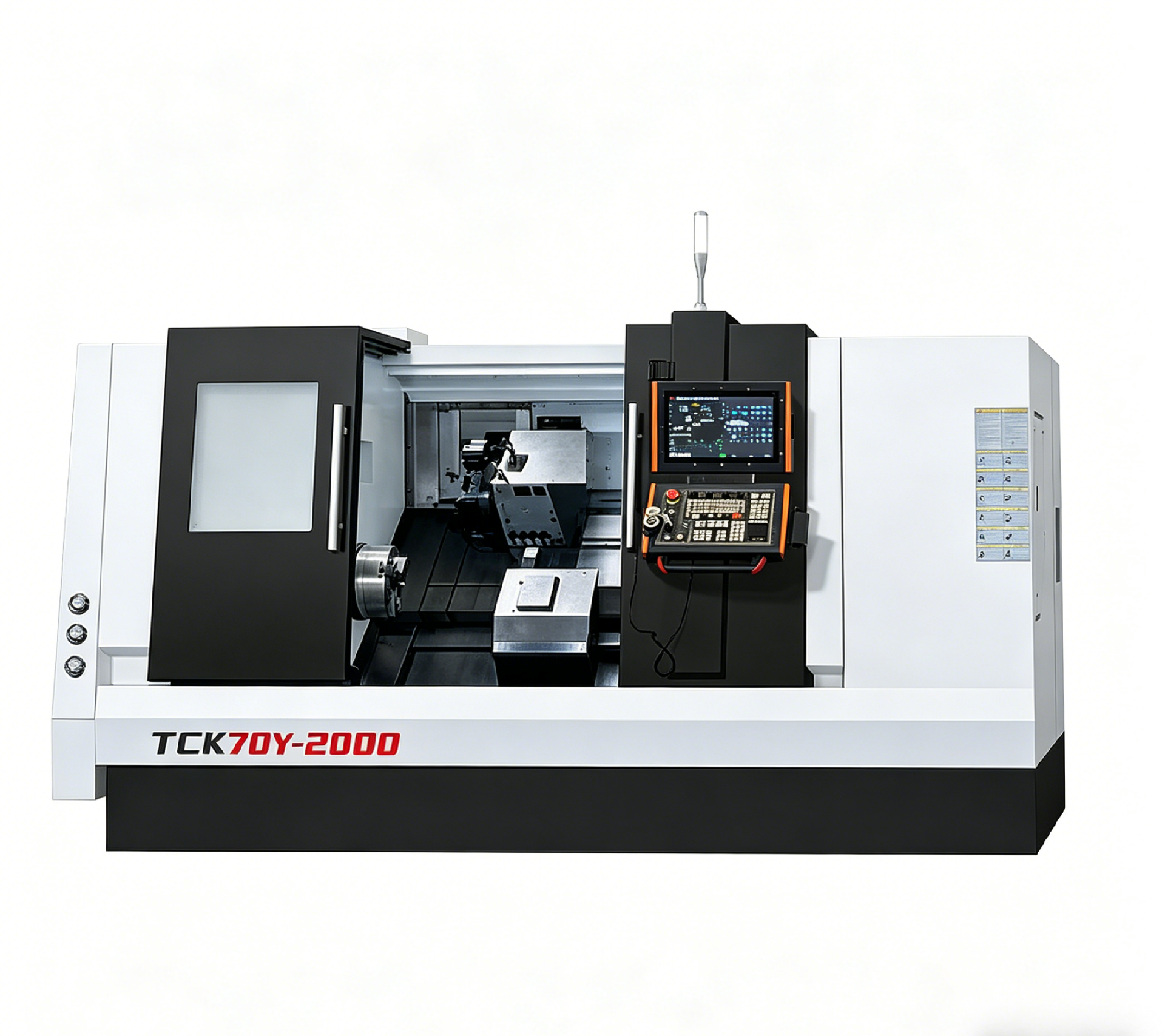
Long shafts are where most turning shops lose money. The part is too long for a standard lathe, so it gets set up twice, re-chucked, and re-dialed in — and the run-out you fought for on the first side is gone by the second. The 70Y mill-turn machine from BONANZA is built around that problem. It covers a maximum cutting length of 1,000 to 3,000 mm, and it carries a customized Mohs 5# spindle structure tailstock that supports the work on the same centerline as the headstock.
Below is what those two numbers mean on the floor, where the machine fits, and what to check before asking for a price.
What a 1,000 to 3,000 mm cutting length actually buys you
The 70Y comes in a range of maximum cutting lengths rather than one size. Bed length drives the price, the floor space, and how much of the machine is doing useful work.
Three things decide which length you need:
- Finished part length plus workholding. A 900 mm shaft is not a 900 mm machine. Add the chuck or collet stack at the headstock, plus the length the tailstock center occupies, and you can easily be at 1,100 mm of real estate before the first cut.
- Whether you turn from bar or from a sawn blank. Bar work with a bar feeder pushes the requirement further, because the feeder side needs clearance too.
- Growth you can actually forecast. Buying one size up for parts that might show up in two years is usually cheaper than buying twice, but two sizes up is dead space and dead capital.
A shop running 600 to 1,400 mm hydraulic cylinder rods and lead screws will be comfortable in the lower part of the range. Anyone cutting 2,000 mm and above — tie rods, ball screw blanks, long spindles — needs the upper end, and should plan the crane or hoist before the machine lands.
The Mohs 5# tailstock, and why the taper matters
The tailstock on the 70Y uses a customized Mohs 5#, that is Morse 5, spindle structure. Morse 5 is the taper size you will find on the heavy end of general machining: it takes standard dead centers, live centers, and taper-shank drill chucks without an adapter sleeve, and the larger shank diameter resists the deflection that a smaller taper shows under steady thrust.
Two practical consequences:
- Tooling stays ordinary. You are not locked into a proprietary center. Off-the-shelf Morse 5 live centers fit, which keeps spares cheap and available.
- The thrust path is short and stiff. On a long part, tailstock thrust is what keeps the work from climbing. A Morse 5 shank mated to a properly ground quill takes that load over a larger contact area than an MT3 or MT4 arrangement.
The tailstock is a spindle structure, not a plain quill riding in a barrel. The rotating element is ground into its own housing on its own bearing arrangement instead of a simple sliding fit. Less play there shows up as less taper in the part and fewer mid-run adjustments.
Rigidity at the top of the spindle
BONANZA specifies better rigidity at the top end of the spindle structure, along with longer service life. That claim points at where a spindle actually fails.
The top of the spindle is the end furthest from the chuck, and it is where bending moment from cutting force is highest relative to the bearing support. When that section is undersized or the bearing preload is loose, you get chatter on interrupted cuts, poor surface finish on long overhangs, and heat that walks the centerline as the shift goes on. A stiffer top section keeps preload stable, which keeps size holding stable from the first part of the shift to the last.
Longer service life follows from the same geometry. Less deflection means less fretting on the bearing seats and less load cycling on the seals, so the spindle stays in tolerance through more running hours before it needs a rebuild.
70Y specifications
| Item | Specification |
|---|---|
| Max. cutting length | 1,000 – 3,000 mm |
| Tailstock | Customized Mohs 5# (Morse 5) spindle structure tailstock |
| Spindle structure | Higher rigidity at the top end, extended service life |
| Machining accuracy | Improved by the spindle-structure tailstock design |
Swing over bed, spindle bore, bar capacity, turret stations, and control configuration are quoted per order on this model. Send the part drawing and the team will confirm the exact build. Full model page: 70Y CNC Mill-Turn Machines.
How the 70Y sits against the rest of the mill-turn line
It helps to place the 70Y against two machines buyers often compare it with, both from the same CNC mill-turn machine series.
The HTMC500T is the shorter, stouter option: max swing over bed 700 mm, max turning length 1,250 mm, max turning diameter 500 mm, spindle nose A2-8 with an 86 mm bore and 75 mm bar capacity, Y-axis travel ±125 mm, and roughly 14,000 kg gross weight. It is the machine for large-diameter, short-to-medium parts that need Y-axis milling in the same setup.
The TCK3100LY covers 1,000 mm of turning length with a 500 mm max turning diameter, A2-8 nose, 85 mm bore, 75 mm bar capacity, Y-axis ±100 mm, and about 8,000 kg. It is a lighter, faster machine for mid-size work with live tooling.
The 70Y is the one you choose when length is the constraint. Where the other two top out around 1,000 to 1,250 mm of turning length, the 70Y reaches 3,000 mm, and it does so with a tailstock built for sustained thrust rather than occasional support.
What to send for an accurate quote
A drawing with tolerances is the minimum. The quote gets much tighter if you also send:
- The blank: bar diameter, or casting/forging with the as-supplied condition.
- Material and hardness, since that drives tooling and cycle time more than part length does.
- The critical features and their tolerance bands, especially concentricity between the two ends.
- Annual volume and batch size, which decides whether a bar feeder or a gantry loader pays for itself.
- Control preference, if your operators are already trained on one platform.
Common questions
Can the 70Y turn and mill in one setup?
Yes. It is a mill-turn machine, not a lathe with a drilling attachment. Milling, drilling, and turning operations on the same part are handled without re-chucking, which is the entire point on long work where re-dialing is expensive.
Is Morse 5 tooling still easy to source?
Yes. Morse 5 is a standard taper. Live centers, dead centers, and taper-shank chucks are stocked by most tooling distributors, so you are not dependent on a single supplier.
How do I know which cutting length to order?
Measure your longest current part, add the workholding and tailstock allowance, then add your realistic growth. If you are within 100 mm of a size break, take the larger one.
For a specific part, the BONANZA team quotes against drawings rather than catalog numbers. Start from the mill-turn series page or the 70Y product page.