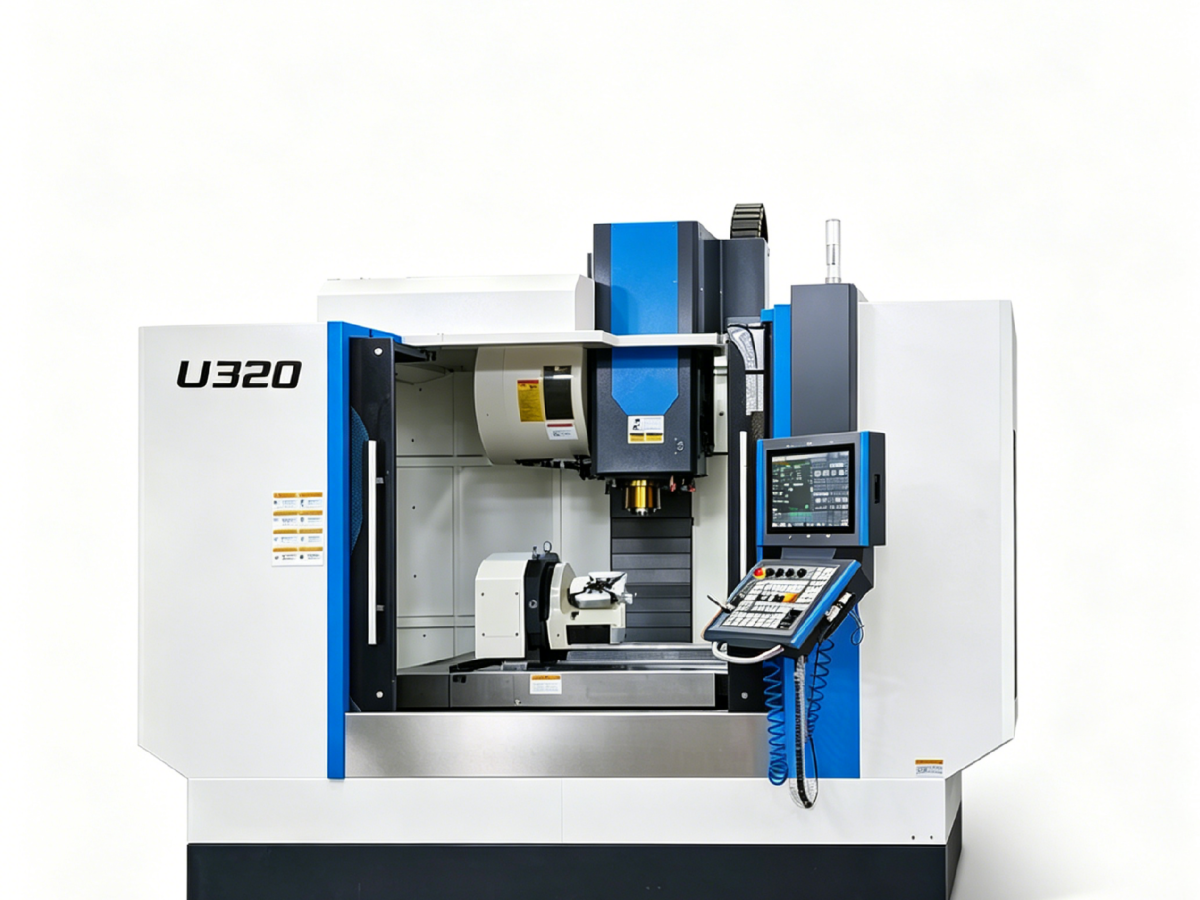
U320 5-Axis Turning and Milling Machine: A Ø320 mm Direct-Drive Table with 1,100 mm of X Travel
Five-axis work rarely fails because the machine cannot move in five directions. It fails because a worm-gear rotary table quietly hands back the accuracy the spindle just bought. The BONANZA U320 5-Axis Turning and Milling Machine attacks that problem head-on: a dual direct-drive rotary table with a Ø320 mm mounting flange and a 150 kg load rating, paired with a direct-drive spindle that runs to 12,000 rpm, and 1,100 mm of X travel.
Here is what the published numbers say, and what they mean when a real part goes on the table.
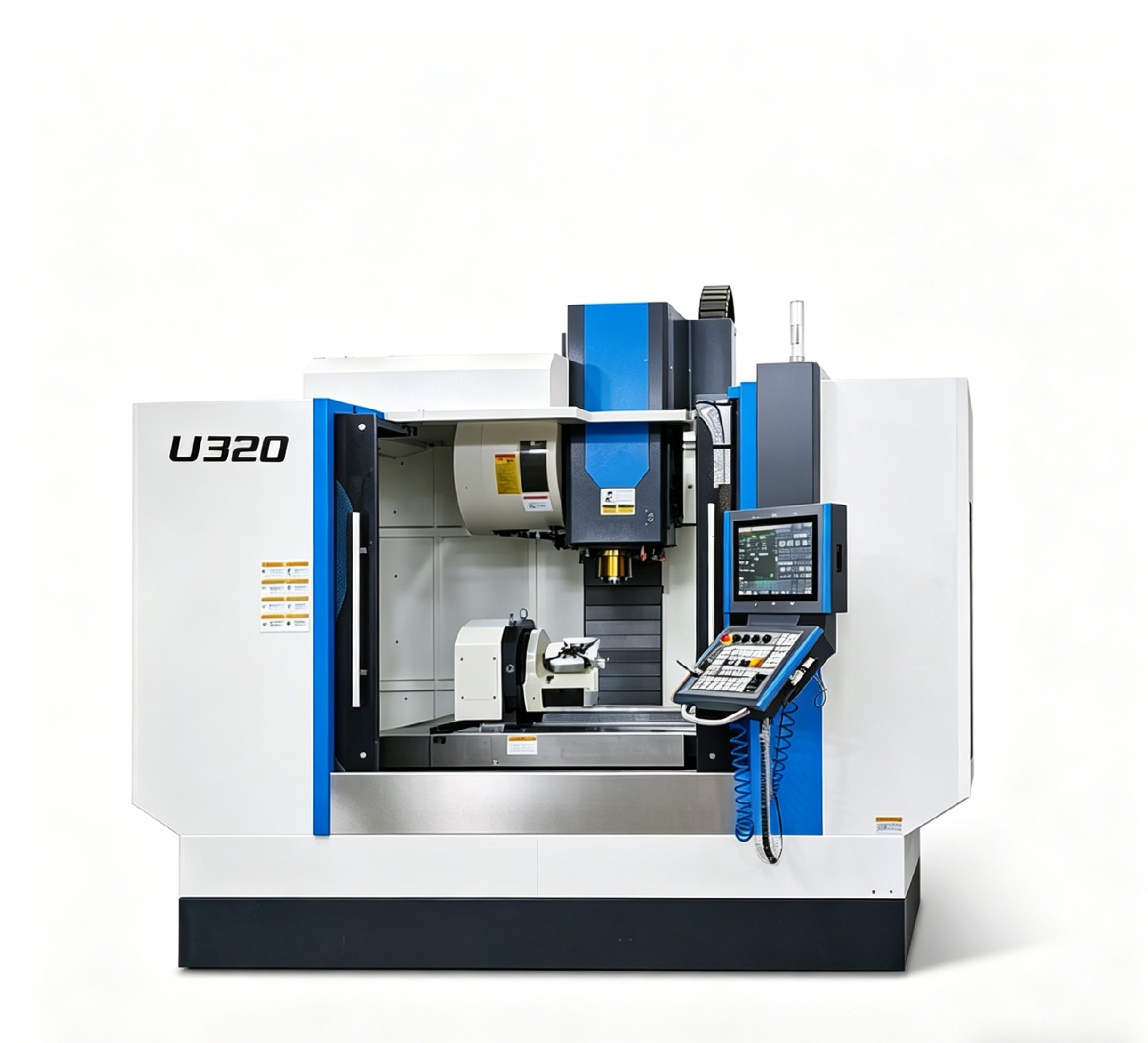
U320 at a glance
| Parameter | U320 |
|---|---|
| X-axis travel | 1,100 mm |
| Y-axis travel | 650 mm |
| Z-axis travel | 650 mm |
| Machining range | 480 × 325 mm |
| Rotary table type | Dual direct drive |
| Table mounting flange diameter | Ø320 mm |
| Table center hole | Ø40 mm |
| Max. table load | 150 kg |
| Spindle type | Direct-drive mechanical spindle |
| Max. spindle speed | 12,000 rpm |
The Ø320 mm table is the actual selling point
Most five-axis machines in this size class index the table with a worm gear. A worm drive is cheap to build and it does work, until you measure what a long cycle does to it. The gear mesh wears, it carries backlash, and heat from a day of continuous rotation moves the table and the part with it.
The U320 takes the direct route instead. A dual direct-drive arrangement puts the motor torque straight into the axis with no gear train in between. What the encoder reads is what the table does, and there is no mechanical slack for the drive to absorb on a reversal. On contoured work, the difference shows up in the finish on a radius and in how repeatable a re-datum actually is.
The practical numbers are honest for the class. The mounting flange is Ø320 mm, the table carries up to 150 kg, and the center hole is Ø40 mm. That center hole is more useful than it reads on a spec sheet: run coolant, air, or fixture wiring through the middle of the table, and you get a clean datum for round parts instead of clamping around the outside. A 150 kg rating covers most of what shops actually put on a table this diameter: impellers, small housings, brackets, valve bodies.
A direct-drive spindle at 12,000 rpm
The spindle is a direct-drive mechanical unit rated to 12,000 rpm. Direct drive means no belt to stretch and no pulley to re-tension on the maintenance list, and the rotor sits on the spindle shaft itself. Speed recovery after a tool change is quick, which adds up over a day of short cuts.
12,000 rpm is a sensible ceiling for this machine class. Light alloys and non-ferrous work can run small tools at their proper surface speed, and steel or cast iron jobs will spend their time well below that anyway. Spindle power and tool-holder style are not fixed in the published spec, so confirm both for your build at quote time: a job that lives in hardened material needs a different answer than one cutting aluminium housings all day.
1,100 mm of X travel on a compact five-axis frame
Plenty of five-axis machines can reach five sides of a part in theory. In practice the sequence stalls on travel: the part fits on the table, but the head runs out of X before the tool reaches the far corner. The U320 lists 1,100 mm on X, 650 mm on Y, and 650 mm on Z, with a stated machining range of 480 × 325 mm.
That spread is worth reading carefully. The 480 × 325 mm envelope is the working zone you size your parts against; the 1,100 mm of X travel is what keeps the head from running out of room on long fixtures and off-center set-ups.
Who the U320 suits
This machine makes sense if any of these describe your shop:
- You run contoured parts that need real simultaneous five-axis motion, not just angled drilling on a three-axis machine
- Your workpieces sit in the 50 to 150 kg range and need a table that holds position under load
- You are moving parts between machines today and re-establishing datums on every trip
- You want five-axis capability without taking on worm-gear table maintenance
If your parts are plain three-axis prismatic work, a vertical machining center will do it for less money. The U320 earns its place when the geometry turns curved and the datums start to matter.
Where it sits in the BONANZA five-axis lineup
The 5-axis turning and milling series covers a wide spread, and the models are not interchangeable:
- The U260 is the compact end of the direct-drive family: Ø260 mm flange, 80 kg table load, 850/600/600 mm travel.
- The U320 sits in the middle with a Ø320 mm flange, 150 kg load, and a much longer 1,100 mm X axis.
- The U400 is the largest of the direct-drive U-series: Ø400 mm flange, 200 kg load, 1,300/700/750 mm travel, and an 11 kW spindle.
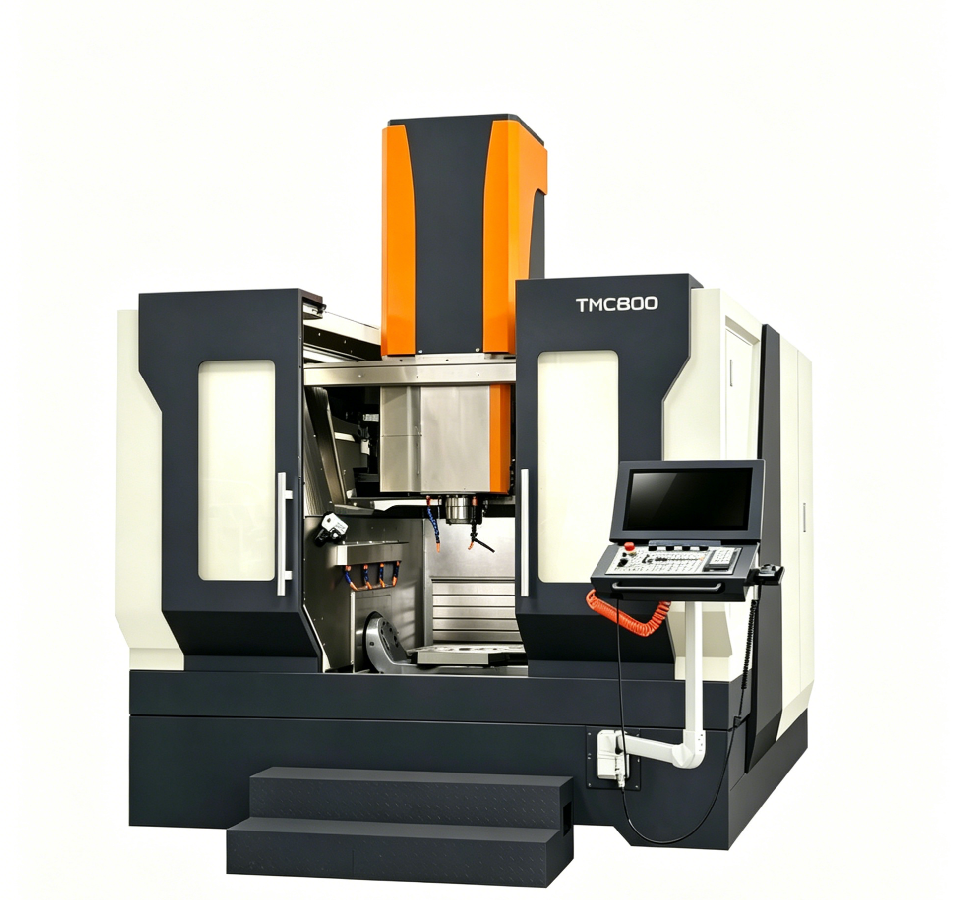
- If your work needs a tilting trunnion and higher speed instead of a flat direct-drive table, the TMC630 and TMC800 run HSK-class spindles at 15,000 rpm with an A-axis that tilts through ±110°.
Table diameter, table load, and spindle type decide this class of purchase. Pick the machine whose smallest of those three still clears your heaviest part.
What to confirm before you order
Published specs cover travel and table capacity well, and they are quiet on a few things that matter at installation. Machine weight and overall dimensions are not listed for the U320, so ask the factory for the drawing before you plan rigging, floor loading, and door clearance. Confirm spindle power and tool-holder type for your build, and confirm the workholding: fixtures for a Ø320 mm direct-drive table need to be balanced and sized for the load rating, and that is a conversation worth having before the machine ships rather than after.
Frequently asked questions
How much weight can the U320 table carry?
150 kg, with a Ø320 mm mounting flange and a Ø40 mm center hole. That covers most impeller, housing, and bracket work in this size class.
What is the difference between the U320 and the U260?
Both use dual direct-drive tables. The U320 has a larger Ø320 mm flange, a 150 kg load rating against the U260’s 80 kg, and 1,100 mm of X travel against 850 mm, so it takes heavier parts and longer set-ups.
Does the U320 need a special foundation?
Weight and footprint are not published in the current spec sheet, so ask BONANZA for the arrangement drawing and installation weight before you prepare the floor.
Bottom line
The U320 is built for shops that have already paid the price of backlash once and do not want to pay it again. A dual direct-drive Ø320 mm table rated to 150 kg, a 12,000 rpm direct-drive spindle, and 1,100 mm of X travel over a 480 × 325 mm working envelope add up to a five-axis machine that holds what it positions.
Have a part that needs it? Send the BONANZA team your drawing or a short list of typical jobs, with material and part weight, and you will get a direct answer on whether the U320 5-Axis Turning and Milling Machine fits, or whether the smaller U260 or the larger U400 is the better match.