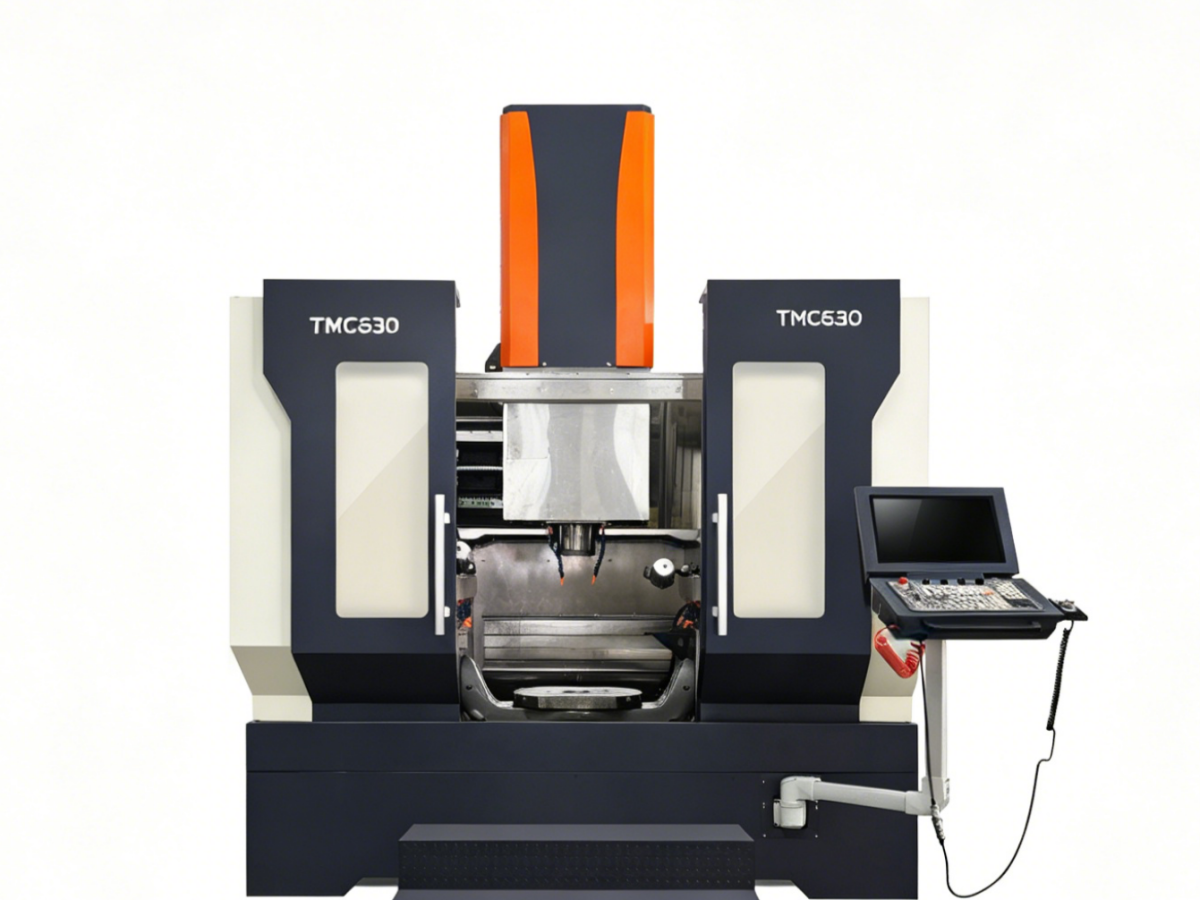
TMC630 5-Axis Turning and Milling Machine: A 650 mm Trunnion Table for Mixed Turning and Milling Work
Five-axis lathes come in two flavours. There are the compact machines with a 260 or 320 mm table, built for small medical and hydraulic parts you can lift by hand. Then there is the TMC630 5-axis turning and milling machine, a 650 mm trunnion built to hold 500 kg on the table while a 15,000 rpm HSKT63 spindle works the part from any angle.
Machine tools are not only about capacity. They are about what happens when you push a large workpiece and the tool bites. Here are the numbers, and what each one means on the floor.
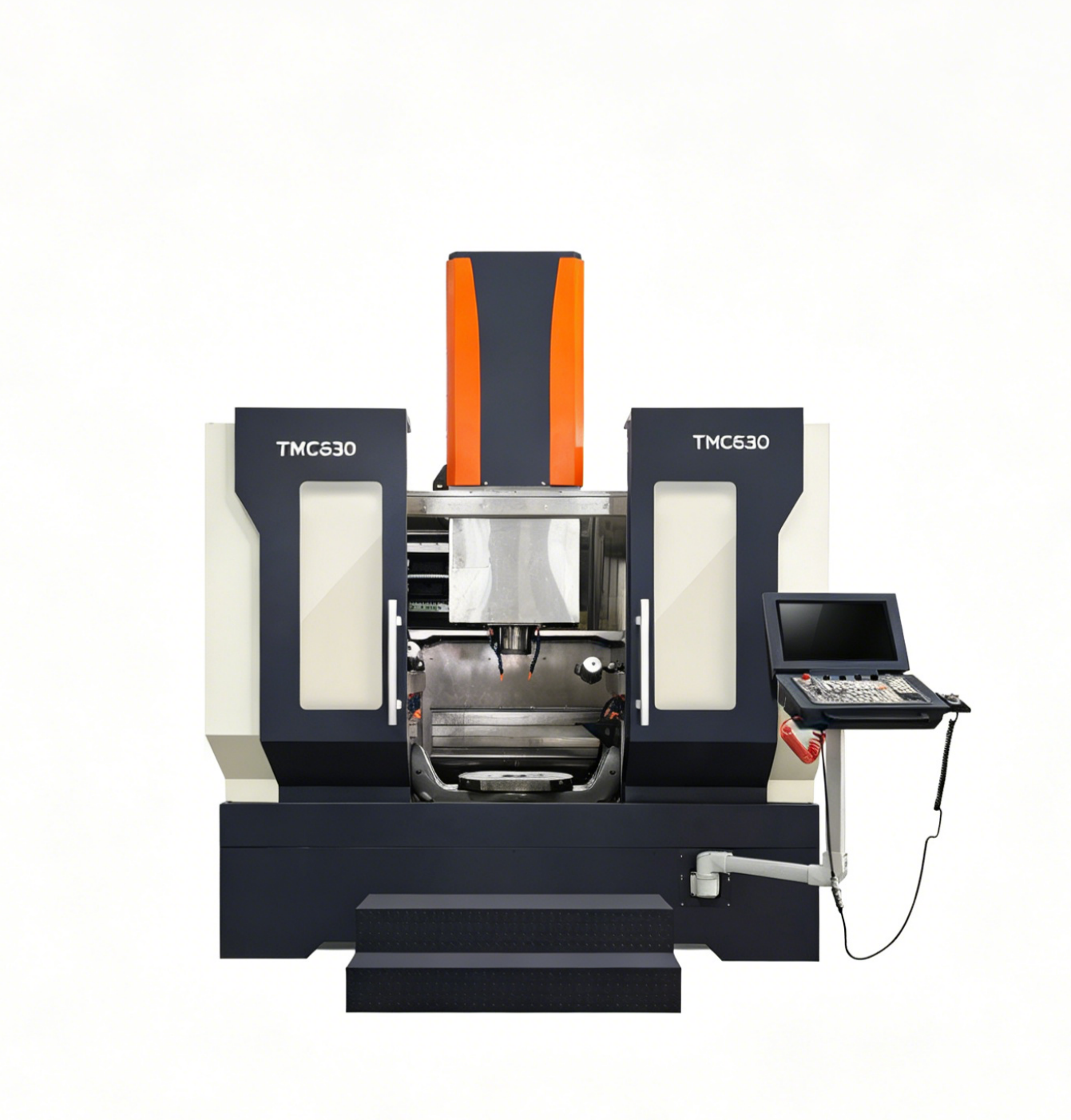
TMC630 specifications at a glance
| Parameter | TMC630 |
|---|---|
| X-axis travel | 700 mm |
| Y-axis travel | 350 + 590 mm (including tool change stroke) |
| Z-axis travel | 550 mm |
| A-axis tilt range | ±110° |
| C-axis rotation range | 360° |
| C-axis rotary table diameter | 650 mm |
| Rotary table permissible load | 500 kg |
| C-axis max speed | 400 rpm |
| A-axis max speed | 100 rpm |
| Spindle taper | HSKT63 |
| Max spindle speed | 15,000 rpm |
| Machine weight | 11 t |
The 650 mm table and 500 kg load are the reason this machine exists
Most machines in this class ask you to break the job into two setups, or to accept a table that will not take the weight. The TMC630 avoids both. A 650 mm trunnion rated for 500 kg holds castings, valve bodies and pump housings that a smaller table cannot carry, and holds them while the spindle reaches five faces without a rechuck.
Load rating is where a lot of five-axis quotes fall apart. People compare table diameters and forget that a large casting also needs workholding, an angle plate and fixtures, all of it inside the 500 kg budget. On a 650 mm table that arithmetic works. On a 400 mm table it often does not, and the shop finds out after the machine is on the floor.
The C axis turns at up to 400 rpm. That is not a lathe spindle, and the TMC630 is not pretending to be one. It is a positioning and contouring motion that keeps the tool engaged while the part rotates: useful for turning a flange OD, milling a curved pocket wall, or drilling a bolt circle without moving the part.
HSKT63 at 15,000 rpm: a high speed spindle for light cuts and fine finishes
The spindle spec tells you the intended work. HSKT63 is a stub taper designed for high speed, and 15,000 rpm puts this machine in finishing territory: aluminium, thin-wall parts, small-diameter end mills, and the fine stepovers that make a good surface finish. If your work is heavy roughing in steel, you want a different machine. If it is profile milling a complex part in one clamping to a tolerance that survives a CMM, this spindle is built for that.
How the TMC630 compares with the rest of the BONANZA five-axis range
BONANZA builds a full 5-axis turning and milling machine series, from small direct-drive U models to the larger TMC800. The models differ mainly by the parts they fit:
- U260 is the smallest: direct-drive rotary table of 260 mm, 80 kg load, 12,000 rpm spindle, for parts with a machining range around 380 × 300 mm.
- U320 steps up to 320 mm flange diameter, 150 kg load and larger travels for work that has outgrown a small table.
- LH400 and LH500 use 400 mm and 500 mm tables with 200 kg and 350 kg loads, plus long Z travel for shaft-like parts milled along their length.
- TMC630 is the mid-table workhorse: 650 mm table, 500 kg load, HSKT63 taper, plus a wider X travel of 700 mm than the LH machines, which is useful when the part sits off the table centre.
- TMC800 is the largest, with 850 mm of X travel, 1040 mm of Z travel and the same HSK-T63 spindle.
If your parts are heavy and awkward rather than long, the TMC630 is usually the right starting point. If they are long and comparatively light, an LH machine is cheaper for the same result.
What the axis travels actually cover
Read the Y travel carefully. The figure is 350 + 590 mm, where the extra 590 mm is tool change stroke. The useful cutting envelope is closer to the first number, and the extra stroke is what the machine needs to change tools. That distinction matters when you plan a fixture.
Z travel of 550 mm with an A axis that tilts ±110° gives you good access to the ends of a part and the ability to work past vertical, which is how you reach the back face of a flange or a bore that sits at an awkward angle. For valve bodies and hydraulic blocks with passages on several faces, that reach is what removes the second setup.
Shop floor notes before you request a quote
At 11 t the machine needs a proper floor, so plan lifting and rigging around that weight rather than the footprint. A 15,000 rpm spindle also wants a stable, vibration-free base; on a weak floor you lose finish long before you lose accuracy.
Think about tooling before you order. HSKT63 holders are a smaller ecosystem than BT40, so check availability with your supplier and budget for a starter set. Coolant matters as well: aluminium at 15,000 rpm makes fine chips and plenty of heat, so discuss through-spindle coolant with BONANZA if your parts need deep pockets or long drills.
Be realistic about the CAM side too. Five-axis work lives or dies on post-processor quality, so ask for a post that matches the control on the machine you buy and test it on a simple part before the machine reaches your shop.
Frequently asked questions
What size parts can the TMC630 hold?
The C-axis rotary table is 650 mm in diameter with a permissible load of 500 kg. That allowance covers the workpiece plus workholding, so a 400 kg casting with an angle plate will sit close to the limit. X/Y/Z travels are 700 / 350 + 590 (including tool change stroke) / 550 mm, and the A axis tilts ±110°.
Can the TMC630 replace a lathe and a machining centre?
It closes the gap between them for parts that need turning features and milling on several faces. The C axis rotates to 400 rpm, which covers contouring and positioning rather than high-speed turning. Shops machining valve bodies and hydraulic manifolds use it to finish parts in one clamping instead of two or three setups.
Is HSKT63 tooling easy to find?
HSKT63 is a standard stub taper, but it is less common than BT40 or HSK-A63 in some markets. Check holder availability with your tooling supplier before you commit, and include a starter set in your budget. BONANZA can advise on the tooling package that suits your parts.
Talk to BONANZA about your parts
Nobody can pick a five-axis machine from a spec table alone. Send BONANZA your drawings or a description of the parts you run and you get a straight answer on whether the TMC630 5-axis turning and milling machine fits, or whether a larger TMC800 or a lighter LH model serves you better. Browse the full five-axis series, then request a quote through the website.