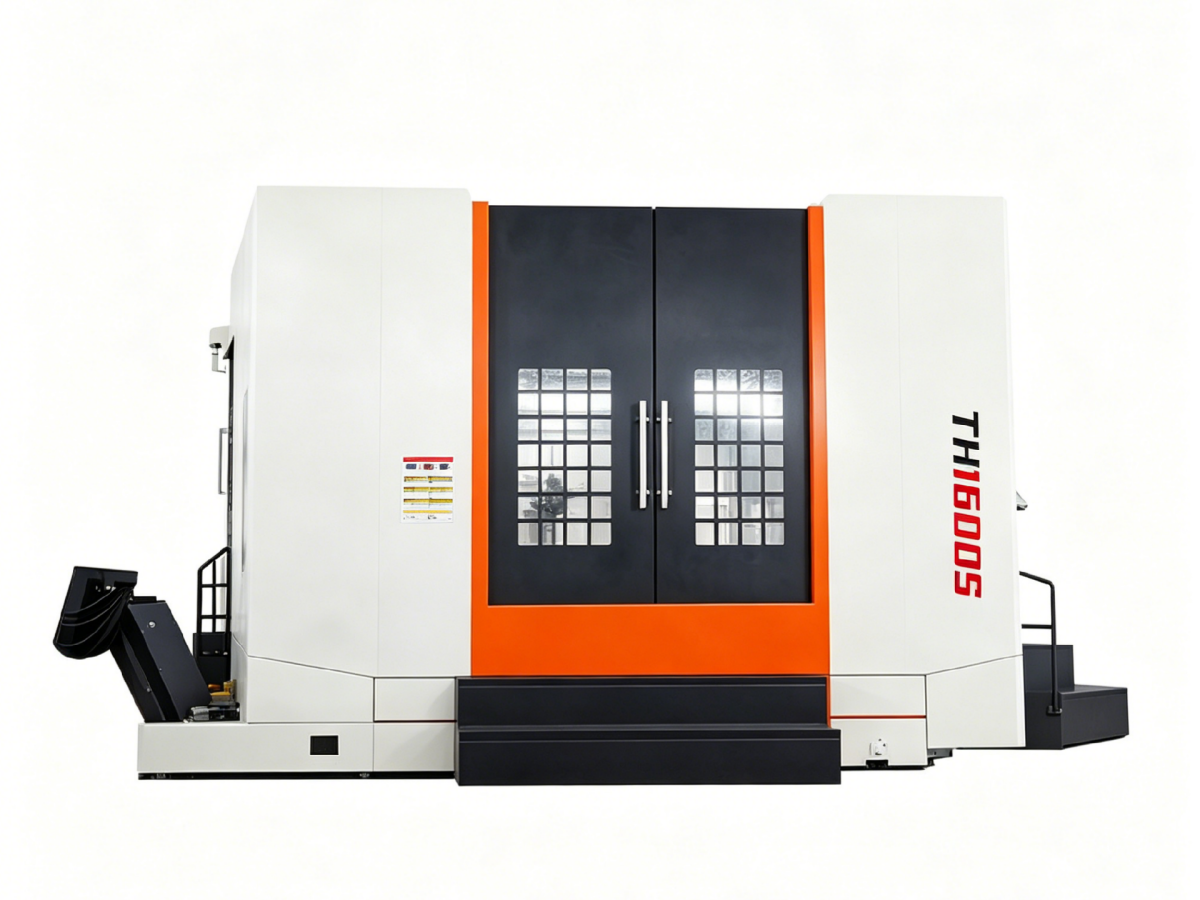
A 1600 mm pallet that carries ten tonnes is not a machine you buy for speed. It is the machine you buy when the part in front of you is a gearbox housing, a press frame or a machine-tool bed casting, and every previous setup has involved a crane and three hours of indicating before the first cut. The TH1600S is BONANZA’s largest published horizontal machining center, and its numbers describe a very specific kind of work.
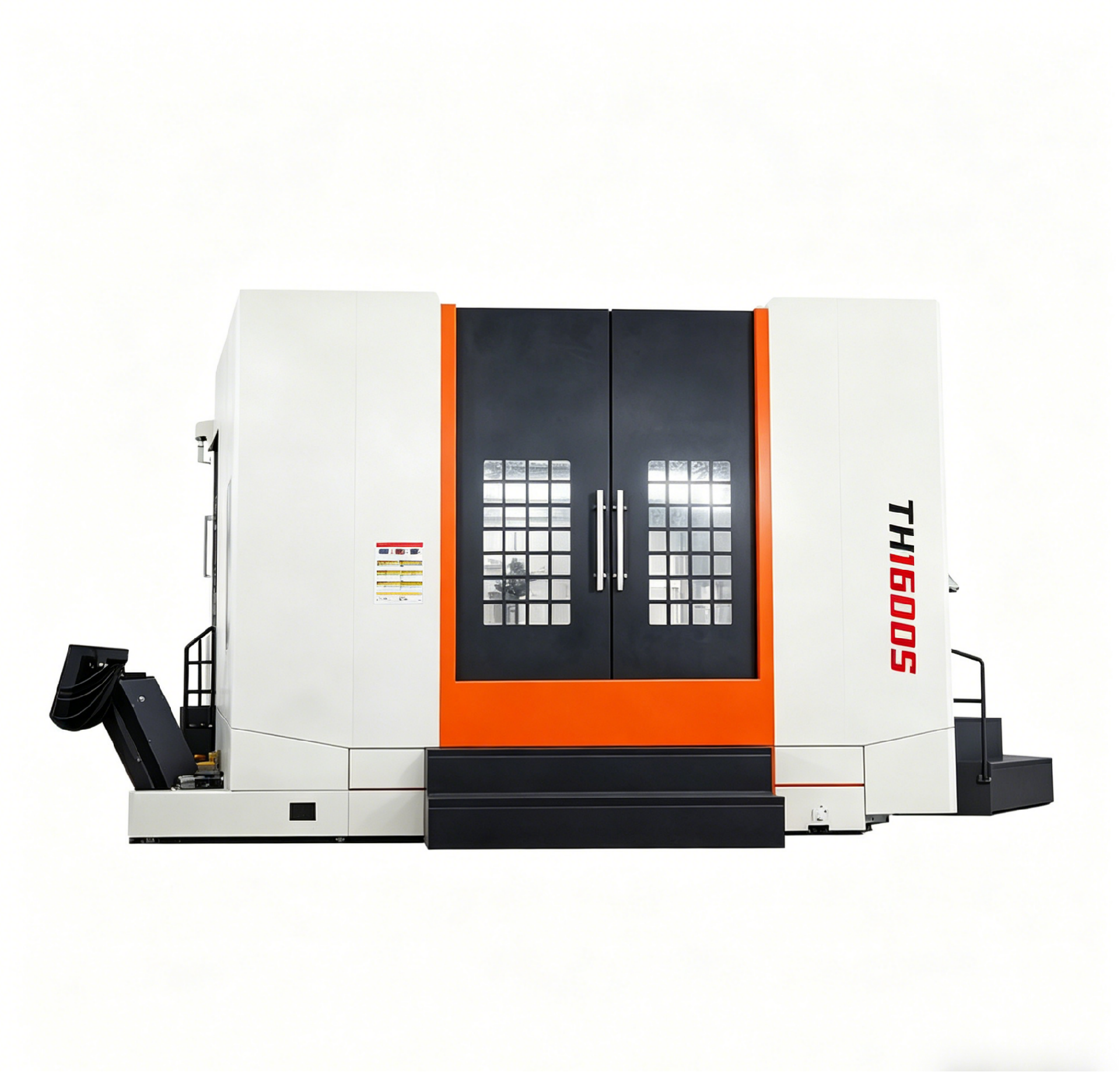
TH1600S published specifications
| Item | TH1600S |
|---|---|
| Table size | 1600 × 1600 mm |
| Max. load capacity | 10,000 kg |
| T-slot (number × width × pitch) | 7–28–220 mm |
| X-axis travel | 2000 mm |
| Y-axis travel | 1500 mm |
| Z-axis travel | 1800 mm |
| X / Y / Z rapid traverse | 12 / 12 / 12 m/min |
| Spindle taper | BT50-45° |
| Spindle speed range | 1500 r/min |
| Machine weight | 24,000 kg |
What the 10,000 kg rating actually changes
Most horizontal machining centers in the 630 to 800 mm class are rated between 500 kg and 2,000 kg. That figure is not a suggestion bolted on by the sales department. It comes from the pallet casting, the indexing mechanism underneath it, the clamp pressure and the way the assembly sits on the machine bed. Put a 9 tonne casting on a pallet rated for 2 tonnes and nothing dramatic happens on the first day. Over six months the table face loses flatness, the index positioning drifts, and the operator starts shimming.
At 10,000 kg, the TH1600S lets you load a part that is heavy in absolute terms rather than heavy relative to the machine. A large pump housing, a die-cast tool base, a mining equipment frame — these normally get pushed onto a floor borer or a gantry mill, where one setup takes half a shift and every additional face is a new setup. Here the part is clamped once and the pallet indexes.
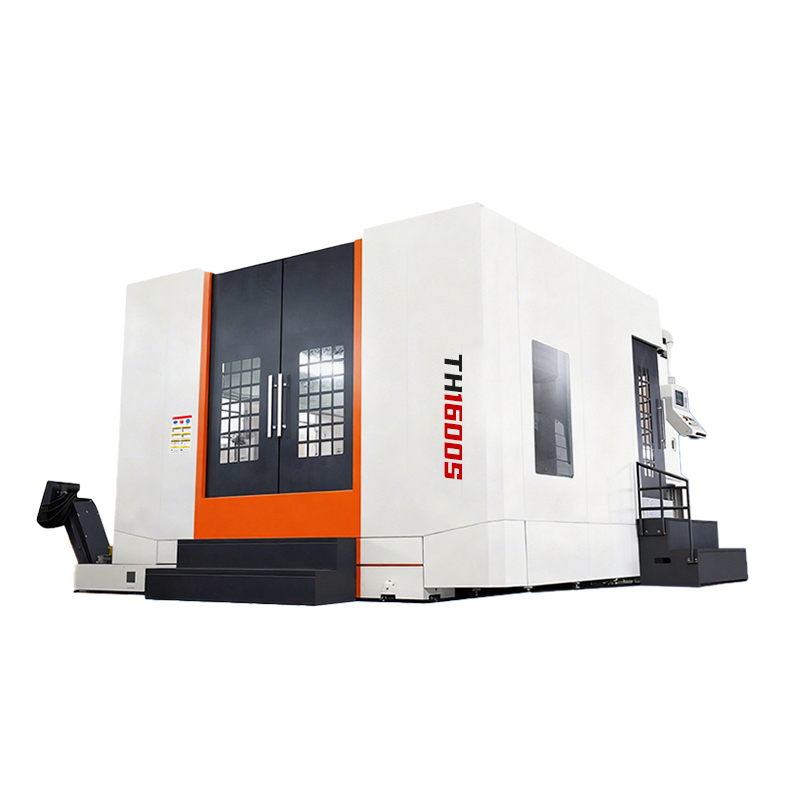
The travel envelope: 2,000 × 1,500 × 1,800 mm over a 1,600 mm table
The relationship between table size and travel matters more than the travel numbers alone. X travel is 2,000 mm against a 1,600 mm table, leaving 200 mm of overtravel at each end. That is enough to reach the outer edges of a full-size part, and it is the margin that matters when you are boring a bearing seat on the extreme corner of a housing. Y of 1,500 mm is slightly under the table width; Z of 1,800 mm is the figure that decides whether the machine can swing a large face mill and still reach the far wall of a deep cavity.
The T-slots are 28 mm wide at 220 mm pitch, seven of them. Wide slots and a coarse pitch mean you are bolting down with M24 or M30 studs, not the M16 hardware common on smaller pallets. If your fixture design assumes 18 mm slots, plan for new fixture plates.
BT50-45° at 1,500 rpm — a torque machine, not a speed machine
The spindle speed ceiling tells you what this machine is for. At 1,500 r/min with a BT50-45° taper, the TH1600S is built around low-speed, high-torque cutting: rough boring in cast iron, face milling steel, drilling large diameters without a pilot, tapping coarse threads. The 45° taper is self-releasing and holds rigidly under heavy radial load — exactly the load a large boring bar puts on a spindle.
What it is not built for is aluminum. If your work is thin-wall aluminum housings, high-speed finishing with small tools, or 20,000 rpm engraving, this spindle will be the bottleneck and you will spend your days at 15 percent of the machine’s capability. Be honest about the material mix before you specify a machine this size.
BONANZA does not publish spindle power or torque for the TH1600S on the product page. Ask for both figures in writing, along with the torque curve, before you commit. A 1,500 rpm BT50 spindle can be geared anywhere from roughly 15 kW to 30 kW and the difference decides whether you can run a 125 mm face mill at depth or not.
12 m/min rapids are not a problem here
Twelve meters per minute looks slow next to the 24 to 36 m/min quoted on small vertical machines. On a 24 tonne structure it is sensible: high acceleration loads the guideways and ballscrews, and the parts this machine cuts are measured in hours, not seconds. If cycle time is dominated by positioning on a 1600 mm pallet, the problem is the process, not the rapid rate.
Where it sits in the BONANZA horizontal range
| Model | Pallet | Max load | Travel X/Y/Z | Spindle | Weight |
|---|---|---|---|---|---|
| TH500 | 1200 × 600 mm | 800 kg | 1100/750/650 mm | BT40 taper | 7,200 kg |
| 1000S-DT | 1000 × 1000 mm | 4,000 kg | 1800/1000/1300 mm | BT50-45°, 3000 rpm | 16,000 kg |
| TH1400S | 1400 × 1400 mm | 5,000 kg | 1800/1300/1500 mm | BT50-45°, 2000 rpm | 19,500 kg |
| TH1600S | 1600 × 1600 mm | 10,000 kg | 2000/1500/1800 mm | BT50-45°, 1500 rpm | 24,000 kg |
The jump from TH1400S to TH1600S is not incremental. Travel grows by 200 mm in X, 200 mm in Y and 300 mm in Z, but the load rating doubles from 5,000 kg to 10,000 kg and the machine puts on 4,500 kg of cast iron. That extra mass is the reason the load rating can double: the pallet support, the bed and the column were redesigned, not stretched.
If your heaviest part is 4 tonnes and fits a 1,400 mm square, the TH1400S is the cheaper correct answer. Buying the TH1600S for a 4 tonne part means paying for foundation work, crane capacity and floor space you do not need. See the full horizontal machining center range for the complete comparison.
Installation is part of the specification
At 24,000 kg, the TH1600S needs a designed foundation, not a standard 200 mm slab: an isolated block with anchor bolt pockets, plus a slab or soil assessment before delivery. Lifting needs a crane rated well above 24 tonnes with spreader beams. Measure the door, the truck turning radius and the crane reach before you sign anything — machines sit on loading docks for two weeks because nobody measured the door.
What the published sheet does not cover
Several items that decide the real capability of a machine this size are not on the product page. Before ordering, ask BONANZA to confirm in writing:
- Spindle motor power, torque and the torque curve across the speed range
- Positioning and repeat positioning accuracy, and the inspection standard used (ISO 230-2 or JIS B 6336, for example)
- Tool magazine capacity, maximum tool diameter and maximum tool weight
- Whether the machine is supplied with a pallet changer as standard or as an option, and the number of pallet stations
- Table indexing type and increment — whether it is a 1° indexing table or a full contouring B axis
- Guideway type on each axis and the ballscrew diameter and class
- CNC controller make and model, and which functions are included versus optional
None of these are small details. On a machine in this class, the pallet changer question alone can change the price by a meaningful percentage, and the accuracy standard determines whether the machine suits jig-boring work or only roughing and semi-finishing.
Who should be looking at this machine
The TH1600S makes sense for heavy equipment builders, mining and construction machinery suppliers, large pump and valve producers, and job shops that regularly turn away work because nothing on the floor can hold it. It makes less sense for a shop whose heaviest part is 800 kg, because the machine will spend its life cutting air at 1,500 rpm.
If you want to talk through your part envelope, weight and material mix against the TH1600S and the rest of the range, send the drawing to BONANZA’s engineering team. We will tell you if a smaller machine will do the job.