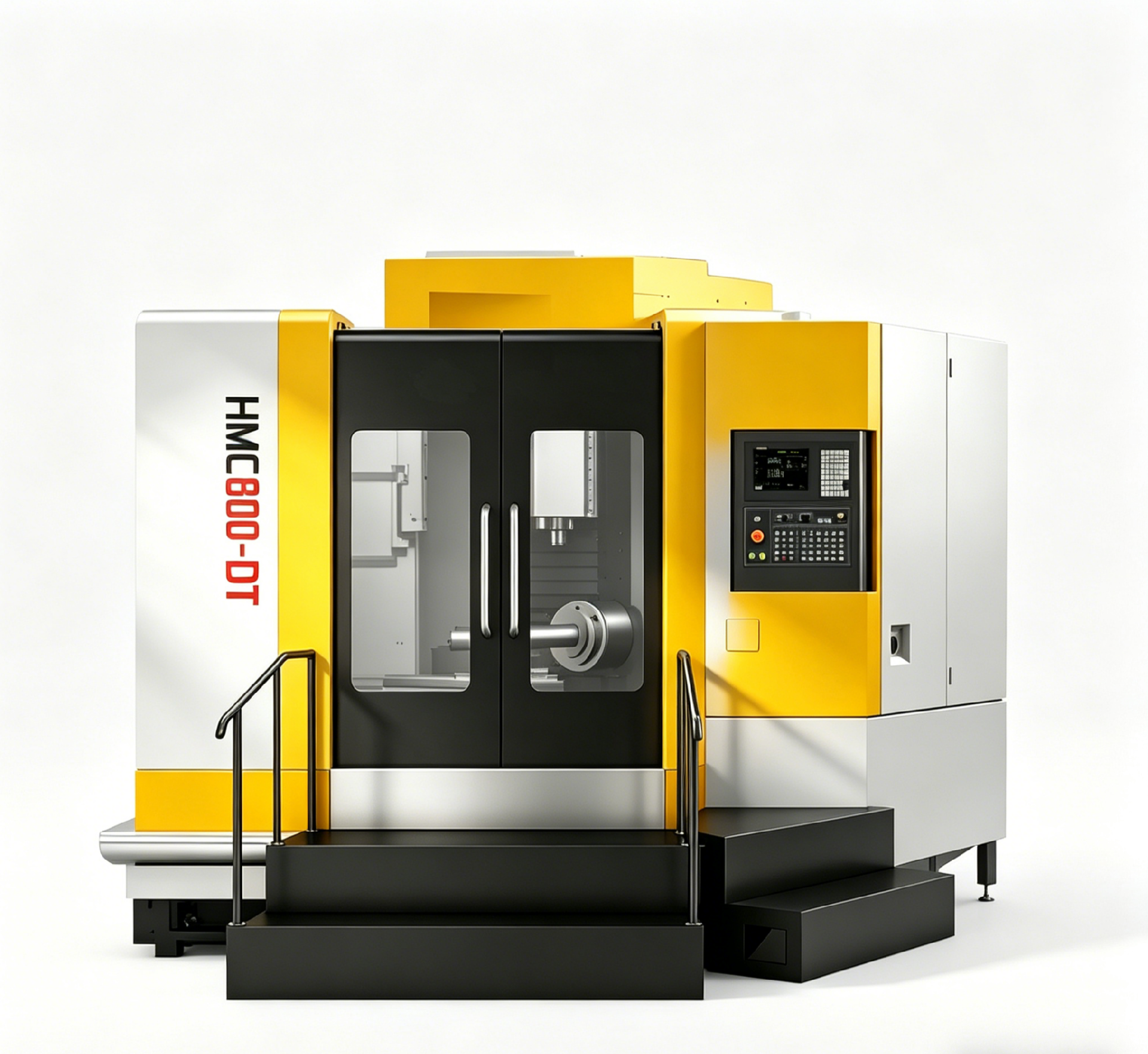
HMC800 Horizontal Machining Center – 2,500 kg on the Table and a BT50-200 Spindle
Horizontals get bought for one reason: the part has faces on four sides, and nobody wants to flip it three times. The BONANZA 800-DT Horizontal Machining Center, listed on the specification sheet as the HMC800, is aimed at that job. An 800 × 800 mm table rated to 2,500 kg, a BT50-200 spindle turning to 6,000 rpm, 1,300 / 1,150 / 1,000 mm of travel, and 16,000 kg of machine underneath it.
Here is what those numbers mean once a box casting is clamped down.
HMC800 at a glance
| Parameter | 800-DT (HMC800) |
|---|---|
| Table size | 800 × 800 mm |
| Max. worktable load | 2,500 kg |
| T-slot | 7-22-100 mm |
| X / Y / Z travel | 1,300 / 1,150 / 1,000 mm |
| Rapid traverse X / Y / Z | 12 / 12 / 12 m/min |
| Spindle taper | BT50-200 |
| Spindle speed | 6,000 rpm |
| Machine weight | 16,000 kg |
What 2,500 kg on an 800 mm table buys
An 800 mm square table is a common size, and the load rating is where models separate. The 800S-DT is rated to 2,000 kg on the same table, the 630-DT to 1,200 kg on 630 mm, and the 1000S-DT to 4,000 kg on 1,000 mm.
The 800-DT carries 500 kg more than the 800S-DT without asking for more floor space. Heavy parts are usually the real constraint on a job, not the cut. A cored housing on a pallet at 2,300 kg rules out any machine rated at 2,000 kg, however good its spindle is.
The table is T-slotted at 7-22-100 mm, so fixture plates bolt straight down and tall workpieces do not need a tombstone.
The spindle: BT50-200 at 6,000 rpm
BONANZA publishes the spindle as BT50-200. The taper is BT50, and 200 is the nose designation the factory uses for this build. What matters on the floor is a large taper with a 6,000 rpm ceiling, which points at torque rather than top-end speed.
A BT50 holder takes larger diameter tools than BT40 and holds them more rigidly at long gauge lengths. On a boring pass through a gearbox housing, or a face mill taking a deep cut across a 700 mm casting, that rigidity keeps the tool quiet and the bore on size. A 6,000 rpm limit rules out high-speed aluminium work; in steel and cast iron this spindle is in its element.
Spindle motor power and torque are not published for the 800-DT. If roughing is a large part of your cycle, ask for the motor rating and torque curve in writing at quote stage.
Split bed, high-low rails, and a spindle reducer
Four design points are called out on the product page, and each one does something specific.
- A T-shaped split bed with an interface reserved for an exchange workbench, so the machine can be extended to pallet changing later.
- X-axis guide rails in a high and low layout, which limits saddle overhang at the ends of travel.
- A reducer on the spindle, which raises cutting torque at the tool. This is how a 6,000 rpm spindle keeps its authority in a heavy cut.
- 55 size heavy-duty rails set a wide distance apart, spreading the load from a 2,500 kg table over a wider base.
Travel and rapids
The 800-DT covers 1,300 mm in X, 1,150 mm in Y and 1,000 mm in Z. A horizontal spindle approaches from the side, so travel has to clear the workpiece rather than sit above it. The 1,300 mm X stroke over an 800 mm table reaches every face of a part that hangs past the table edges.
Rapid traverse is 12 m/min on all three axes, so a full X traverse takes about six and a half seconds. If your parts are small and your cycles are short, this is not the machine for them.
Where the HMC800 sits in the range
The horizontal machining center series steps up in a clear order:
- 630-DT: 630 × 630 mm table, 1,200 kg load, 1,100 / 900 / 1,000 mm travel, BT50 φ190 at 6,000 rpm, 12,000 kg.
- 800S-DT: 800 × 800 mm table, 2,000 kg load, 1,300 / 1,000 / 1,000 mm travel, BT50-45°, 15,500 kg.
- 800-DT (HMC800): 800 × 800 mm table, 2,500 kg load, 1,300 / 1,150 / 1,000 mm travel, BT50-200 at 6,000 rpm, 16,000 kg.
- 1000S-DT: 1,000 × 1,000 mm table, 4,000 kg load, 1,800 / 1,000 / 1,300 mm travel, BT50-45° at 3,000 rpm, 16,000 kg.
Read down the list and the pattern is obvious: bigger tables, slower spindles. Parts heavy enough to need a 5,000 kg table also need a tool that can take a deep cut without stalling.
The 800-DT sits in the middle, which is a useful place to be. It holds more weight than the 800S-DT without the extra floor space of a 1,000 mm table, and it keeps the 6,000 rpm spindle that the 1000S-DT gives up. If your parts top out near 1,500 kg, the 800S-DT does the job for less.
Installation notes
BONANZA does not publish an overall footprint, door width or height for the 800-DT, so those have to come from the factory before delivery. Foundation design, floor loading and the route from the dock to the final position all need checking first, because a doorway measured after the truck arrives is an expensive mistake.
Who the 800-DT suits
- Box housings, valve bodies and pump casings that need boring and milling on four faces
- Castings and weldments between roughly 2,000 and 2,500 kg that have outgrown a 630 or 800S table
- Shops that want headroom on table capacity
- Heavy work in steel and cast iron, where a BT50 taper at 6,000 rpm with a reduced spindle beats a faster BT40
What to confirm before you order
- Spindle motor power and torque rating, if heavy roughing is part of the plan
- Tool magazine capacity and holder style for your build
- Whether the reserved workbench interface can be supplied as a working pallet changer, and on what lead time
- Positioning and repeat accuracy figures, plus the acceptance test standard
- Overall footprint, foundation drawing, floor loading and doorway clearance
Frequently asked questions
What is the difference between the 800-DT and the 800S-DT?
Both use an 800 × 800 mm table with a 7-22-100 mm T-slot. The 800-DT carries 2,500 kg against 2,000 kg, has 1,150 mm of Y travel against 1,000 mm, and uses a BT50-200 spindle at 6,000 rpm. It weighs 16,000 kg against 15,500 kg.
How fast is the 800-DT spindle?
6,000 rpm, with a BT50-200 taper. The machine is set up for torque in steel and cast iron, not high-speed work in aluminium.
Is the HMC800 a 3-axis machine?
The published specification lists X, Y and Z only, so it is a 3-axis horizontal. There is a reserved interface for an exchange workbench, which points at future pallet automation. Raise a fourth axis with the factory at quote stage.
Bottom line
The 800-DT, or HMC800, is a middle-weight horizontal built for heavy multi-face work. An 800 × 800 mm table rated to 2,500 kg, 1,300 mm of X travel, a BT50-200 spindle at 6,000 rpm and 16,000 kg of structure let it hold a big casting and machine around it without re-fixturing. The 12 m/min rapids and the conservative top speed are the right trade-offs for that job, not compromises.
Send the BONANZA team the drawing with material, part weight and finished size. You will get a straight answer on whether the 800-DT Horizontal Machining Center fits, or whether an 800S-DT or a larger TH1400S is the better match.