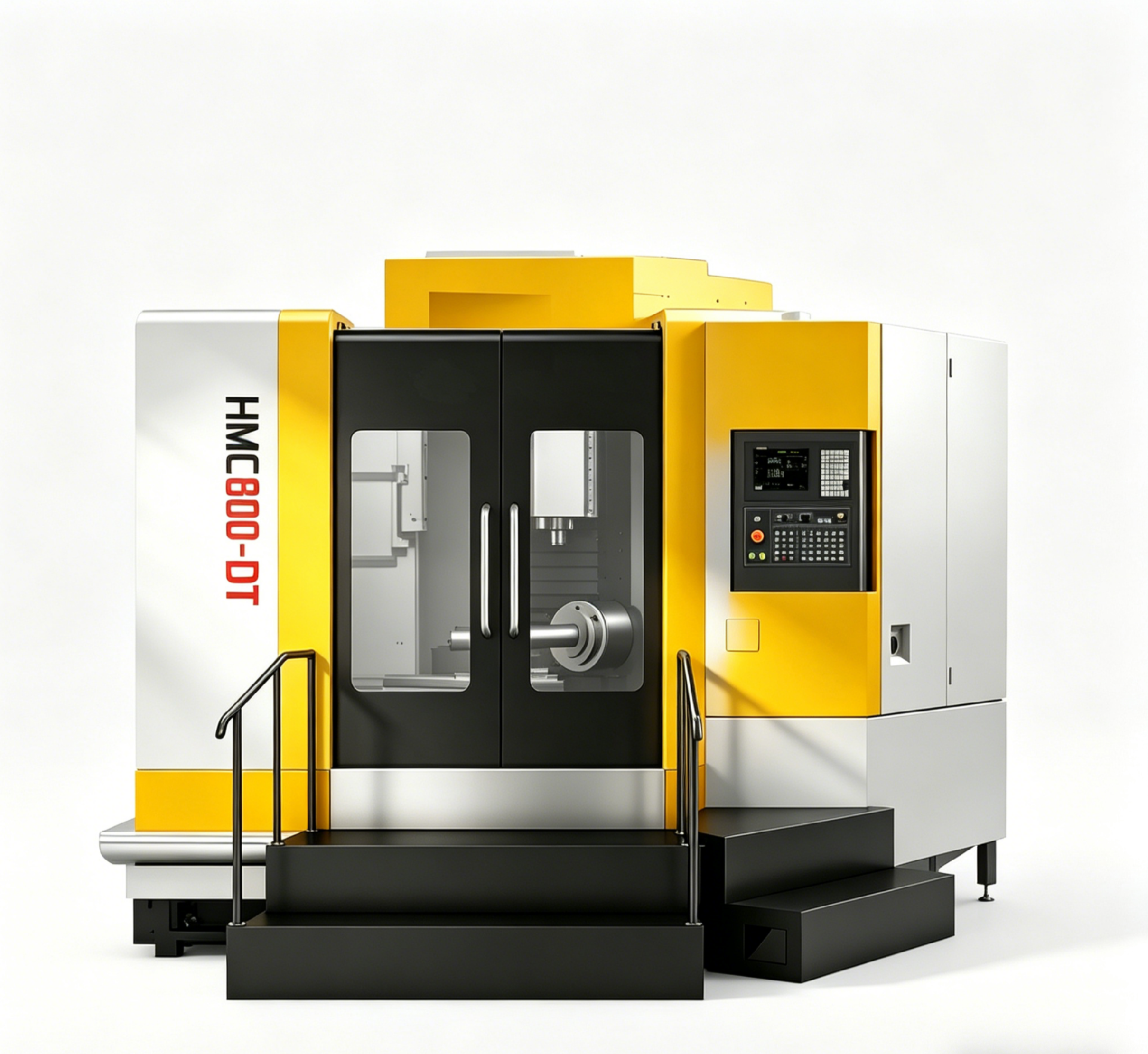
An 800 mm pallet horizontal is the size most shops land on when a big vertical stops keeping up. The 800-DT is the heavy end of that size in the BONANZA range: 2,500 kg on the table, 1,150 mm of Y travel, and a BT50-200 spindle running through a reducer. On the spec sheet it looks like a small step up from the 800S-DT. In the cut, the difference is mostly in what the spindle can push and how the column is held.
Here is what the published figures say, what the structure is doing, and which questions still need an answer from the factory before a purchase order goes out.
What this machine is
The 800-DT is built on a T-shaped split base with an interface reserved for an exchange worktable. That last part matters more than it sounds. A reserved interface means the pallet changer is a factory option, not part of the standard machine, so a shop can buy the machine now and add the changer later without replacing the base. If you are planning two-pallet work from day one, say so at the quotation stage.
The column rides on 55 size heavy-duty guideways set at a wider span than usual, and the X axis uses a high-low rail arrangement instead of two rails at the same height. Each item solves a specific problem that shows up when you hang a 200 mm face mill out of a BT50 spindle and take a heavy pass through cast iron.
The spindle, and what the reducer is for
The 800-DT publishes a BT50-200 spindle at 6,000 rpm. The 200 in that designation is the spindle nose outer diameter, and it is the largest nose in this range: the 630-DT and 1000S-DT list BT50-190 or BT50-45°, and the 800S-DT lists BT50-45°. A bigger nose means more bearing span and more mass right behind the taper, which is what you want when the tool is long and the load is off-centre.
The reducer sits between the motor and the spindle. Its job is torque multiplication: motor speed goes down, spindle torque goes up by roughly the same ratio, minus losses. That is why the top speed is 6,000 rpm and not 8,000 or 10,000. A geared spindle and a high-speed spindle are different tools. If your work is 100 to 160 mm bores in steel, heavy face milling on weldments, or cast iron housings where you want to bury a 10 mm depth of cut and let the insert do the work, the reducer is the reason this machine is in the catalogue. If your work is Ø6 mm finishing in aluminium at 12,000 rpm, this is the wrong spindle and you should be looking at a 40-taper machine.
High-low rails and the wide guideway span
On a horizontal, the load on the column is not symmetric. Cutting force pushes the spindle sideways, and the column tries to roll about the X axis. Two rails at the same height resist that by spacing them apart, but the bed only gives you so much width before the machine gets unnecessarily large. Putting one rail higher than the other means resistance to roll comes partly from the height difference rather than from width alone, which keeps the bed compact while still holding the column steady in an interrupted cut. Combined with the 55 guideways on a wider span, the intent is clear: rigidity first, speed second. That also explains the rapids, 12 m/min on all three axes, the slowest in this 800 mm group.
The numbers that decide the work
Travel is 1,300 mm in X, 1,150 mm in Y and 1,000 mm in Z. X is the long axis, which is where tombstones and multi-station fixtures live. The Y figure is the interesting one: 1,150 mm is 150 mm more than the 800S-DT and 250 mm more than the 630-DT, and on a horizontal that extra Y is what lets you stack two rows of parts on one pallet and still reach the top of both. The table takes 2,500 kg across 800 × 800 mm, with seven 22 mm T-slots on 100 mm pitch. Fixture weight counts against that, and a two-station tombstone for gearbox housings can run 400 to 600 kg before the first part goes on.
| Parameter | 800-DT | 800S-DT | 630-DT | 1000S-DT |
|---|---|---|---|---|
| Table size | 800 × 800 mm | 800 × 800 mm | 630 × 630 mm | 1,000 × 1,000 mm |
| Max. table load | 2,500 kg | 2,000 kg | 1,200 kg | 4,000 kg |
| T-slot (no. × width × pitch) | 7-22-100 | 7-22-100 | not published | 5-22-160 |
| X / Y / Z travel | 1,300 / 1,150 / 1,000 mm | 1,300 / 1,000 / 1,000 mm | 1,100 / 900 / 1,000 mm | 1,800 / 1,000 / 1,300 mm |
| Rapid traverse X / Y / Z | 12 / 12 / 12 m/min | 15 / 12 / 12 m/min | 18 / 15 / 15 m/min | 14 / 12 / 14 m/min |
| Spindle taper | BT50-200 | BT50-45° | BT50Φ190 | BT50-45° |
| Spindle speed | 6,000 rpm | not published | 6,000 rpm | not published |
| Machine weight | 16,000 kg | 15,500 kg | 12,000 kg | 16,000 kg |
| Machine dimensions | not published | 6,800 × 3,400 × 4,500 mm | not published | 4,380 × 3,910 × 4,700 mm |
800-DT against the 800S-DT
Same pallet, same X travel, 500 kg more load capacity, 150 mm more Y, and 3 m/min less rapid on X. The 800S-DT is the faster machine with the lighter structure; the 800-DT is the one with the reducer and the heavier spindle. If your cycle is dominated by cutting time, the 800-DT wins. If it is dominated by positioning between stations, the 800S-DT does.
800-DT against the 1000S-DT
The 1000S-DT gives you 4,000 kg, 500 mm more X and 300 mm more Z, and asks for a 4,380 × 3,910 mm footprint. The 800-DT exists for the parts that just fit an 800 pallet and do not justify the extra floor space or the extra 4 tonnes of machine.
What the page does not publish
BONANZA publishes the geometry, the load rating and the spindle interface for this model. It does not publish the machine dimensions, spindle power or torque curve, tool magazine capacity, maximum tool diameter and length, positioning accuracy and repeatability, the inspection standard behind those figures, the guideway type on Y and Z, or the controller model. The T-slot for the 630-DT is also missing from its own page, which is the kind of gap that turns into a fixture redesign two weeks before installation.
For a 16-tonne machine, those are quotation questions, not website questions. Ask for the general arrangement drawing, the torque curve at both continuous and intermittent ratings, and the accuracy figures with the measuring standard named. If a supplier cannot put accuracy in writing, that is information too.
Installation reality
Sixteen tonnes is not a forklift job in most shops. You need a crane or a heavy rigging contractor, a floor that takes the point loads, and a route in that clears the machine and the lifting gear. Because the dimensions are not published, get them from the factory before you book the rigger, and measure the door yourself.
Who it fits
This is a machine for box-type parts in steel and cast iron where the cycle is limited by metal removal rate: gearbox housings, hydraulic manifolds, pump and valve bodies, and subcontract work arriving in batches of tens to low hundreds.
It is not for high-speed aluminium, not for Ø5 mm finishing work, and not for parts that need a 1,000 mm pallet. If you send us the part drawing, the material and the faces that need machining, we will tell you which of these machines we would put it on.
Full specifications are on the 800-DT product page. The lighter 800 pallet machine is the 800S-DT, the next size up is the 1000S-DT, and the smaller pallet is the 630-DT. The rest of the range is listed on the horizontal machining center series page, and the contact page is the fastest way to get a quote.