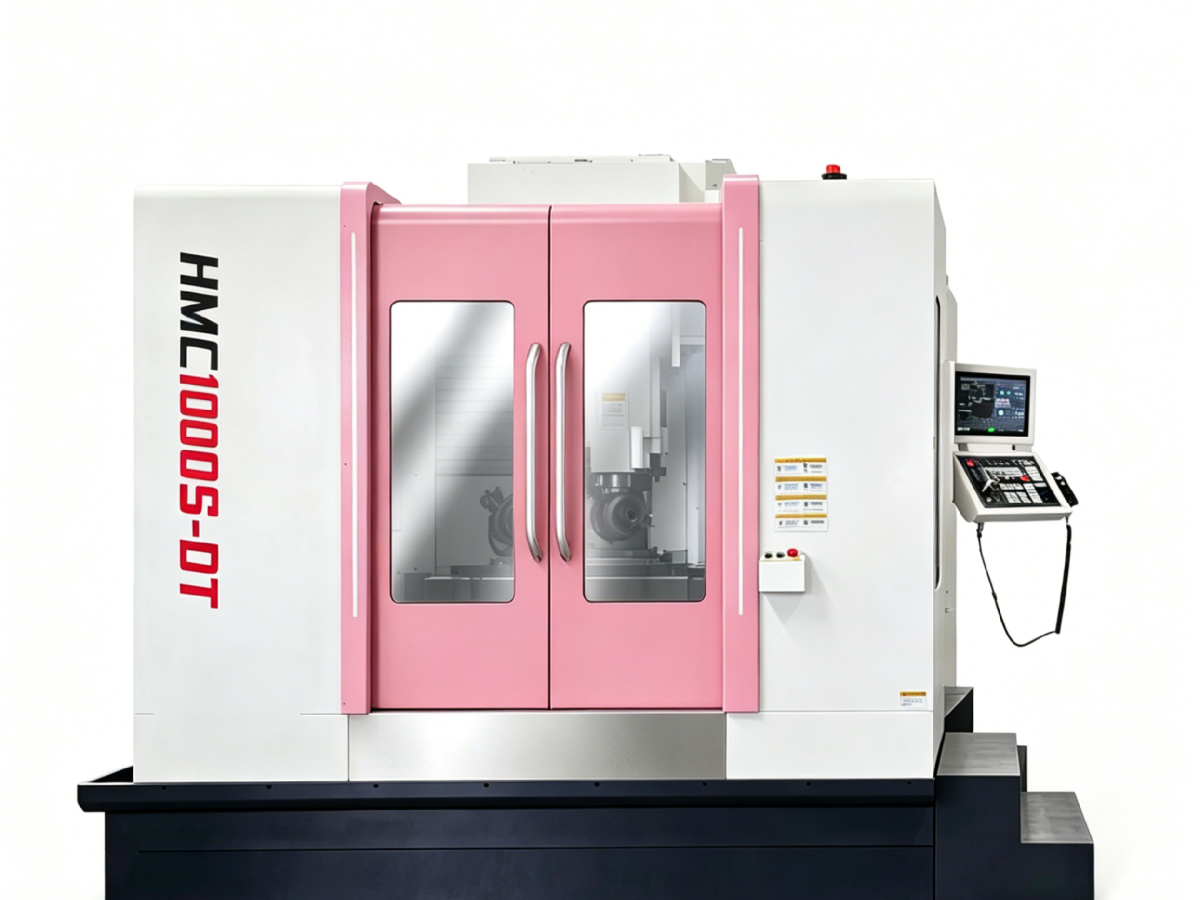
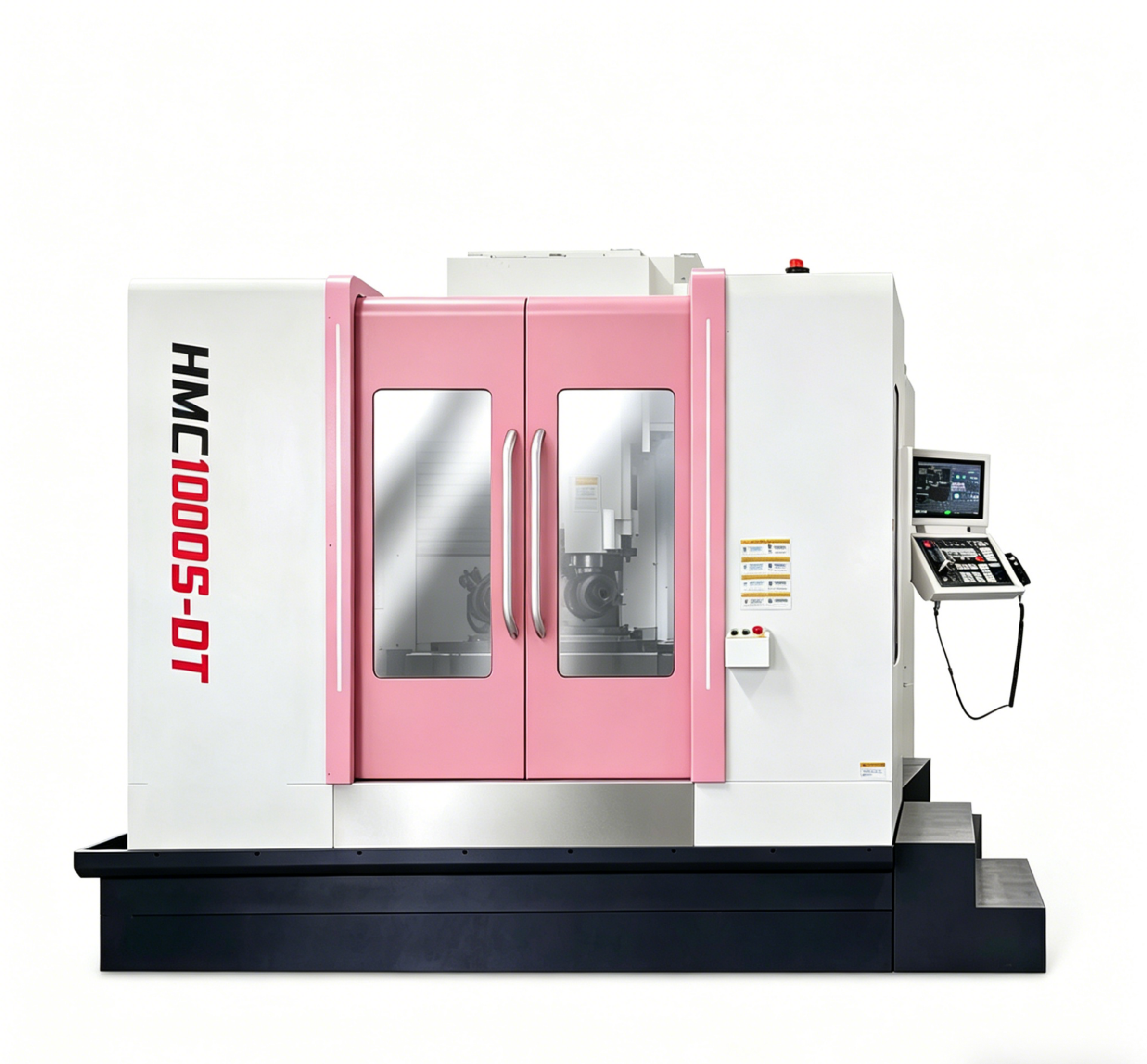
If you are sizing a horizontal machining center around a 1,000 mm pallet, the pallet itself is rarely the problem. The 1000S-DT publishes a 1,000 × 1,000 mm table rated for 4,000 kg, and that headline is what most buyers compare first. The figure that actually decides whether a job fits is the 1,300 mm of Z travel sitting behind it: 300 mm more than the machine’s own Y stroke, and 300 mm more than the 800S-DT gives you at the same nominal 1,000 mm Y.
That gap is worth understanding before you ask for a quote, because it changes which parts go on the machine and which ones stay on a boring mill.
The published envelope
| Item | 1000S-DT |
|---|---|
| Table size | 1,000 × 1,000 mm |
| Max. worktable load | 4,000 kg |
| T-slot | 7-22-125 mm |
| Spindle taper | BT50-45° |
| Spindle speed | 3,000 rpm |
| X / Y / Z travel | 1,800 / 1,000 / 1,300 mm |
| Rapid traverse | X 14, Y 12, Z 14 m/min |
| Machine weight | 16,000 kg |
Why 1,300 mm of Z is the working number
On a horizontal, the Z axis carries the column toward and away from the pallet. Every millimetre of it is either boring depth, clearance for a long tool assembly, or room to swing a facing head. A 1,000 mm pallet with only 1,000 mm of Z is a square envelope: fine for plates and shallow housings, tight the moment a gearbox casting needs a bore 600 mm deep with a boring bar long enough to reach it.
Boring depth and tool overhang
Take a valve body 900 mm tall. Rough boring with a 60 mm bar typically leaves 250 to 300 mm of overhang beyond the spindle nose once the tool clears the casting face. Add the facing allowance and the retract distance, and you are consuming 800 mm of Z before the bar touches metal. On a 1,000 mm Z machine the remaining 200 mm is your margin for error. On the 1000S-DT you still have 500 mm — the difference between one setup and a second operation on a horizontal borer.
The same arithmetic applies to deep-cavity mould work and to pump housings with stepped bores at both ends.
Rapids tell you what the axis is for
The published rapid figures are 14 m/min on X, 12 m/min on Y and 14 m/min on Z. Z running as fast as X is a small hint about intended use: this is a machine expected to do a lot of positioning in and out of the part, not just face milling across a table. Y is the slowest of the three at 12 m/min, which fits a heavier column and saddle assembly.
Table, T-slots and what clamps to them
The table is 1,000 × 1,000 mm with T-slots published as 7-22-125 mm — seven slots, 22 mm wide, 125 mm pitch. A 22 mm slot takes M20 T-bolts with normal clearance, so fixtures can use M20 studs instead of stepping down to M16. On a 4,000 kg rated table that matters: M16 clamping on a part that heavy looks thin once you add BT50 cutting force.
Seven slots at 125 mm pitch cover 750 mm of the table width. If your fixture base is wider, plan for a sub-plate rather than clamping at the outer edge.
16,000 kg: what the mass buys
At 16,000 kg the 1000S-DT sits between the 800S-DT at 15,500 kg and the TH1400S at 19,500 kg. For 500 kg over the 800S-DT you get a pallet that is 200 mm larger in each direction, double the load rating at 4,000 kg against 2,000 kg, and 300 mm more Z travel. That is an efficient trade, and it is the main argument for the 1,000 mm class over the 800 mm class if your parts are heavy rather than merely long.
Mass is not a specification you cut with, but it is why a 4,000 kg part can be machined without the column ringing. Foundation and levelling still decide the result: a 16-tonne machine on a thin slab will move, and no amount of casting weight fixes that.
1000S-DT, TH1000S and 800S-DT on paper
| Model | Table | Load | X/Y/Z travel | Spindle | Weight |
|---|---|---|---|---|---|
| 800S-DT | 800 × 800 mm | 2,000 kg | 1,300 / 1,000 / 1,000 mm | BT50-45° | 15,500 kg |
| 1000S-DT | 1,000 × 1,000 mm | 4,000 kg | 1,800 / 1,000 / 1,300 mm | BT50-45°, 3,000 rpm | 16,000 kg |
| TH1000S | 1,000 × 1,000 mm | 4,000 kg | 1,800 / 1,000 / 1,300 mm | BT50-45°, 3,000 rpm | 16,000 kg |
| TH1400S | 1,400 × 1,400 mm | 5,000 kg | 1,800 / 1,300 / 1,500 mm | BT50-45°, 2,000 rpm | 19,500 kg |
The 1000S-DT and TH1000S publish identical figures, line for line. That is not a typo in this article, and it is worth saying plainly: when two models in a range share a table, a spindle and a travel set, the difference lives in the configuration package — the structure type, the way the axes are built, the options fitted — not in the headline table. Ask for both configuration sheets side by side before you treat them as the same machine.
What the page does not publish
The product page gives taper, speed, travels, rapids, table rating and weight. It does not give spindle power or torque, ATC capacity, positioning accuracy, repeatability, pallet change time, or the control model. Those are the numbers that decide cycle time and, for a BT50 machine running at 3,000 rpm, the numbers that decide whether you can take a 5 mm depth of cut in steel or only 2 mm.
3,000 rpm with BT50-45° points to a geared or heavy-duty arrangement aimed at torque rather than speed. If your work is aluminium at high feed rates, this is the wrong end of the range and a 6,000 rpm BT50-190 machine such as the 630-DT fits better. If your work is cast iron and steel housings, 3,000 rpm is enough and the extra Z travel is worth more than spindle speed.
Choosing within the 1,000 mm class
Three rules of thumb hold up in practice. If your heaviest part is under 2,000 kg and no bore is deeper than about 400 mm, the 800S-DT does the job for less floor space. If the part is heavy and deep — gearboxes, valve bodies, pump housings, mould bases — the 1,300 mm Z on the 1000S-DT is the feature you are buying. If the pallet itself needs to be 1,400 mm before the part fits, step up to the TH1400S, which trades spindle speed down to 2,000 rpm for a 5,000 kg load and 1,500 mm of Z.
Full specifications for the 1000S-DT horizontal machining center are on the product page, and the rest of the range is listed under horizontal machining centers. Send us the part drawing and the fixture weight and we will confirm the Z requirement against the real spindle nose dimensions rather than the table figures alone.