U400 5-Axis Turning and Milling Machine: A 400 mm Direct-Drive Table That Actually Holds Tolerance
Five-axis machines get sold on promises: “complex parts in one setup,” “full five-sided machining,” “no repositioning errors.” Then the machine arrives and the rotary table flexes under a heavy workpiece, the spindle drifts at 10,000 rpm, and the promises quietly disappear. The BONANZA U400 is a different kind of answer. It pairs a Ø400 mm dual direct-drive rotary table with an 11 kW direct-drive spindle, in a package with 1300 mm of X travel and a 610×500 mm machining envelope. No gearboxes in the table drive, no belt stretch in the spindle, fewer places for error to hide.
Here is what the U400 actually brings to a shop floor, and where the specs stop being marketing.
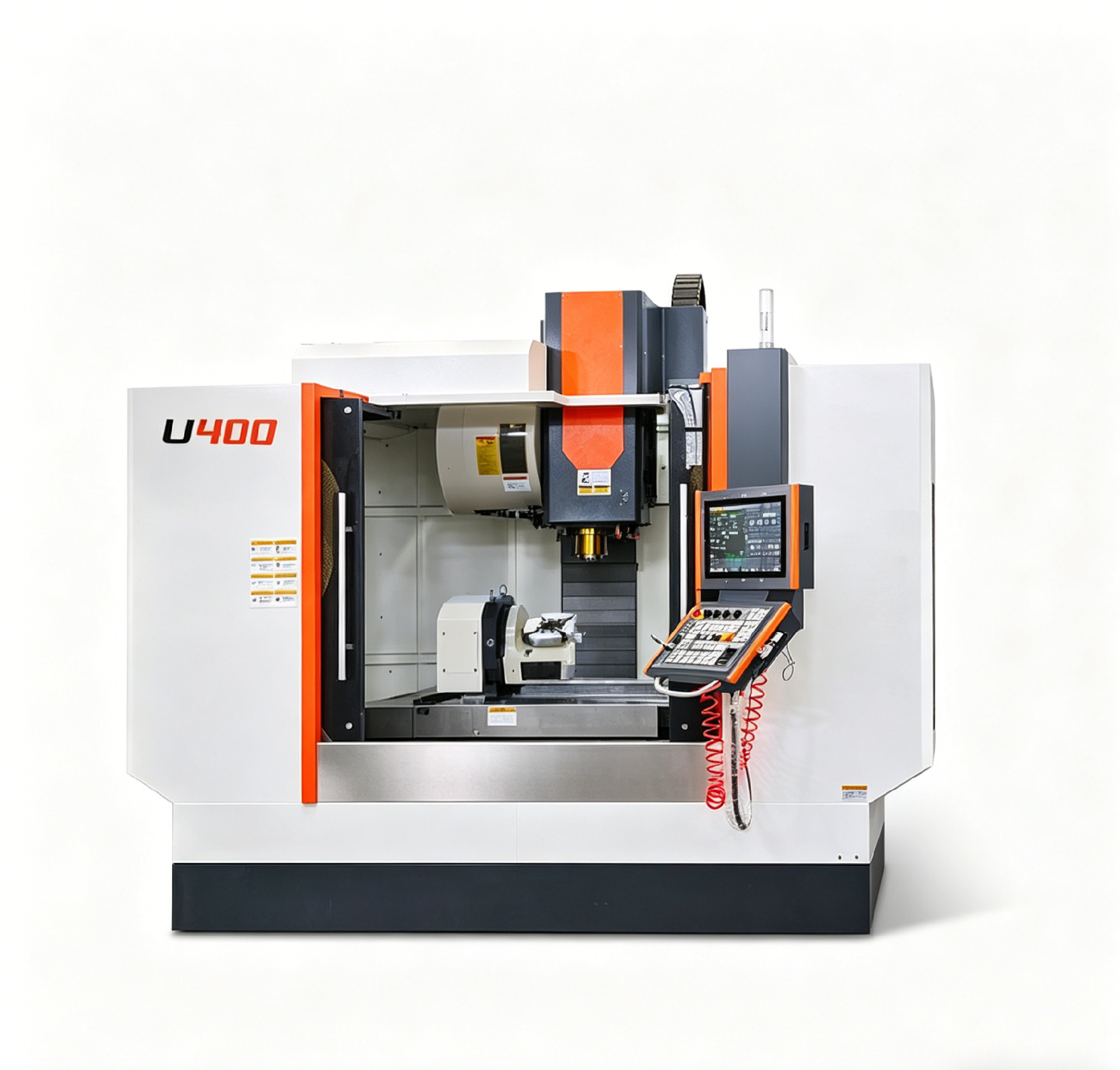
U400 at a glance
| X-axis travel | 1300 mm |
| Y-axis travel | 700 mm |
| Z-axis travel | 750 mm |
| Machining range | 610 × 500 mm |
| Rotary table flange | Ø400 mm |
| Table center hole | Ø80H7, through hole Ø60 mm |
| Max. table load | 200 kg |
| Table drive | Dual direct drive |
| Spindle | Direct-drive, 12,000 rpm |
| Spindle power | 11 kW |
The Ø400 mm dual direct-drive table is the real story
Most 5-axis machines in this size class use a worm-gear rotary table. Worm gears have one advantage: they are cheap to build. They also have backlash, wear in over time, and lose positional accuracy as the table heats up through a long cycle. The U400 skips that entirely with a dual direct-drive arrangement, which means the table motor drives the axis with no intermediate gear train. Whatever the encoder measures is what the table actually does, and it does it without the mechanical slack that worm drives accumulate.
The numbers back it up in practical terms. The mounting flange is Ø400 mm, the center hole is Ø80H7 with a Ø60 mm through hole, and the table carries up to 200 kg. That through-hole matters more than most buyers realize: it lets you run coolant, air, or wiring through the center of the table for fixtures, and it gives you a clean datum for round work. A 200 kg load limit on a Ø400 table is honest for this machine class; it covers the vast majority of impellers, housings, manifolds, and mold inserts that shops actually put on machines this size.
An 11 kW direct-drive spindle that does not slow you down
The U400 runs a direct-drive mechanical spindle rated at 11 kW with a 12,000 rpm top speed. Direct drive means the motor rotor is on the spindle shaft itself, so there is no belt to stretch, no pulley to slip, no periodic retensioning on the maintenance list. The spindle accelerates fast, which adds up over a day of short tool changes and rapid positioning moves, and it holds speed under load better than a belt-driven unit of the same rating.
Twelve thousand rpm is a practical ceiling for this class of work. If your parts are mostly aluminum housings and aerospace-ish details, that speed range lets you run small tools at their proper surface speed. If you are cutting steel or cast iron, you will spend most of your time well below 6,000 rpm anyway, and the 11 kW motor has the torque to keep the cut going instead of stalling out of a heavy pass.
1300 mm of X travel and a 610×500 mm envelope
What sets the U400 apart inside the BONANZA U-series is reach. X travel is 1300 mm, Y is 700 mm, Z is 750 mm, and the machining range is 610×500 mm. That is a bigger envelope than the U260 or U320, which means longer parts and bigger fixtures fit without compromise. The practical effect: you can set up a part once and machine five sides, then leave the table indexing and the spindle running instead of moving the job to a second machine.
The 1300 mm X travel also helps with the classic 5-axis trap: the part fits on the table, but the head runs out of travel before the tool reaches the far corner. The U400 keeps that from becoming your problem on parts that fit its 610×500 mm range.
Who should buy the U400
This machine makes sense if any of these sound like your shop:
- You machine impellers, blade profiles, or turbine-adjacent parts that need real A/C-axis contouring, not just angled drilling
- You are tired of repositioning parts between operations and re-establishing datums every time
- Your workpieces sit in the 100-200 kg range and need a table that does not deflect under load
- You want 5-axis capability without the maintenance bill of a worm-gear table
If your work is genuinely all 3-axis prismatic parts, a vertical machining center like the 1160 or 855 will do it for less money, and nobody here will argue with that. The U400 earns its keep when the geometry stops being flat and starts being complex.
Where it sits in the BONANZA range
The U400 is the largest of the direct-drive U-series machines in the BONANZA 5-axis turning and milling lineup. For smaller work, the U260 (Ø260 mm table, 80 kg load) and U320 (Ø320 mm table, 150 kg load) share the same dual direct-drive table design in a more compact frame. If you need a tilt-table machine with higher speed and HSK tooling instead, the TMC800 runs a 15,000 rpm HSK-T63 spindle with a ±110° A-axis. Match the table size and spindle to your actual part envelope, and the choice gets straightforward.
Bottom line
The U400 is not the cheapest way into 5-axis machining, and it is not pretending to be. It is the machine for shops that have already learned the hard way what backlash and table deflection cost in scrap and rework. A dual direct-drive Ø400 mm table, an 11 kW direct-drive spindle at 12,000 rpm, and a 610×500 mm envelope add up to a 5-axis machine that holds what it positions, keeps the maintenance list short, and handles the parts that actually pay for this class of equipment.
Want to check your part mix against the U400? The full specification is on the U400 5-Axis Turning and Milling Machine product page, or send BONANZA your drawings and get a straight answer on whether it fits.