TMC800 5-Axis Turning and Milling Machine: One Setup for Parts That Need More Than Four Sides
There are two ways to make a complex turned part. One is to move it between a lathe, a machining center and a couple of fixtures, and to eat the setup time, the refixturing error and the queue between machines. The other is to leave it clamped once and let the machine bring the tool to every face. The BONANZA TMC800 is built for the second way: a 5-axis turning and milling machine with a tilting A-axis and a full C-axis, sized for parts that need turning, milling, drilling and angled work without a second clamping.
Here is what the machine actually gives you, and where the numbers start to matter.
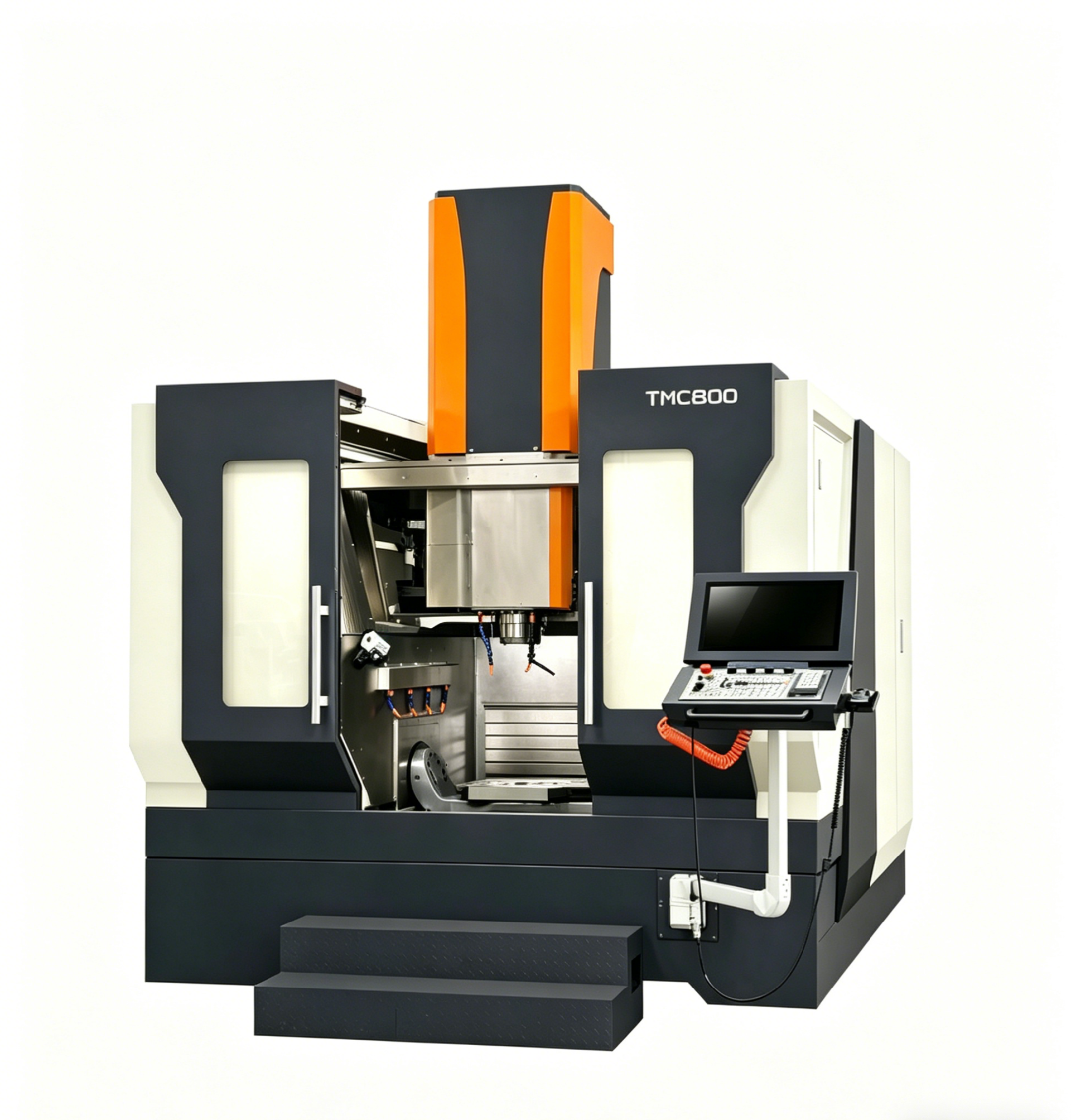
TMC800 at a glance
| X-axis travel | 850 mm |
| Y-axis travel | 1040 mm |
| Z-axis travel | 600 mm |
| A-axis tilt range | ±110° |
| C-axis rotation | 360° |
| Spindle taper | HSK-T63 |
| Max. spindle speed | 15,000 rpm |
| Machine weight | 11 t |
A ±110° A-axis is not a 90° indexer in a costume
Plenty of machines advertise “five axes” and then give you a C-axis plus an A-axis that parks at 90°. That covers flats and a few drilled holes, and not much else. The TMC800’s A-axis tilts to ±110°, which means it can swing 20° past vertical. That extra travel is what lets you machine undercuts, angled faces and drafted surfaces in the same setup where you turned the outside diameter. Pair that with 360° C-axis rotation and you can reach five sides of the part, plus every angle in between, without moving the workpiece.
For a valve body with a sloping port face, a bracket with a compound angle, or an impeller-style component with blades at an angle to the axis, this is the difference between one program and a handful of setups with custom angle plates.
15,000 rpm on an HSK-T63 spindle: fast enough to be worth it
The HSK-T63 taper is a turning-and-milling spindle interface, not a retrofit afterthought. Its dual-face contact gives you the stiffness to take real milling cuts, and the hollow taper keeps tool changes repeatable at speed. The 15,000 rpm top end is where small-diameter milling cutters and drills actually live: a 6 mm end mill wants 10,000 rpm or more to cut aluminum properly, and finishing passes on small steel features benefit from the same range. If your parts mix includes light alloys or fine-detail milling, the speed is not a marketing number, it is what keeps the cycle time honest.
Travel that fits the part, not the other way around
The TMC800 moves 850 mm on X, 1040 mm on Y and 600 mm on Z. The 1040 mm Y travel is the detail worth reading twice: it gives you room to swing a long workpiece or a large rotary table through the machining zone without the table edge becoming the constraint. The Z travel of 600 mm is enough for typical turned-and-milled components like housings, spindles and pump parts, and it keeps the machine’s footprint reasonable on a shop floor where square meters cost money every month.
11 tonnes says something about rigidity
Machine weight is a budget, and the TMC800 spends 11 tonnes of it on the bed, column and base castings. That mass is what keeps vibration out of the cut when you are roughing steel on one side of the part and holding a tight tolerance on the other. A lighter machine can hit the same numbers on paper; the difference shows up in surface finish consistency and tool life over a full production week. For shops that run unattended or semi-attended, that stability is worth more than a few extra rpm on the spec sheet.
Who should actually consider the TMC800
This machine earns its place in a shop that does any of the following:
- Components that need turning, milling, drilling and tapping in one clamping, especially with angled or off-axis features
- Small-to-medium batches where setup time per piece is the real cost, not spindle hours
- Work with tight geometric tolerances that currently suffers from refixturing error across multiple machines
- Shops moving up from 3+2 positioning to full simultaneous 5-axis machining for contoured surfaces
If your parts are simple flanges that never need an angled cut, a standard CNC lathe will do the job for less money, and there is no shame in that. The TMC800 pays for itself when the part complexity is what is costing you.
Where it fits in the BONANZA lineup
The TMC800 sits at the top of the BONANZA 5-axis turning and milling range. Below it, the U260 covers compact parts up to 380 × 300 mm with a 12,000 rpm direct-drive spindle and a lighter footprint. The U320 steps up to a 480 × 325 mm machining range with a 150 kg table load, and the U400 stretches to 610 × 500 mm with 200 kg on the table. If your parts are mostly turned with occasional milling rather than true five-sided work, the TCK3100LY mill-turn or the wider mill-turn series is the more direct answer. Match the machine to the actual part mix, not to the brochure.
Bottom line
The TMC800 is a serious answer to a specific problem: complex parts that currently travel through two or three machines to get done. With ±110° of A-axis tilt, 360° C-axis rotation, an HSK-T63 spindle at 15,000 rpm and an 11-tonne rigid base, it is built to finish those parts in one setup and hold the tolerances while it does. It is not the cheapest machine in the range, and it is not trying to be. It is the one that removes setups, and in a job shop, that is where the money actually goes.
Ready to check it against your part list? See the full details on the TMC800 5-Axis Turning and Milling Machine product page, or send BONANZA your workpiece drawings and get a straight answer on whether it fits.