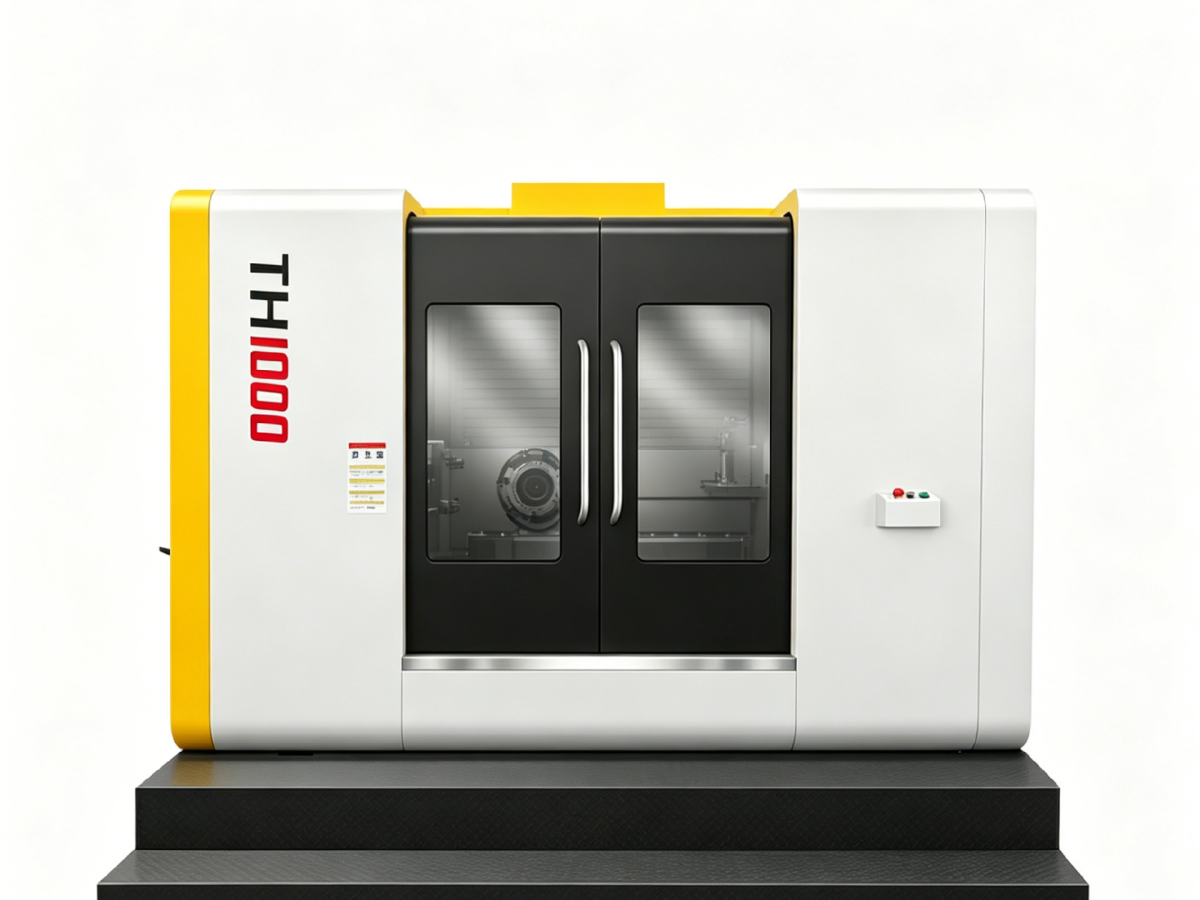
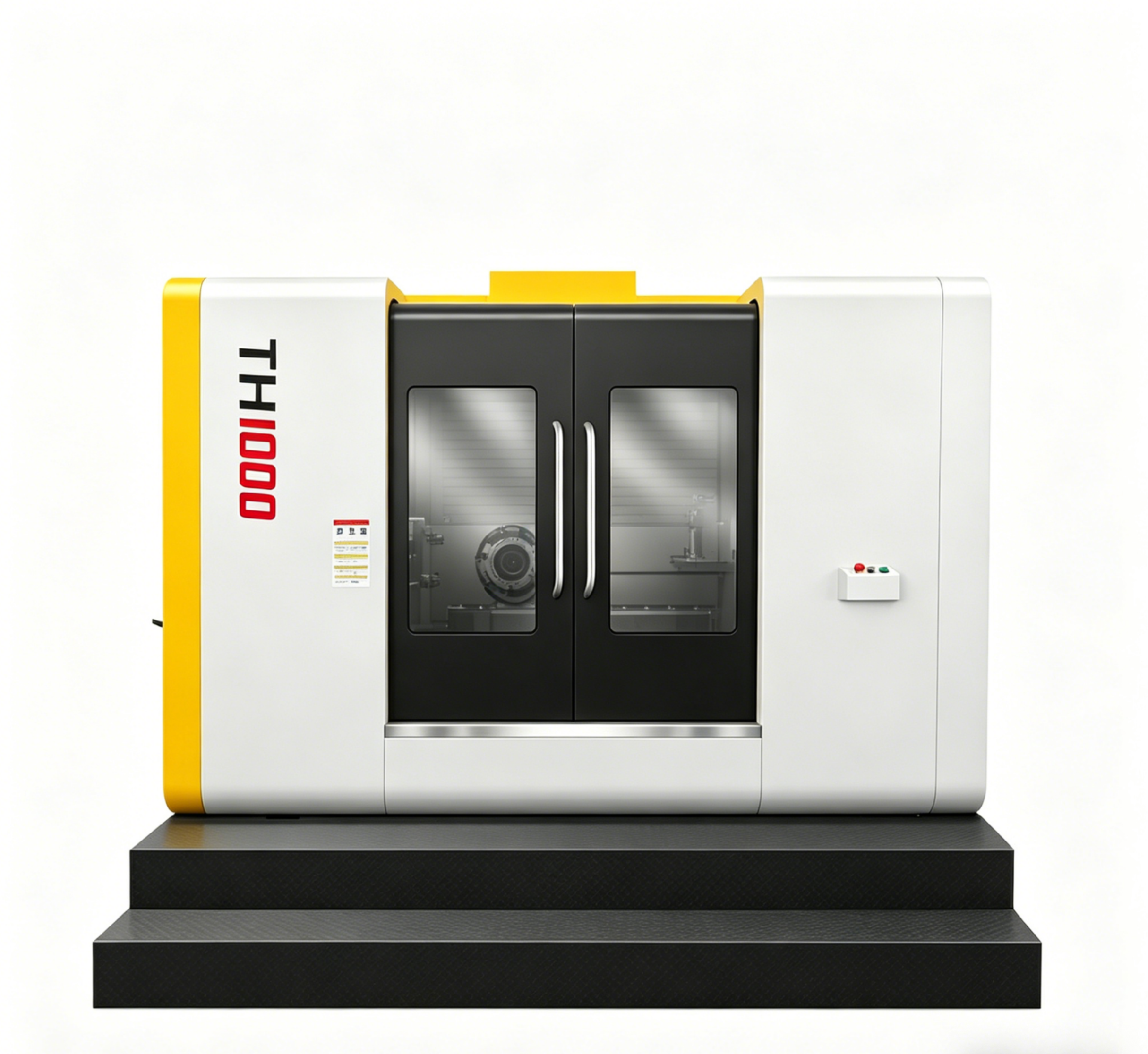
Most buyers start a horizontal machining center search with two numbers: pallet size and spindle taper. That narrows the field quickly, but it leaves out the part that decides how the machine behaves after the first year of production — the frame. The TH1000 is a 1000 × 1000 mm pallet machine, and BONANZA offers it on three different structural layouts. Which one you order changes how the machine handles heavy boring cuts, how easily it swallows long box-type workpieces, and how much floor space it needs.
Here is what each layout is for, and what the rest of the TH1000 package looks like on paper.
Three frame layouts, one model number
The TH1000 is built as a boring and milling machine structure, a positive T-structure, or an inverted T-structure. The distinction is not cosmetic.
Boring and milling structure
This is the layout to pick when the work is dominated by bore-to-bore alignment on large housings — gearboxes, pump casings, valve bodies with several coaxial bores. The column and spindle carry the stiffness where a boring bar needs it, and the operator is not fighting the table for access to the far side of the part.
Positive T-structure
The table sits on a T-shaped base with the column behind it. It is the most conventional of the three and the easiest to tool around. If your parts are a mix of box bodies and plate-like components and you want straightforward loading from the front, this is usually the sensible default.
Inverted T-structure
The inverted layout puts the mass lower and pulls the center of gravity down with it. On tall workpieces, or on jobs where the operator needs to reach over the table, the difference in rigidity and access is noticeable.
None of the three is “best.” The TH1000 does not force one answer on you.
Table and work envelope
The pallet is 1000 × 1000 mm with a maximum worktable load of 3500 kg. T-slots are 7-22-125 mm, which is the standard pattern for this class and takes the usual 22 mm bolts without an adapter plate.
Travels are 1300 mm in X, 1100 mm in Y and 1200 mm in Z. Read that against the pallet: the X travel gives you 300 mm of overhang beyond the pallet edge, which is the number that matters when a weldment hangs off one side. Rapid traverse is 15 m/min on X and Z, 12 m/min on Y. Those are working speeds, not showroom numbers: fast enough to keep non-cutting time down, without acceleration spikes that trip servo alarms.
Machine weight is 18000 kg. That figure is worth more attention than buyers usually give it. Mass in the base and column is what absorbs interrupted cuts, and 18 tonnes on a 1000 mm pallet is a casting-heavy design rather than a fabricated lightweight. If your floor is a suspended slab rather than a ground-bearing pad, check the load rating before you order — and plan the foundation before delivery, not after.
BT50-190 spindle at 6000 rpm
The spindle is BT50 with a Ø190 mm nose, running to 6000 rpm. The larger nose diameter is the detail that separates this spindle from a standard BT50. More material around the taper means more resistance to deflection under a long boring bar, and better heat distribution when you run high-speed finishing passes back to back.
6000 rpm is not a high-speed spindle, and it is not meant to be. It is the top of a range that holds torque at 200 rpm for a roughing cut in cast iron and still runs smooth at 5000 rpm in aluminium. Jobs that need 12,000 rpm for small tools in hardened steel want a different machine.
What the TH1000 is built to cut
The work the TH1000 is specified for falls into three groups:
- Box bodies and gearbox housings. Multi-face machining from a single setup, with the pallet rotating to bring each face to the spindle. Boring, facing and drilling all land on the same datum, which removes the stack-up error you get from moving a part between a VMC and a horizontal borer.
- Valve bodies. Coaxial bores, flange faces and bolt circles. The boring and milling structure exists for this job.
- Molds and mold bases. Deep pockets, multi-angle work, and the U-shaped drilling pattern that shows up on water lines and ejector plates.
Multi-face and multi-angle machining, boring and U-shaped drilling are all named in the specification, and that combination is what a horizontal layout is for. One setup, five faces, one tolerance stack.
TH1000 specifications
| Parameter | TH1000 |
|---|---|
| Table size | 1000 × 1000 mm |
| Max. worktable load | 3500 kg |
| T-slot (number × width × pitch) | 7-22-125 mm |
| X-axis travel | 1300 mm |
| Y-axis travel | 1100 mm |
| Z-axis travel | 1200 mm |
| X-axis rapid traverse | 15 m/min |
| Y-axis rapid traverse | 12 m/min |
| Z-axis rapid traverse | 15 m/min |
| Spindle taper hole | BT50 Φ190 |
| Spindle speed | 6000 rpm |
| Machine weight | 18000 kg |
| Structure options | Boring and milling / positive T / inverted T |
Where it sits in the horizontal range
The TH1000 is the 1000 mm pallet machine in the middle of the BONANZA horizontal lineup, and the neighbours are close enough that the comparison is worth making before you send an enquiry.
The TH1000S shares the 1000 × 1000 mm pallet but goes a different direction: 4000 kg load capacity, 1800/1000/1300 mm travels, BT50-45° spindle at 3000 rpm, 16000 kg. Longer X travel, heavier part, slower spindle. If your workpieces are long weldments rather than compact housings, the TH1000S is the one to look at.
The 800-DT steps down to an 800 mm pallet with a T-shaped split structure, 55 heavy-duty guide rails and a BT50-200 spindle, with an interface reserved for a pallet changer. Shops planning to automate later usually start there.
The 630-DT is the 630 × 630 mm entry point: 1200 kg load, 1100/900/1000 mm travels, BT50 Φ190 at 6000 rpm, 12000 kg. Same spindle speed as the TH1000, smaller envelope, easier to fit into a tight floor plan.
Before you request a quote
Three things decide which TH1000 you actually need, and none of them are on the spec sheet.
First, the heaviest part you will realistically load, not the average. A 3500 kg rating on a 1000 mm pallet is generous, but the fixture weight counts against it.
Second, how many faces you machine per setup. Two faces and a horizontal is overkill. Four or five faces and it pays for itself in fixturing alone.
Third, whether a pallet changer is in your future. Retrofitting one onto a machine that was not prepared for it costs more than buying the right frame the first time.
Send us the part drawing and the batch size. We will tell you which of the three structures fits, and what the machine needs to look like to run that part for the next ten years.
Request a TH1000 quote or browse the full horizontal machining center series.