630-DT Horizontal Machining Center – 630 x 630 mm Pallet, 1,200 kg Load, 18 m/min Rapids
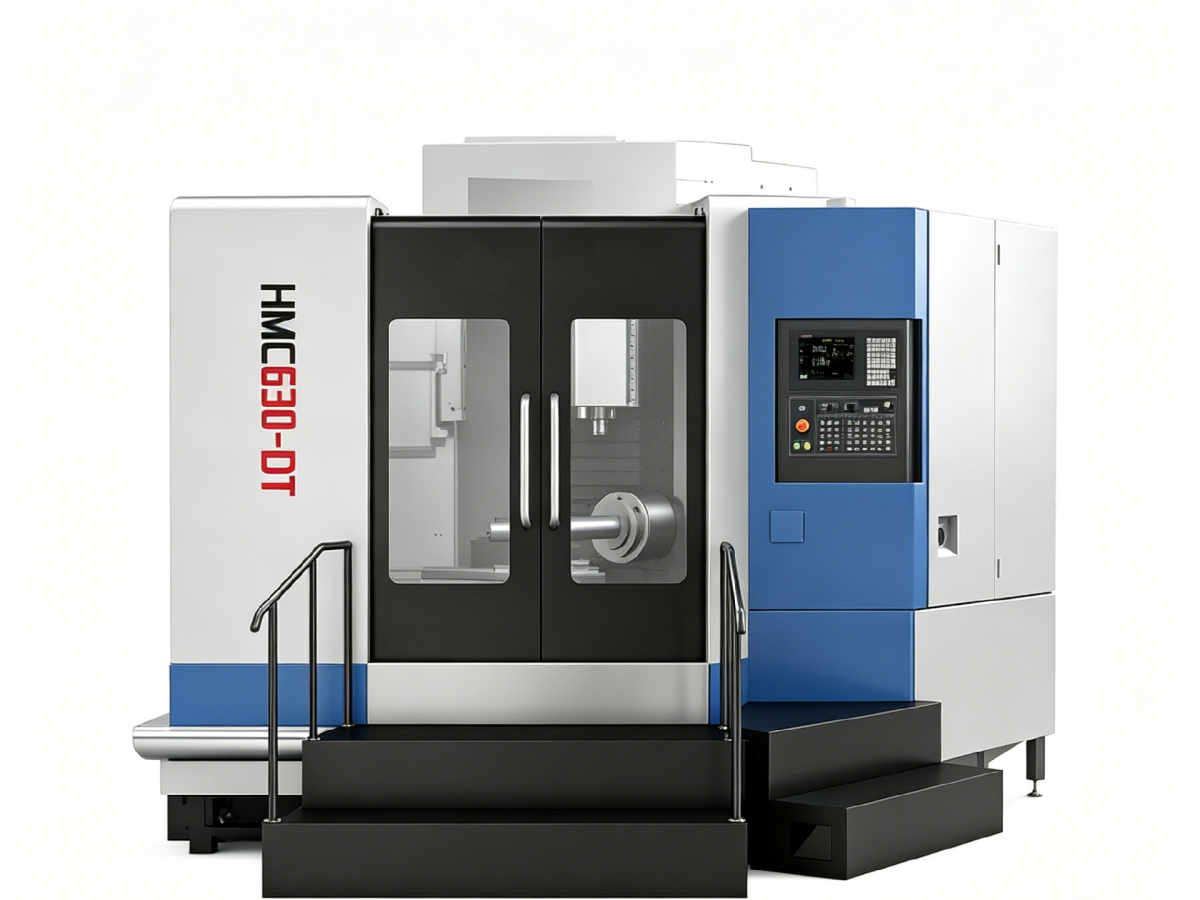
A 630 mm pallet machine is the point where a shop stops thinking about small parts and starts thinking about fixtures. The pallet itself weighs a few hundred kilos, the tombstone on top weighs more, and by the time two vises and a workpiece are mounted you are carrying real mass on a table that still has to index to a few microns. The 630-DT is built around that: a 12,000 kg casting, a BT50-190 spindle, and a 630 x 630 mm table rated for 1,200 kg.
What the 1,100 / 900 / 1,000 mm travels cover
The X stroke of 1,100 mm decides your part size. On a horizontal machine the pallet sits in the X-Z plane and the column travels in Z, so X is the horizontal sweep across the pallet face. With a 630 mm pallet and 1,100 mm of X travel, the spindle centre reaches 235 mm past each edge at the extremes. That overhang is what lets you machine a workpiece wider than the pallet without moving the clamp.
Y at 900 mm is generous for this class. A part standing 800 mm tall on a tombstone still fits inside the envelope with room for a face mill body. Many 630 machines stop at 710 or 750 mm of Y, which pushes tall parts onto a bigger pallet machine or into a second setup.
Z at 1,000 mm is the deepest of the three and the least obvious. Z travel is what you spend on tool length, fixture depth and boring bar overhang. A 1,000 mm stroke means a boring bar reaching 600 mm into a gearbox housing still leaves 400 mm for positioning and retract. That is the difference between boring a deep bore in one pass and boring it from both ends.
The BT50-190 spindle at 6,000 rpm
The spindle is BT50 with a 190 mm nose diameter, turning up to 6,000 rpm. The 190 mm figure is the bearing span at the front of the cartridge, and for heavy cutting it matters more than the taper. A wider nose means larger bearings, and larger bearings mean the spindle resists deflection when a face mill takes 5 mm depth across 100 mm width.
6,000 rpm on a BT50 is a deliberate ceiling. It is fast enough for aluminium with a 63 mm face mill and small-diameter carbide in steel, and slow enough that the cartridge stays cool and the bearings keep their preload over years of two-shift work. If the work is cast iron housings, valve bodies and steel weldments, this is the right band. If you run aluminium at 15,000 rpm all day, the BONANZA VMC range with BT40 spindles covers it better.
18 m/min on X, 15 m/min on Y and Z
X is the heaviest moving element and also the fastest at 18 m/min. That is not accidental: X carries the pallet and the full workpiece load, so the drive has to move 1,200 kg of table plus fixture without lagging. Y and Z move the column and spindle head, which are lighter in the axis direction, and they run at 15 m/min.
The effect shows up twice. Tool-to-tool positioning between features on a large housing is short, so a 40-hole drilling cycle does not lose time travelling. And a machine that reaches rapid speed quickly and holds position firmly can use smaller safety clearances in the program: 2 mm off the surface instead of 10 mm, because deceleration is predictable.
1,200 kg on a 630 mm pallet: load density, not just load
Read the 1,200 kg rating against the pallet size rather than in isolation. A 630 x 630 mm pallet carrying 1,200 kg works at roughly 3 kg per square centimetre if the load is spread evenly. Put that same mass on one small vise at a corner and the pallet sees a tipping moment instead of a distributed load.
Two rules keep you inside the rating. Keep the fixture centre of gravity close to the pallet centre, and clamp at four points rather than two. A tombstone with the part mounted low and bolted at the corners carries the full 1,200 kg without complaint. A tall angle plate with mass at the top will show taper in the bores long before you reach the rated figure.
Where the 630-DT sits in the range
BONANZA builds four machines on or near the 630 mm pallet size, and they are not interchangeable. The 630-DT is the general-purpose build: 1,100 x 900 x 1,000 mm travels, 1,200 kg, BT50-190 at 6,000 rpm, 12,000 kg.
The HMC630II-ZT shares the pallet, the 1,200 kg rating, the BT50-190 spindle and the same travels and rapids. The ZT layout is a configuration choice rather than a capacity change, so the decision comes down to fixture and operator access.
The HTMC630-VI is the lighter 630: same pallet and spindle, but a 500 kg load rating and shorter travels at 1,050 / 800 / 850 mm. It suits smaller valve bodies and brackets where pallet size is chosen for fixture room rather than part mass.
Above this class, the 800-DT moves to a 2,500 kg pallet with a BT50-200 geared spindle, and the 1000S-DT goes to a 1,000 x 1,000 mm pallet with a 4,000 kg rating. Machine mass climbs from 12,000 kg to 15,500 kg at the 800 mm step. See the full horizontal machining center range.
Specifications
| Table size | 630 x 630 mm |
| Max. worktable load | 1,200 kg |
| Spindle taper | BT50, 190 mm nose diameter |
| Spindle speed | 6,000 rpm |
| X / Y / Z travel | 1,100 / 900 / 1,000 mm |
| X-axis rapid traverse | 18 m/min |
| Y / Z rapid traverse | 15 m/min |
| Machine weight | 12,000 kg |
What to check before you specify one
Measure the largest part you actually run, not the largest in the catalogue, and confirm it fits inside 1,100 x 900 x 1,000 mm with the fixture attached. Weigh fixture plus part and keep the total under 1,200 kg with a low centre of gravity. Then look at spindle duty: cast iron and steel housings with carbide inserts at moderate speed match the BT50-190 at 6,000 rpm.
If all three answers land inside those figures, the 630-DT holds tolerance on box bodies, valve bodies, pump housings and mould bases without asking for a bigger pallet. If one misses, the 800-DT or 1000S-DT is the honest next step, and it is cheaper to learn that before the foundation is poured.
Send drawings and cycle requirements to the BONANZA engineering team and we will confirm fixture layout, pallet loading and spindle configuration against your part family.