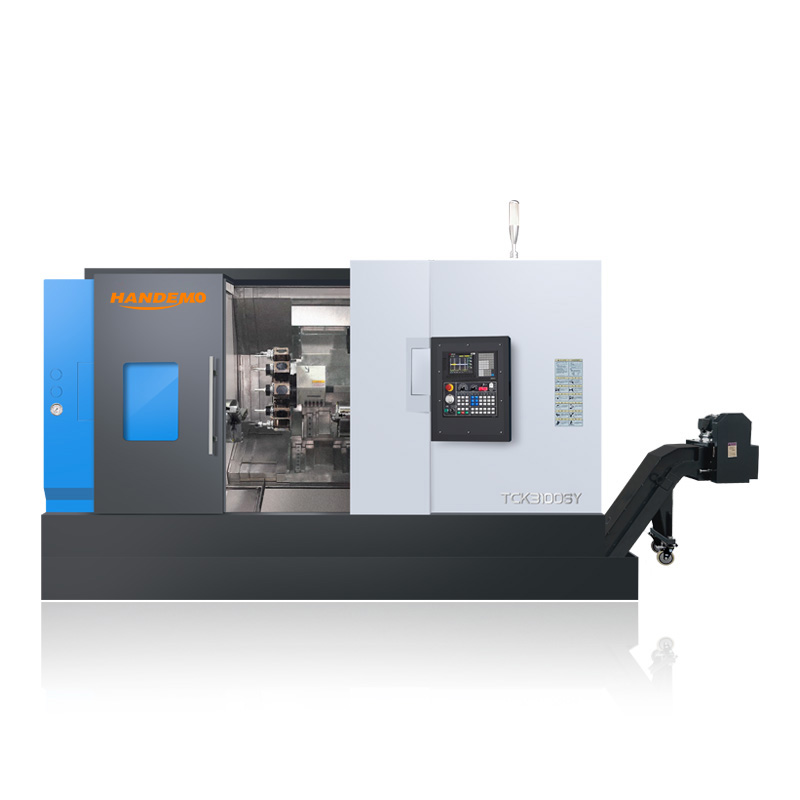
Why the Two Spindles Are Not Rated the Same
Most dual-spindle mill-turn machines are sold on the second spindle as if it were a copy of the first. On the BONANZA 3100SY CNC mill-turn machine it is not: the main spindle carries 37 kW, the sub-spindle 30 kW. That 7 kW gap is the most useful number on the specification sheet, because it tells you where the machine expects the heavy cut to happen.
The main spindle is A2-8 with an 85 mm bore and a 3,000 r/min ceiling. The sub-spindle is A2-6, turns to 4,000 r/min and handles the back side after the part transfers. So the front of the cycle takes the interrupted cuts, the scale and the deep boring; the back of the cycle takes the finishing, the second-operation features and the part-off. Design the process around that asymmetry and the machine behaves. Fight it, and you will spend your days watching the sub-spindle stall on a cut the main spindle would have walked through.
The Envelope in Real Terms
Cutting diameter is 500 mm and cutting length is 1,000 mm, with 750 mm of swing over the bed. In practice, the 500 mm diameter figure is the one that decides the job. A 500 mm flange leaves no room for a boring bar to swing past the outside diameter on a single pass, so you plan the operation as a face-and-bore sequence rather than an outside-diameter roughing pass and a separate bore. On a 450 mm part there is enough clearance and the cycle gets simpler.
The Z axis travels 1,350 mm against 1,000 mm of cutting length. That extra 350 mm is not slack — it is what lets the turret reach both ends of a long shaft without the tailstock and the sub-spindle fighting for the same 200 mm of bed.
X travel is 400 mm and Y is ±100 mm. That Y stroke is the number that separates this machine from a lathe with a live tool turret. A ±100 mm Y axis with interpolation means an offset bolt circle, a milled flat that is not on the centre line, or a keyway that sits 60 mm off axis can all be cut without a second op and without a fixture.
One Clamp, Six Operations
The published claim for the 3100SY is turning, milling, planing, grinding, drilling and gear hobbing in a single clamping. Take that list apart and each item has a real consequence on the shop floor.
Turning and milling are routine on any Y-axis machine. Planing is the interesting one: a wide flat that would normally need a shaper or a long cycle on a machining centre can be generated with the Y axis and a suitable tool, because the turret is a 12-station power turret and not a fixed block. Drilling needs no comment beyond spindle orientation for cross holes.
Grinding and gear hobbing are the two claims that save the most money, and they are also the two that need the most care. Grinding on a mill-turn is not a replacement for a cylindrical grinder on a hardened shaft; it is a way to hold a finishing tolerance on a soft part without unclamping it and losing the datums. Gear hobbing on the same platform means a spline or a small gear can be cut in the same setup as the bore it has to run true to — which is exactly the tolerance that goes out the window when you move the part to a hobbing machine.
What 10,000 kg Buys
The machine weighs 10,000 kg and measures 4,450 × 2,320 × 2,713 mm. At that mass, thermal drift over a shift is slow enough to be a scheduled problem rather than a surprise. It is also heavy enough that the foundation is not optional: a 10-tonne casting with an A2-8 spindle doing interrupted cutting will walk a thin slab. Budget for a proper isolated pad, and re-level after the first two weeks.
Rapids are 12 m/min in X and Y and 16 m/min in Z. Those are not the fastest numbers in the catalogue, and they do not need to be. On a machine cutting 500 mm diameter parts with a 12-station turret, the cycle is dominated by cutting time and index time, not by traverse. The 16 m/min on Z matters more than it looks: on a 1,350 mm stroke, the difference between 12 and 16 m/min is roughly two seconds per full-stroke move, and a cycle that makes twenty of those adds up over a shift.
3100SY Specifications
| Parameter | 3100SY |
|---|---|
| Max. turning diameter on bed | 750 mm |
| Max. cutting diameter | 500 mm |
| Max. cutting length | 1,000 mm |
| Spindle nose | A2-8 |
| Main spindle bore | 85 mm |
| Main spindle speed | 3,000 r/min |
| Main spindle motor power | 37 kW |
| Sub-spindle nose | A2-6 |
| Sub-spindle speed | 4,000 r/min |
| Sub-spindle motor power | 30 kW |
| X-axis travel | 400 mm |
| Z-axis travel | 1,350 mm |
| Y-axis travel | ±100 mm |
| X / Y / Z rapid traverse | 12 / 12 / 16 m/min |
| Tool turret | 12-station power turret |
| Dimensions (L × W × H) | 4,450 × 2,320 × 2,713 mm |
| Machine weight | 10,000 kg |
Where It Sits in the Range
Three machines bracket the 3100SY and the choice usually comes down to one number.
The 2100LY is the lighter Y-axis machine: same mill-turn idea, less mass, and a turret mounted directly on the pallet with a low centre of gravity that allows 7–10 mm single-side cuts. If your parts are under 300 mm and the cycle is dominated by milling, the 2100LY does the work for less floor space.
The TCK3100LY keeps the 1,000 mm cutting length and adds Y-axis milling, but without the second spindle. If you are not transferring the part, you are paying for a sub-spindle you will not use.
And if the 500 mm diameter is the binding constraint on more than a third of your work, the next step is the 5-axis group rather than a bigger lathe — a 5-axis turning and milling machine solves the reach problem that a Y axis cannot.
The full set of models, sorted by bar capacity and Y travel, is on the CNC mill-turn machines series page.
Buying Checklist
Power first: confirm your supply can carry 37 kW and 30 kW spindles plus servo and coolant load, ideally not both at full draw at once. Then confirm the part transfer: does the sub-spindle have the chuck and the stroke to grip your part at the diameter you actually cut, and does the part-off leave enough material to face? Then confirm the turret: 12 stations sounds generous until you count the boring bars, and a 500 mm part eats stations fast.
Finally, ask which of the six claimed operations you will genuinely run in the first year. That answer, not the brochure, tells you whether the 3100SY is the right machine or whether the money belongs in a bigger single-spindle lathe and a separate machining centre.